
Cua Hoi fishing port, the "rear base" for offshore fishing.
(Baonghean)The fishermen of Quang Ngai are renowned for their "heroic" teams that sailed out to sea, asserting Vietnam's sovereignty over the Hoang Sa archipelago centuries ago. Today, their descendants continue the tradition of their ancestors, conquering fishing grounds amidst the vast ocean and sky of the Fatherland. We had the opportunity to meet them on a sunny late summer day at Cua Hoi fishing port.
The story of clinging to the sea…
Among the fishing boats that docked at Cua Hoi port this time, we met many "sea wolves" from Quang Ngai province. For them, their entire lives have been intertwined with the salty sea, with voyages across the East Sea. Captain Nguyen Mo Duc (52 years old), a sturdy man with skin tanned dark by the sun and wind of the open sea, was mending nets with his crew after a half-month voyage; during that voyage, the 480-horsepower vessel QNg 92451, along with 15 fishermen, moved continuously between fishing grounds in Bach Long Vy Island, Co To Island... to Da Nang until the hold was full of fish before returning to land.
Captain Nguyen Mo Duc and the 14 crew members on board are all from Quang Ngai province. Having gone to sea with his father since he was 14, the sea has been "his whole life" until now. He said: "Nowadays, fishermen have the means to invest in larger ships with powerful engines, capable of venturing into distant fishing grounds and fishing for extended periods, so the chances of success on each trip are much higher than before."
Captain Duc's ship was built four years ago at a cost of nearly 3 billion VND. It has accompanied him on many voyages, but for this "sea wolf," the time spent fishing in the Hoang Sa (Paracel) Islands remains the most profound and memorable. "Like many other fishermen from Quang Ngai, our traditional fishing ground is the Hoang Sa Islands. There are many fish there, and they are abundant. Fishing there guarantees a sure catch. But in recent years, the situation out there has become too tense, so we have to limit our access to it," Mr. Duc said sadly.
Captain Tran Van Thoi (51 years old) is also from Tu Nghia, Quang Ngai. He is the captain of two fishing vessels, QNg 92338 and QNg 92339, with dozens of crew members. This fishing trip was a failure. After only 7 days at sea, they had to return due to vessel damage. The ships had just finished repairs at Cua Hoi port two days prior, and the crew was taking advantage of the time to rest and mend their nets in preparation for going out to sea again. Captain Thoi has also been going to sea with his father since he was 8 years old. Speaking to us, he joked, "My family is a family of the ocean. For generations, we've been connected to and depended on the sea for our livelihood."
Having spent his entire life at sea, fishing in almost every fishing ground, Mr. Thoi's fishing boats "found their calling" in the Gulf of Tonkin fishing grounds since the early 1990s. He said: "Each trip lasts for months. Whenever the hold is full of fish, we call boats from shore to bring food, supplies, and fuel to sell, and in return, they buy our fish and bring it back to shore. On average, each trip yields a profit of hundreds of millions of dong; a less profitable one is sixty or seventy million dong. But there are also trips where we come away empty-handed, like the one we just had."
The crew members on Mr. Thoi's ship come from many different provinces: Thanh Hoa, Da Nang, Quang Nam, and Binh Dinh. The lives of fishermen are intertwined with the sea, and the dangers they encounter daily have become commonplace. But for these fishermen, the longing for their wives, children, and families during their days at sea is the real somber note in their struggle for survival. Nguyen Danh, a crew member from Quang Ngai, confided: “Fishing at sea, even a small mistake can be life-threatening. Simply pulling in a net weighing an average of 10 tons of fish, if the hauling rope breaks, it's incredibly dangerous. That's not even considering storms, big waves, and strong winds. But we're used to it, we accept everything, except for one thing: missing our wives and children. Sometimes we only get to see our families during Tet (Lunar New Year).” Before this fishing trip, Danh's wife in Quang Ngai had given birth a few days earlier. Seeing how joyfully he talked about his newborn son, one could understand the longing of a father who had spent a year immersed in the sea for his return home.
"Where the harbor is safe, the boats will dock."
That was the answer we received from many fishermen from other provinces at Cua Hoi fishing port when we asked: Why do you dock your boats here when there are so many other fishing ports along the North Central coastal provinces? On the Cua Hoi fishing port that day, nearly 40 offshore fishing boats were crowded together, waiting to buy supplies before heading out to sea.
Captain Duc shared: “Our ship often docks at Cua Hoi fishing port because the water flow here is very favorable for ships to enter, the fishing logistics services are relatively complete, and importantly, the products we work hard to produce are all bought up as soon as we arrive at the port. Fishermen from Quang Ngai who fish in fishing grounds from Quang Binh northward all stop here when they come ashore.”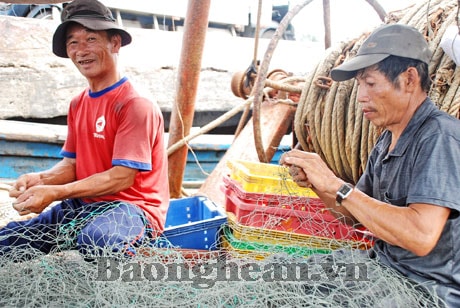
Fishermen mend their nets in preparation for heading out to sea.
Mr. Nguyen Huu Tho, Deputy Director of the Nghe An Fishing Port Management Board, said: “Cua Hoi Fishing Port is a frequent entry and exit point for fishing vessels from 13 provinces, from Nam Dinh to Binh Thuan. Implementing the policy of socializing the fishing industry, the fishing logistics services at Cua Hoi Port relatively fully meet the needs of fishermen. This is also the main reason why Cua Hoi Port has become a “common home” for many fishermen in our country. Within the fishing port area, there is a lodging area for families of fishermen from Quang Ngai to rent. They stay here waiting for their husbands and children to return after each trip. We only collect a tax of 250,000 VND/room/month and provide clean water. All of this is to contribute to creating conditions for fishermen to feel secure going out to sea, both for economic purposes and to protect the sovereignty of the Fatherland's sea and islands. However, the pier and docks still do not meet the needs for long-term mooring due to the short length of the pier…”
Hopefully, one day soon, Cua Hoi fishing port will be upgraded so that it will always be a peaceful anchorage for the mighty fishermen of the sea. As we said goodbye to Cua Hoi fishing port, Captain Thoi's boat was preparing for a new voyage. He was busy preparing offerings to pray for safety before his journey to conquer the open sea.
Thanh Duy


