
Beware of imported milk of unknown origin.
(Baonghean)Milk of unknown origin, poor quality milk, and even counterfeit milk are quite common on the market. Using these products poses many potential risks to babies.
Should you use "imported goods"?
In most stores, consumers can easily ask to buy "imported" powdered milk, and the store owners will introduce them as genuine products purchased from abroad, hence the lack of Vietnamese labels. Despite being tax-evading products, "imported" milk is still openly and widely advertised on websites. Due to a preference for foreign goods and the fact that many people, despite not understanding the foreign language labels or knowing the ingredients, believe that "imported" goods are genuine because of their attractive packaging.
Taking advantage of this consumer psychology, many counterfeit manufacturers, both domestically and internationally, have produced fake goods bearing the labels of famous brands to deceive consumers under the guise of "imported goods" for profit. Nguyen Van Huy, a truck driver on the Ho Chi Minh City – Lang Son route, stated: "Many products labeled as powdered milk from famous American and European brands are actually 'imported' from China."
Clearly, using "imported" goods carries many risks, as there is no documentation certifying their origin and no quality control by any agency or organization. Besides the risk of buying counterfeit or fake products, "imported" milk products, due to improper storage and transportation procedures for food items, can have their quality compromised. Buying counterfeit or low-quality products can have unforeseen consequences for young children. Even if the "imported" goods are genuine, buyers may still face the risk of purchasing milk products manufactured for other markets and therefore unsuitable for Vietnamese consumption.
Unlike milk officially imported through distributors, "hand-carried" milk has no legal entity responsible in Vietnam under any circumstances. Therefore, when problems arise, neither the seller nor the buyer knows where to turn for compensation.
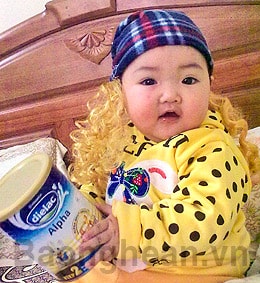
Baby Nguyen Ha Van, 10 months old - daughter of Ms. Vo Thi Thuy
In Le Loi ward, Vinh City, imported milk is not used.
Even imported milk, regardless of its origin, still needs careful consideration.
The recent discovery that Danlait "goat milk" did not meet protein standards serves as a lesson for parents to be cautious when choosing milk products for their children.
In reality, the counterfeit Danlait "goat milk" product, before being officially imported by Manh Cam Company, had already been present in Vietnam for a long time as "hand-carried goods." Danlait is only a dietary supplement, but when sold in the Vietnamese market, it is advertised as goat milk. According to Manh Cam Company's import documents, the selling price of this product is only 3 Euros per box (approximately 81,000 VND per box), but the retail price on the market reaches 415,000 VND per box. Clearly, those who used Danlait "goat milk" for a long time were not only cheated out of a large amount of money but also negatively impacted their children's nutrition and development because this "milk" does not have enough protein to meet the developmental needs of children.
When the Danlait "fake goat milk" scandal was exposed by the public and the press, a user with the nickname tichuot2005 expressed his frustration on social media forums: "Many times, the press and major milk companies in Vietnam have warned about the quality of imported milk: origin, buying fake or counterfeit milk, altered expiration dates, or nutritional content unsuitable for Vietnamese children... Yet many parents still believe the sellers' words, which is simply due to a preference for foreign products." Another user with the nickname thuydang wrote: "Why be so eager to give your children foreign milk and then sit there feeling angry? Just give your children high-quality, affordable Vietnamese products that are exported to so many countries around the world. If we don't support domestic products, how can our national economy develop?" Another member shared: "It's because of the mothers' preference for foreign products. I raised three children using only domestic milk products, and they all grew well." Many people have asked: Given the current influx of foreign milk products, besides Danlait, how many other products that don't meet protein standards haven't been discovered yet?
Be smart when choosing milk for your baby.
Ms. Nguyen Thi Thanh, an employee at a store on Nguyen Thai Hoc Street in Vinh City, said: “Although imported powdered milk is twice, even three or four times more expensive than domestic brands, most customers still prefer to buy imported milk. The discount offered to distributors by imported milk companies is also higher, so we make more profit selling imported milk.” According to Ms. Thanh, most consumers believe that “you get what you pay for,” and that the more expensive the milk, the better, but they don't know which type of milk is most suitable for their children's health to achieve the best results.
Ms. Vo Thi Thuy (Le Loi Ward – Vinh City) shared: “I recently gave birth to my first daughter 10 months ago. At birth, she weighed 3.2 kg. Friends who visited gave me many expensive imported milk formulas. I had little breast milk, so I had to supplement with formula, but after more than two months, I still noticed that she was growing slowly, had abnormal digestion, and showed signs of jaundice. At the Children's Hospital, the doctor advised me to only give my baby one suitable type of formula and not to give her multiple types at the same time. I researched and learned about the improved Dielac Alpha product, developed by Vinamilk in collaboration with the National Institute of Nutrition, using a formula specifically for Vietnamese children. I bought it for my baby to try for a while and noticed that she developed very well, gained weight quickly, had stable digestion, and slept soundly. Since then, I have only given her this type of formula, and now, at 10 months old, she weighs 11.8 kg, is 0.76m tall, and is very active.” smart".
Dr. Nguyen Huu Toan – former Head of the Nutrition Department, Cho Ray Hospital, Ho Chi Minh City. Ho Chi Minh City offers this advice: “Parents should carefully research product information before choosing milk for their children to make the right choice. First, the product must have a clear origin and information. Second, it must be suitable for the child's physical condition and nutritional needs. In reality, infant formula varies from market to market. For example, in Europe, with its cold climate, manufacturers must use different formulas than in Africa and the Middle East, which have hot climates. Vietnam is a tropical country with a different climate and temperature than Europe, so the nutritional needs of children must also be different, requiring infant formulas with specific formulas. Many people are so cautious that they ask acquaintances in France or the US to buy and send milk for their children, but this is not necessarily the best option, as those products may not be suitable for Vietnamese children. Currently, many mothers choose domestically produced products for their children, and I believe that is a good choice.” "That's smart. Because many domestic milk products now use modern production technology, their quality is comparable to imported milk, but the price is much cheaper. Furthermore, domestic milk products have been researched to create formulas suitable for Vietnamese people and have been inspected by relevant authorities, so parents can rest assured."
Text and photos: Hoang Hao


