SRI improved rice cultivation
(Baonghean) - Different from traditional methods of planting and caring for rice, the improved SRI rice cultivation model cultivates ecological rice, similar to the traditional form, bringing higher productivity, while reducing the amount of seeds, nitrogen fertilizer and care, minimizing diseases. From local experimental models, the improved SRI rice cultivation model is opening up prospects for bumper crops for farmers.
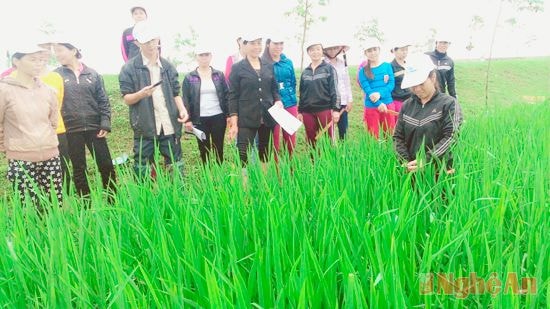 |
| Delegation of officials from Hung Nguyen District Plant Protection Station surveyed the project. |
In Hung Long commune (Hung Nguyen district), in 2014, two rice growing models were piloted in this form. After harvest, rice grown in the model always yielded higher yields than the same type of control rice. In the spring crop of 2014, in Hung Long commune, the average yield in the experimental area with Khai Phong rice variety reached 3.3 quintals/sao, an increase of more than 1 quintal compared to the control area. With good care by families, the rice yield reached up to 3.9 quintals/sao. In the summer-autumn crop, the commune planted control rice with the mutant Khang Dan variety also gave positive results, with the highest yield reaching 2.7 quintals/sao while the control area only reached 2.5 quintals/sao. In addition, the cost of seeds, fertilizers, and care was much more economical.
In particular, with this method, only 1-2 sprays of pesticides are used, no herbicides are used, but weeding is done by hand. Farmers weed and fertilize, and pile up the soil at the base of the plants, so the fertilizer will be brought close to the base, helping the plants to come into contact with the fertilizer sooner, and more oxygen will be brought into the base. These factors create favorable conditions for the rice to grow quickly. In Hung Long commune today, 90% of households have cultivated rice according to this model. Mr. Hoang Nghia Khoa (Hamlet 7B, Hung Long commune) said: "Our family applies the SRI rice planting model with a planting density of 30 clumps/m2, not only significantly reducing the investment source, the rice's disease resistance is high, but also bringing higher yields. The flowers are large, the grains are full, and the average yield is about 3.5 quintals/sao". Mr. Le Cong Nam, technical officer of Hung Nguyen Plant Protection Station said: "When planting, farmers often plant at high density, which not only wastes seeds, fertilizers and care but also creates favorable conditions for pests to develop due to being too dense and lacking air. With the SRI method, these factors are limited. Moreover, sparse planting also helps the rice to lay healthy and concentrated buds."
With the harsh weather in Nghe An, applying the improved SRI rice farming model also helps rice increase its resistance, limiting the negative impacts of natural disasters, especially during the drought season.
Rice transplanting according to the SRI process, each sao uses 0.6 - 0.7 kg of seeds, while the traditional method is 2 - 2.5 kg; transplanting sparsely with a density of only 1 - 2 seedlings per clump, the clumps are about 22 cm apart, and the rows are about 25 cm apart. Therefore, if in the past, people had to spend more than 2 sessions to transplant 1 sao of rice field, with this method, the transplanting can be completed in less than 1 session. For fertilizers, the amount of organic fertilizer can be used as in previous fertilization methods, however the amount of inorganic fertilizer is reduced by 20%, saving costs for farmers. In one crop, farmers only need to water 2-3 times to meet the needs for rice growth and development. However, it is important to note that after the first fertilization, let the water in the field gradually dry up, then add water to the field only at a level of 3-4 cm. After the second fertilization, let the field dry and only add water to the field when the rice plants form panicles. |
Phuong Thao