
Issuing land use rights certificates for forestry land: Difficult due to lack of funding.
(Baonghean) - Allocating land and forests to the people is one of the policies issued by the Government with the goal of "making every plot of land, every forest, every hill have its owner." However, the progress of allocating forest land and issuing land use right certificates is still slow, significantly affecting the development of the forest economy...
Recently, the Provincial People's Committee decided to review and separate forest land at agricultural and forestry farms and protective forest management boards to convert and return a portion of the forest land to the districts for management and reallocation to the people. However, the progress of land allocation to the people in these localities is still slow. In Chau Binh commune, Quy Chau district, after people illegally entered and encroached on land belonging to forestry farms, the Provincial People's Committee directed Co Ba Forestry Farm to hand over 1,800 hectares of land to the local authorities for management and allocation to households in Chau Binh and Chau Hanh communes. Mr. Nguyen Van Thien, Head of Village 32, said: The Chau Binh Commune People's Committee has only temporarily handed over 89 hectares/235 households to Village 32. Meanwhile, the people urgently need the land divided into plots and parcels soon so they can receive the land for management and production. A drawback in the land allocation process here is that the land is not allocated in areas suitable for farming and habitation, but rather 3-4 km away from the intended location, causing considerable difficulties.
Mr. Kim Van Duyen, Chairman of the Chau Binh Commune People's Committee, said: Chau Binh commune has received 1,135 hectares of forest land from Co Ba Forestry Station, but only over 100 hectares have been allocated to the people so far. Procedures are currently underway to allocate land to 96 households in Ke Can village. The reason for the delay in allocating forest land to the people is due to the manual surveying process. Besides the two commune land surveyors, the rest are officials from other sectors with weak professional surveying skills; the vast and rugged mountainous terrain also affects the progress.
According to a review, Quy Chau district needs to hand over 15,000 hectares of forest land to the people. The Quy Chau District People's Committee's plan was to complete the land handover by June 30, 2014, but only 2,000 hectares out of 15,000 have been handed over so far. The reason is that on-site handover is very difficult; there is a lack of supporting equipment and machinery, mainly relying on manual surveying and measurement using "provisional" methods. The district has established a Steering Committee and has had to mobilize all departments and offices, with many non-specialized staff, resulting in limited expertise. The district is requesting the Provincial People's Committee to allocate funds to carry out the forest land surveying work. The estimated cost for the surveying is over 16 billion VND.
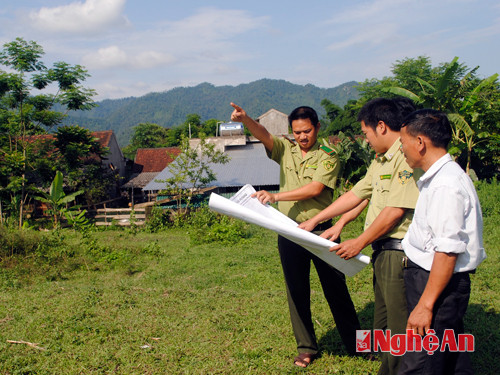 |
| The Que Phong Forest Protection Unit, in coordination with the Tien Phong commune government (Que Phong district), has allocated forest land to local people. |
Currently, some localities have been allocated forest land, but are mainly using "blank forest land registers" instead of land use right certificates. Mr. Nguyen Van Ba, from Hamlet 14, Dien Doai Commune (Dien Chau District), said: His family owns 22.1 hectares of land that was granted a "blank forest land register" in 1995. They are now hoping the State will issue them land use right certificates so they can confidently manage production. This land has been primarily used for planting acacia and eucalyptus trees, which has not been very productive. Recently, several businesses surveyed the area, expressing interest in investing in intensive timber plantation, but due to the lack of "red certificates," they have hesitated to invest.
Mr. Bui Van Nam, Chairman of the People's Committee of Dien Doai commune, reported: Dien Doai currently has over 400 hectares of forest land, of which over 200 hectares are managed by the people according to forest land certificates issued in 1994-1995. To date, only 30 households/23.65 hectares have had their forest land certificates converted to land use right certificates. The reason is due to procedural obstacles, especially a lack of funds for surveying, leading to delays in issuing forest land use right certificates.
The entire Dien Chau district currently has approximately 7,400 hectares of forest land, but over 80% of the area is being used by people under "white forest land registers" and has not yet been issued land use right certificates, mainly concentrated in the communes of Dien Lam, Dien Doai, Dien Phu, etc. According to Mr. Le Van Thuan - Head of the Dien Chau Department of Natural Resources and Environment, the reason for the delay in converting from forest land registers to land use right certificates is also due to a lack of funding; it is estimated that measuring the area would cost about 11 billion VND.
In Nghi Loc district, to date, 550 land use right certificates have been issued, equivalent to over 2,300 hectares of forest land. Nearly 2,000 hectares remain unregistered for forest land use. Regarding this issue, Mr. Nguyen Van Chat, Head of the Land Management Department (Department of Natural Resources and Environment), stated: Currently, the entire province still has approximately 25,000 hectares of forest land that have not yet been handed over to the people, concentrated in the districts of Tuong Duong, Quy Chau, Que Phong, and Ky Son. Most of these districts have submitted applications for approval of funding for forest land allocation, but the province lacks the necessary funds. This funding is primarily used for land allocation, surveying, and cadastral mapping. To overcome the funding constraints, some districts are hiring consulting firms to conduct preliminary surveys at their own expense, promising to reimburse them once funding is secured, but they are facing considerable difficulties.
To ensure that forests have true owners, linking rights with responsibilities, and creating conditions for people to protect the forests, confidently manage and invest in forest development on the assigned forest areas, the aforementioned difficulties and obstacles need to be resolved soon.
Van Truong


