
Met tree on Ha Son land
Bamboo and rattan cultivation for shoots is a model actively adopted by farmers in many localities of Quy Hop district, thanks to its many advantages such as low initial investment, ease of care, and relatively high economic efficiency; especially in improving neglected gardens and greening barren hills and mountains. The effectiveness of bamboo and rattan cultivation for shoots, as part of the 5 million hectare reforestation project implemented by the Quy Hop Protective Forest Management Board in 2005 in Long hamlet, Ha Son commune, Quy Hop district, is a prime example.
(Baonghean)Bamboo and rattan cultivation for shoots is a model actively adopted by farmers in many localities of Quy Hop district, thanks to its many advantages such as low initial investment, ease of care, and relatively high economic efficiency; especially in improving neglected gardens and greening barren hills and mountains. The effectiveness of bamboo and rattan cultivation for shoots, as part of the 5 million hectare reforestation project implemented by the Quy Hop Protective Forest Management Board in 2005 in Long hamlet, Ha Son commune, Quy Hop district, is a prime example.
Mr. Truong Van Thanh, Chairman of the People's Committee of Ha Son commune, said: "The bamboo planting program under Project 661 of the Forest Protection Management Board is developing very well, and the people participating in planting have earned a good income. In particular, the project has contributed to creating jobs and alleviating poverty for the people in the area." Visiting the bamboo garden of Mr. Truong Van Luong's family, one of the 20 households in Long hamlet, Ha Son commune, which received investment from Project 661 (a 5 million hectare reforestation program) for planting 2 hectares of bamboo for shoots and greening barren hillsides, we saw that the bamboo began producing shoots within a year of planting, and Mr. Luong's family has started earning income, which has been increasing year by year. He confided: "In 2005, the land was barren, full of reeds. Since the project started, my family and all the villagers have been planting bamboo, and now it's doing very well. A single clump of bamboo earns 100,000 dong a year. Some families have planted 2,000 clumps, earning nearly 100 million dong. The price of pruned bamboo is 25-30,000 dong per plant. My family plans to plant a few more hectares soon."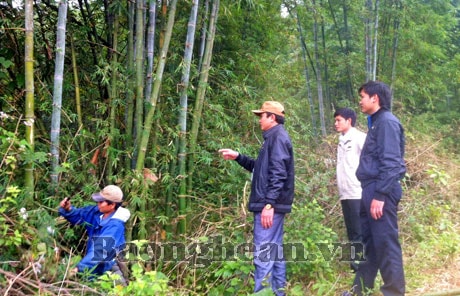
The garden of Mr. Truong Van Luong's family covers nearly 2 hectares.
The bamboo and rattan planting project of the Quy Hop Forest Management Board was implemented in Long hamlet, Ha Son commune from 2005 with 20 participating households, covering a total area of nearly 50 hectares. Participating households received support of 4 million VND/hectare, covering all costs for purchasing seedlings, fertilizers, labor, and technical training. After nearly 7 years of implementation, the project has been successful, bringing practical benefits to the people. Mr. Truong Van Thuong, head of Long hamlet, Ha Son commune, said: "Currently, some areas in the hamlet are not yielding good results from other crops, so we will encourage people to continue planting rattan to increase their income because rattan is very suitable for the land in the area."
For bamboo, it's a plant that grows quite well on poor, barren land, requires little care, but yields high economic returns. Bamboo produces shoots year-round, and these shoots are popular and considered a clean vegetable product that doesn't use pesticides, ensuring good health for consumers. Furthermore, planting bamboo helps improve neglected gardens, green barren land and hills, contributing to increased forest cover and ecological balance.
Although the project's budget was very small, only nearly 200 million VND, it has brought practical benefits, especially to ethnic minority people in mountainous areas like Quy Hop district in particular and other localities in the province in general.
Huy Nham (Quy Hop Radio Station)


