
Thanh Vinh Eel Porridge
(Baonghean)Food connoisseurs always seek out eel porridge whenever they visit Vinh City. For those who have been away from home for a long time, a bowl of eel porridge is considered a "culinary culture," on par with the fragrant and slightly bitter taste of green tea, the alluring sweetness of sweet potatoes cooked in rice husks, and the fermented pickled eggplant that has forever been a part of Nghe An's poetry!
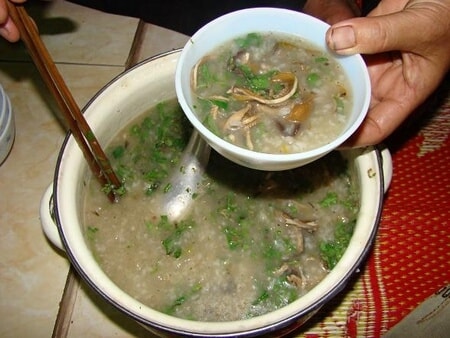 |
| Illustrative image |
Nowadays, eel porridge stalls can be found in all 20 wards and communes of Vinh City, but connoisseurs often meet at the Quan Bau intersection in the morning, while in the evening or late at night they gather near the Provincial Post Office guesthouse. It seems that the stomach knows where to find the best eel porridge stall thanks to a sharp mind and a discerning palate. Many passersby easily forget the name of the owner, the location of the stall, but the taste of Vinh City's eel porridge, reaching the level of culinary art, lingers in people's hearts and lasts through time. I deliberately chose not to mention the names of the ranked stalls among the hundreds scattered throughout Vinh City, as that would easily lead to favoritism. It's better to let the "customers" remember and find their own "servants," because "money has eyes." People in the past did this, and people today are even more so with their choices of what they need. All I know is that in the competition on the "eel porridge battlefield," there are many winners and many who fail. Typically, each restaurant sells 5-7 kilograms of eel per day, with very few achieving the record of 20-30 kilograms. "High-class" restaurants don't serve continuously, only for three or four hours in the morning or evening, because they believe in the saying, "If we have rice to eat, we should let others have a bowl of porridge."
The skill of catching eels in my hometown of Nghe An has become legendary. To catch eels, you have to distinguish them from crab or snake burrows, and you have to correctly identify the eel's membrane before reaching in to catch it (the membrane is the film of water at the mouth of the burrow). Eel membranes are clear in the water, crab membranes are murky, and snake membranes are sometimes clear, sometimes murky. Using their experience in eel hunting, these skilled hunters let crabs off the hook and give young eels a "suspended sentence," only judging eels the size of their little finger or larger. They are so "skilled" that they can tell the weight of an eel in a burrow just by looking at the water's membrane. Once they locate the membrane, they push hard with their foot at the end of the burrow, and the eel will dart out to escape. However, with their calloused middle, index, and ring fingers, they create a "trident" grip, clamping down on the eel's neck and pulling it out easily—easier than pulling up cassava in sandy soil after a rain. The eel hunting profession has also become a curse; thousands of bomb craters in my hometown have become ponds, lakes, and burrows where eels breed. Strangely, while snails, frogs, shrimp, and crabs are easily driven to extinction by countless types of chemical fertilizers, the eel, which "doesn't mind getting its head dirty," continues to reproduce and thrive, providing an inexhaustible source of income for farmers.
The story goes that, at one time, the poet Phùng Quán from Hanoi was assigned to spend an extended period at Đông Hiếu Farm in Nghĩa Đàn District. Back then, the communal pond was so heavily guarded that no one dared touch it without the farm leader's orders. Yet, the poet Phùng Quán found a way to exploit the potential of nature to improve his meager meals. He mixed mud with buffalo dung, plastered the mixture inside a bamboo basket 5-10 cm thick, and left it to dry in the sun. He even created a lid resembling the mouth of a traditional basket. At night, he had someone place his "lifesaving weapon" in the pond, and by morning, the basket was already full of eels, weighing several dozen kilograms. Phùng Quán's poetic talent and eel-trapping skills were equally impressive; when he lacked poetic inspiration, he found his favorite way to create verses through his eel-trapping abilities.
After a delicious meal, I pulled out a 200,000 dong note to pay for 10 bowls of eel porridge for everyone. My friends were astonished: "How cheap!" Well, "mastering one skill brings honor," the old saying holds true for all times, especially for the superb eel porridge chefs of Nghe An, particularly in the sunny and windy city of Vinh.
Diocese


