
The quality of personnel is a breakthrough area.
(Baonghean)To successfully achieve the goals of the Party Congress Resolutions at all levels, Tan Ky district issued Project No. 06 on "Improving the quality of cadres in the political system at the commune and town levels in the period 2011-2015 and subsequent years". After more than two years of implementation, the quality of cadres in communes and towns in Tan Ky has seen positive changes…
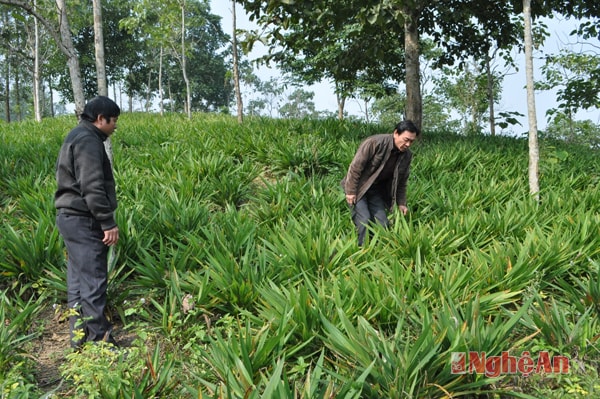 |
| Mr. Vi Van Hanh's garden of fragrant root plants (Tan Huong 2 village, Huong Son commune) yields high economic returns. |
Formerly a region with many shortcomings, the personnel management in Huong Son commune, one of the remote and disadvantaged communes in Tan Ky district, has always been in a state of constant shortage. Before 2010, only two commune officials had university degrees. Furthermore, due to difficult road conditions, low remuneration, and a lack of planned training and development, officials were discouraged and stagnant. It was not uncommon for officials to leave for the South to seek work elsewhere. For many years, the team of officials at the commune and village levels failed to develop.
Thanks to the attention and guidance of the District Party Committee Standing Committee, especially since the implementation of Project 06 on "Improving the quality of cadres in the political system of communes and towns," cadre work in Huong Son has seen positive changes. It began with the development of sound planning, based on which cadres and civil servants were sent for training and further education. Since 2010, the commune has continuously sent cadres to improve their professional and political qualifications. To date, out of 23 positions, 9 have graduated and 14 are currently studying at university; 9 have intermediate-level political qualifications and 11 are currently studying. Not only have the core commune cadres improved, but the quality of semi-professional cadres and mass organizations has also been enhanced, with the first time that cadres from hamlets and associations/organizations, who were included in the local planning, have voluntarily funded their own training to improve their qualifications…
In Tan An commune, after being separated from An Ngai State Farm, the quality of the cadre team faced many difficulties. Following the implementation of Project 06, along with assessing the current state of the cadre team, the commune planned and created conditions for capable cadres to receive training and further education. From 2010 to the present, out of 21 civil servants, 18 have completed or are currently studying for university degrees in their respective fields; 14 are currently studying intermediate-level political science. Thanks to effective cadre management, several targets have been achieved within just over half of the term. Furthermore, the commune has boldly implemented personnel deployment by strengthening the Party Committee with capable cadres to serve as secretaries of Party branches in Catholic areas for training.
Project 06 has been widely implemented, leading to positive changes in the village and hamlet cadres. The model of each village Party branch having one key Party member attend meetings not only assists the commune Party committees in leadership and guidance but also helps guide and support the Party branches in their activities and in leading the socio-economic development of the locality. Mr. Vi Văn Hạnh, from Tân Sơn 2 village, Hương Sơn commune, said: “Previously, the village did not have a Party branch. I was assigned to be the secretary, and after three years of building the village's political system and training village and mass organization cadres to become familiar with their work, I felt secure and submitted a request to the commune Party committee to retire.”
Over the two years of implementing Project 06, the situation in the entire district has changed significantly. Previously, only 47.5% of full-time elected officials in the district had received professional training, and nearly 30% had not yet met the political qualification standards; 9.5% of commune officials had not yet met professional qualifications, and 78% had not yet met the political qualification standards; nearly 40% of part-time officials had not graduated from high school, only 23% had qualifications at the intermediate level or higher, and 77% lacked political qualifications. To date, at the grassroots level, each commune has an average of 7.6 officials with university degrees, meeting the target set by the District Party Congress (7-10 people). 85% of commune-level officials and civil servants have professional qualifications from intermediate level upwards, meeting the target set by the Party Congress Resolution (85-90%). In reality, Project 06 not only helps communes with weak personnel quality improve, but also strengthens communes with strong traditions, making them bright spots in the district's economy and society; communes and towns with problems and obstacles in personnel work are addressed and strengthened by the district, creating trust and consensus among the people.
To achieve these changes, in addition to the project and implementation plan for each commune and town depending on the specific conditions, the District Party Committee's Organization Department issued guidelines for organizing confidence votes according to Project 06 and organized survey and inspection teams to properly evaluate the confidence vote process and year-end cadre ranking, ensuring objectivity and democracy, especially after the self-criticism and criticism review according to Resolution No. 4 of the Central Committee (11th term), this process was organized even more seriously.
In the communes we visited for our research and survey—Huong Son, Nghia Phuc, and Tan An—it was readily apparent that the quality of the political system's cadres had significantly improved. Internal unity and cooperation were strong; records, documents, and minutes of Party, government, and mass organization meetings were meticulously documented and archived; resolutions were issued with thorough preparation; the results of confidence votes were evaluated realistically by superiors; the number of complaints, including those related to cadres, had decreased significantly; and Party committees were consistently ranked as clean and strong units…
Comrade Nguyen Viet Hoa, Chairman of the People's Committee of Huong Son commune, shared: “After receiving training, the professional quality of civil servants in handling work has improved significantly, and the quality of the team of mass organization officials in the commune and villages has also been enhanced. As a result, leadership and guidance in implementing policies and resolutions have become easier because they have the trust and consensus of the people. Evidence of this is that despite the poor soil conditions, difficult irrigation, and the fact that Huong Son is a commune with a large ethnic minority population, there is no abandoned land. The commune has exemplary Party members who are successful in business, such as Mr. Lang Van Chien and Mr. Vi Van Hanh… These are good models for people to learn from and change their way of doing business…”
It can be said that, despite some practical difficulties, Project 06 on improving the quality of cadres in the political system of communes and towns in Tan Ky district during the 2011-2015 period has initially created a significant shift. In an interview with us, Comrade Phan Van Giap, Head of the Organization Department of the Tan Ky District Party Committee, stated: “Along with the issuance and implementation of Project 06, the Standing Committee of the District Party Committee has developed guidelines on the content, process, and forms for voting on cadre confidence that are closely aligned with the actual situation; after the confidence vote and evaluation, clear and specific handling measures are in place. This not only helps higher levels accurately assess the quality and prestige of grassroots cadres but also helps grassroots levels avoid unnecessary difficulties in cadre work, build a spirit of solidarity and cooperation, and advance local movements.”
Van Hai


