
Specific instructions on how to run effectively.
Below are some specific guidelines on how to run effectively, not intended to teach you how to run, but simply to help you run better and more efficiently.
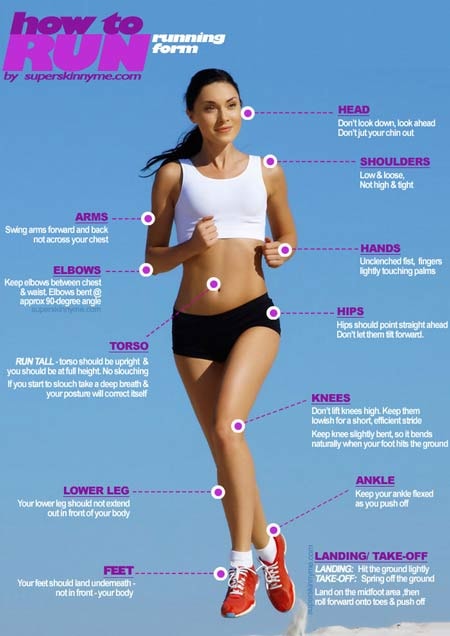 |
When we think about running, we usually only think about our legs. However, proper running requires seamless coordination from head to toe. If the head and upper body are positioned correctly, the lower body and running posture will also be more accurate. One of the important things to remember when running is to know how to distribute your energy effectively. Your goal should be efficient running, not running fast or running for an extended period to the point of boredom.
Efficient running means having enough stamina to run long distances without injury or exhaustion. Perhaps the most concise phrase to describe efficient running is "run straight," meaning that when running, you should stretch your body and keep your back straight.
Below are some specific guidelines on how to run effectively. These aren't meant to teach you how to run, but rather to help you run better and more efficiently. Over time, you'll understand these guidelines better and apply them more effectively. Don't force yourself to understand and follow every single instruction precisely. Just focus on the main task: running. The rest will improve naturally. If you can now run straight, it means you've been doing things correctly all along. The tips below will only help you improve further.
Head
Keeping your head straight while running is key to proper running technique. Look straight ahead, not up or down. This posture will help keep your neck and back straight. Relax your jaw and neck, and don't stick your chin out.
Shoulder
Keep your shoulders square, straight, relaxed, and comfortable. Avoid swinging or drooping your shoulders while running, but also don't raise them too high or tense them up. If you feel your shoulders are tensing, swing and shake them down to relax them.
Upper body
When you keep your head and shoulders in the correct position, your upper body will also be properly aligned while running. You should keep your upper body almost straight, so that your body is stretched but still slightly leaning forward to maintain balance. Don't lean back and don't bend forward too much. Bending forward too much will cause you to take long strides, making you more prone to tripping because you put too much weight on your heels, creating pressure on your knees, hips, and back.
"Running straight" means running with your shoulders and chest open, allowing your lungs to easily absorb oxygen, which will help you breathe more evenly and easily. But remember not to move or twist your upper body too much while running.
Arm
Arm movements while running are crucial because they propel you forward. Arm movements also help control excessive upper body movement. Keep your elbows bent at approximately a 90-degree angle.
Your arms should be relaxed and move in sync with your strides.
Swing your arms up and down. When you raise your arms, let them point towards your sternum. When you lower your arms, let them point towards your chest. The movement should be gentle and fluid, and avoid swinging your arms too high or too low; the range of motion of your elbows should start from the middle of your chest and end at your waist.
Although your arms should swing inward and outward slightly, don't let them sway horizontally with your body. Most of the arm movement should be forward and backward.
Hand
Keep your hands and wrists in a relaxed, clenched fist position.
Hip
Your hips should be pointing forward. If you position your hips correctly while running, your shoulders and upper body will also be in the correct posture. If you lean your hips too far forward or backward, it will cause your pelvis to tilt, and you will lose balance.
Knee/lower leg
When running long distances, avoid lifting your knees too high; instead, keep them relatively low to conserve energy. Lifting your knees high, as in sprints, requires a lot of energy and is usually aimed at generating power and speed. Additionally, keep your knees slightly bent when you land your feet on the ground.
Avoid taking excessively long strides; instead, aim for your foot to touch the ground behind your body. If your foot touches the ground in front of your body, you're taking too long strides. Adjust this by lowering your knee to correct the problem.
Foot
When running, your feet should only lightly touch the ground. Run so that as soon as the middle of your foot touches the ground, your toes quickly follow. You shouldn't stomp your entire foot with each step. Running shouldn't feel stiff or noisy; instead, aim for light, fluid strides that don't create loud sounds.
According to dantri.com


