
The government has instructed Nghe An province to maintain the stability of 94,000 hectares of rice-growing land.
(Baonghean.vn) - This information was provided by a representative of the Department of Natural Resources and Environment during a working session of the Economic and Budget Committee of the Provincial People's Council to review the draft Resolution on Adjusting the Land Use Planning until 2020 and the Land Use Plan for the period 2016-2020.
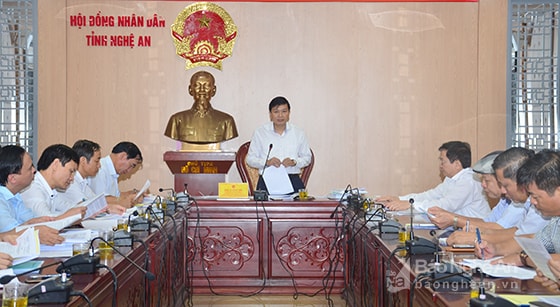 |
| Le Hong Vinh, Head of the Economic and Budget Committee of the Provincial People's Council, chaired the meeting. Photo: Thanh Duy |
At the meeting, delegates heard the draft report on the Resolution on adjusting the land use planning until 2020 and the land use plan for the period 2016-2020.
| On the morning of June 21st, the Economic and Budget Committee of the Provincial People's Council held a review of several draft resolutions of the Provincial People's Committee to be submitted to the 4th session of the 17th Provincial People's Council. Comrade Le Hong Vinh - Member of the Standing Committee, Chairman of the Provincial Party Committee's Inspection Committee, and Head of the Economic and Budget Committee of the Provincial People's Council - chaired the meeting. Also present were members of the Provincial Party Committee: Hoang Viet Duong - Vice Chairman of the Provincial People's Council; and Dinh Viet Hong - Vice Chairman of the Provincial People's Committee. |
According to representatives from the Department of Natural Resources and Environment, the drafting agency, the revised land use plan for Nghe An province aims to ensure consistency with the revised national land use plan and the government's allocation targets, thereby ensuring unified and strict management of land resources in accordance with planning and law.
Therefore, the adjustment of the planning ensures that land is used for its intended purpose, economically and efficiently, in order to rationally exploit natural resources, protect the environment, and proactively respond to climate change; meeting the goals and strategies of socio-economic development, national defense and security of the whole country, the North Central region and the province in the new situation.
During the meeting, many opinions expressed concern about the province's rice cultivation land use until 2020. According to the drafting agency, the land use plan target for the final period (2016-2020) is based on the national allocation, meaning the Government requires the province to ensure 94,000 hectares of rice cultivation land, and this time the drafting agency proposes adding an additional 7,028 hectares of rice cultivation land.
Overall, the area of rice cultivation in Nghe An province from 2016 to 2020 fluctuated annually from over 101,000 to 112,000 hectares, exceeding the government's allocated target and only approaching the province's rice cultivation area at the end of 2015, which was over 114,000 hectares.
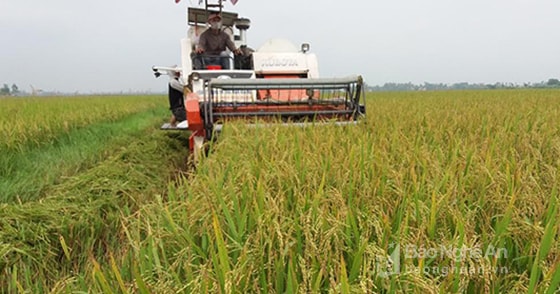 |
| The government has instructed Nghe An province to maintain the stability of 94,000 hectares of rice-growing land. (Photo: Archival image) |
However, during the meeting, opinions were expressed that it is necessary to clarify the exact location and area of rice-growing land to avoid fragmentation and small-scale distribution. Deputy Head of the Economic and Budget Committee of the Provincial People's Council, Dang Quang Hong, stated: "It is important to determine the boundaries and make them public, identifying the boundaries of rice-growing land that needs protection to ensure long-term production stability."
Regarding this matter, Vice Chairman of the Provincial People's Committee Dinh Viet Hong said that on the morning of June 21, the Ministry of Natural Resources and Environment handed over the rice land database to the Department of Natural Resources and Environment, which will then coordinate with the Department of Agriculture and Rural Development to manage it.
The Provincial People's Committee has assigned the Department of Agriculture and Rural Development to determine the boundaries of rice land protection areas and make them public for all citizens to monitor in order to ensure food security. All projects involving the use of rice land require businesses to pay a rice land protection fee, except for projects with special mechanisms permitted by the Government.
"Rice land is currently at a safe level, but the province's spirit is to strictly protect rice land, because acquiring 1 hectare of rice land is a long process. The Provincial People's Committee has also directed that the use of rice land for projects be limited," emphasized Vice Chairman of the Provincial People's Committee Dinh Viet Hong.
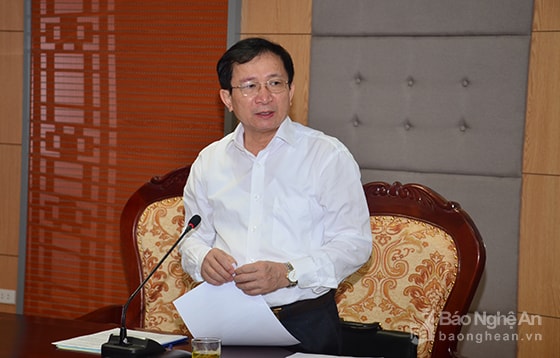 |
| Vice Chairman of the Provincial People's Committee Dinh Viet Hong speaks at the working session. Photo: Thanh Duy |
Vice Chairman of the Provincial People's Council Hoang Viet Duong also requested the drafting agency to clarify the increase and decrease in land allocation for types of land such as protective forest land, production forest land, etc., in the land allocation targets for the period 2016-2020.
Concluding the draft resolution, the Head of the Economic and Budget Committee of the Provincial People's Council, Le Hong Vinh, requested that the drafting committee incorporate the opinions expressed at the meeting to further supplement and clarify the province's land use plan and planning until 2020.
In particular, the Head of the Economic and Budget Committee noted that it is necessary to clearly define and publicly disclose the boundaries of rice production land, ensuring that it is concentrated and covers a large area, in order to implement protection measures and create conditions for land consolidation and the application of science and technology to agricultural production.
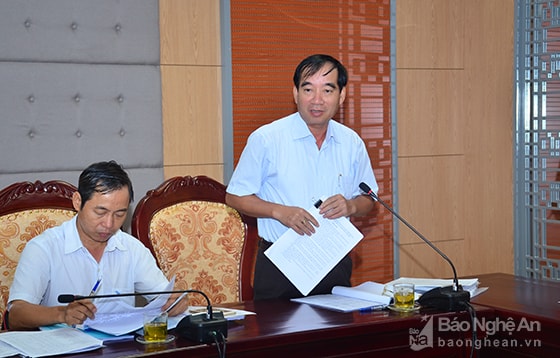 |
| Vice Chairman of the Provincial People's Council Hoang Viet Duong speaks at the working session. Photo: Thanh Duy |
Also this morning, the Economic and Budget Committee listened to and commented on three draft resolutions concerning: the approval of the list of works and projects in Nghe An province requiring land acquisition as stipulated in Clause 3, Article 62 of the Land Law; the conversion of land use purposes for rice cultivation land, protective forest land, and special-use forest land to implement investment projects in Nghe An province; and the planning of surface water resources until 2025, with a vision to 2035, in Nghe An province.
Thanh Duy


