
Chua Market, a land of memories
(Baonghean) - Traveling upstream along the Giang River, or following Highway 533 through Thanh Lien, crossing the suspension bridge, you'll reach Cho Chua (Chua Market), located in Lien Chung hamlet, Phong Thinh commune (Thanh Chuong district). This strategically located area, with convenient access by both land and water, is surrounded by mountains, rivers, fields, and plains, creating favorable conditions for livelihood and attracting a large population. For over half a century, although the temples, shrines, and palaces are no longer present, structures such as the market, bridge, post office, hospital, school, and department store all share the name Cho Chua. This serves as a nostalgic reminder of the past.
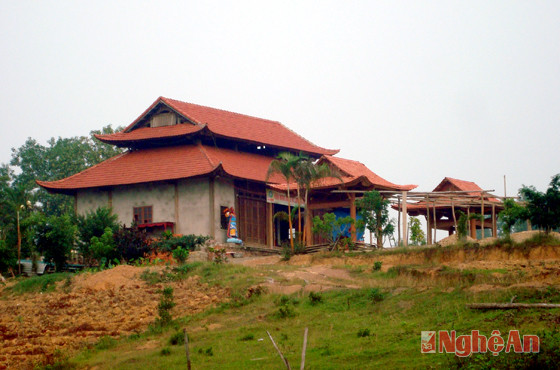 |
| Chung Linh Pagoda. |
Legend has it that 500 years ago, on Chua Mountain, the "Chung Linh Ancient Temple" appeared, a large temple that affirmed the ancient land and the long-standing presence of Buddhism here. "Chung Linh" means sacred bell. In the years before the revolution, the temple still stood with many gilded Buddha statues, surrounded by dense, ancient banyan, fig, and river trees so large that it would take several people to encircle them. Through countless historical changes, today, only traces of the temple remain: the courtyard, an ancient stele, and a headless stone turtle. Currently, Chung Linh Temple is being restored to its original location, much to the anticipation of the local people. Situated on Chua Mountain with an area of 11,000m², facing the Giang River, to the right is Chuong Pond, and to the left is Chieng Pond. The two ponds, stretching along the foot of the mountain, create a picturesque setting that enhances the rare beauty of Chung Linh Temple. Abbot Thich Quang Bao said: “With the attention of the authorities at all levels, the support and contributions of Buddhists, local people, and philanthropists, Chung Linh Pagoda is being restored and renovated, becoming the most beautiful and magnificent pagoda in Thanh Chuong, worthy of being a spiritual and religious center for the whole region.” The pagoda bells once again resonate as before. People from all over are once again making pilgrimages to the pagoda to take refuge in Buddhism. The revival of the ancient pagoda on its old land not only brings charm and peace to the countryside, but also revives many long-standing cultural values of our ancestors, guiding people towards truth, goodness, and beauty...
This place possesses both the tranquil serenity of temples and the bustling vibrancy of the riverine region, with its "markets above and boats below." Adjacent to the Giang River is an ancient market, known as the Temple Market because of its proximity to the temple. Previously, the market was held only once a month, but now it's open every day. Goods from the entire Cat Ngan region are transported by river and land. It's famous for its fish, potatoes, and bamboo shoots from the midland region, a taste of the region's culture, immortalized in poetry: "Thanh Chuong's delicious fish from the Giang River / Delicious potatoes from La Mac, delicious bamboo shoots from the Temple Market." During the historic August Revolution, the people of La Mac gathered at the Temple Market, capturing the village headman, the chief Trung, and the commander My, and, in coordination with people from other villages, rose up to seize power. Despite all the changes, the Temple Market remains on its original land, not only a trading center for the region but also a significant historical site.
Along the banks of the Giang River, from the market, going downstream leads to the Ca Temple, while going upstream leads to the Duc Thanh Shrine. The Ca Temple is dedicated to the people who contributed to the development and protection of the village – Ban Canh Thanh Hoang and Song Dong Ngoc Nu. According to Mr. Nguyen Ba Ton, an 80-year-old veteran, the Ca Temple used to have three majestic buildings: the lower, middle, and upper halls. In front of the temple was a triple-arched gate with statues of guardian generals and horses facing the river, a beautiful sight. The temple was sacred; passersby had to remove their hats and bow their heads. Local residents often came to light incense and pray. During the war, the temple was damaged, leaving only the courtyard, which later became a post office…
In front of the Ca Temple is the Chua Market ferry landing. Previously, the landing, the temple, and the market were connected by a riverside road. Things change, and the old landing is now just a collection of precarious rocks and overgrown trees. For Mr. Ton, who lived and rowed boats on the Giang River during his youth, the river landing holds countless memories. He shared: “Before, I was also a fisherman. My father participated in the resistance against the French, was captured and imprisoned in Vinh prison. After his release, he returned to this river landing, rowing boats to make a living and transporting revolutionary cadres to meetings.” The Chua Market suspension bridge, connecting the two banks of the Giang River and the old ferry landing, has become an unforgettable memory in the hearts of those who, like Mr. Ton, were once closely connected to and traveled up and down the river in their homeland.
The bustling town of Cho Chua retains its old village traditions, with people living on land and by boat, and harmony between the community and the outside world. The local people, Catholics, and Buddhists are united, hardworking, and dedicated to preserving their customs and traditions. Walking through this "future town," the center of the Thanh Chuong region, and hearing the slow, resonant sound of the Chung Linh pagoda bell each evening evokes a whole realm of memories in one's heart...
Huy Thu


