
Provide feedback on the draft Law on the promulgation of legal normative documents.
Continuing its work program, on the afternoon of October 6th, the Standing Committee of the National Assembly gave its opinions on the draft Law on the promulgation of legal normative documents and the draft Ordinance on environmental police.
| RELATED NEWS |
|---|
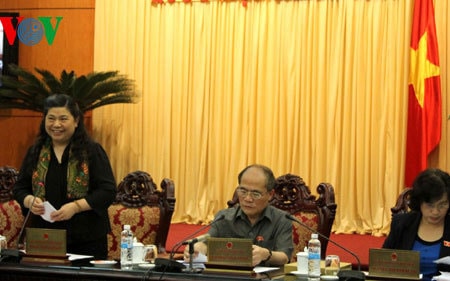 |
| Vice Chairwoman of the National Assembly Tong Thi Phong delivers a speech. Photo: VOV |
Regarding the draft Law on the Promulgation of Legal Documents, the Report on the Revision and Explanation of the opinions of the Standing Committee of the National Assembly and the opinions of the Legal Committee on the draft Law, presented by Minister of Justice Ha Hung Cuong, clearly states: concerning the title of the draft Law, at its 31st session, the Standing Committee of the National Assembly requested that the title of this draft Law be changed from "Law on the Promulgation of Legal Normative Documents" to "Law on Legal Documents."
Responding to this feedback, the Government renamed the draft Law to "Law on Legal Documents." Regarding this issue, the Standing Committee of the Legal Affairs Committee, the reviewing body, held the view that the Constitution of the Socialist Republic of Vietnam stipulates the authority of state agencies in issuing legal documents, particularly Article 119 of the Constitution, which clearly states that all legal documents must conform to the Constitution.
Therefore, renaming the Law to the Law on Legal Documents is necessary to ensure compliance with the Constitution. However, the Standing Committee of the Legal Affairs Committee found that, although the name of the Law has been changed, its scope of application remains essentially the same, still only regulating the issuance of general legal documents. The Drafting Committee is requested to review, supplement, and amend the specific provisions in the Draft to align with the revised name and scope of the Law.
Many opinions expressed during the discussion suggested that the draft law should be titled "Law on the Promulgation of Legal Documents."
According to National Assembly Chairman Nguyen Sinh Hung, the word "promulgating" should be clearly stated in the title of the draft law to distinguish it as a law on the promulgation of legal documents, not a law on its content.
Regarding the discussion on the authority of district and commune-level governments to issue legal documents, the draft Law (Article 3) proposes two options: Option 1: No provision is given for the authority of district and commune-level governments to issue legal documents. Option 2: Provision is given for the authority of district and commune-level governments to issue legal documents.
The Chairwoman of the National Assembly's Committee on Social Affairs, Truong Thi Mai, expressed her disagreement with the provisions in the draft Law as well as the Legal Committee's verification report. Representative Truong Thi Mai suggested that, based on a summary of practical experience and impact reports, the draft should specifically stipulate the appropriate forms of legal documents that can be issued at the district and commune levels. According to the representative, clearly specifying these forms would increase transparency and facilitate law enforcement.
Also agreeing on the need to enhance clarity and transparency in the draft law's regulations, National Assembly Chairman Nguyen Sinh Hung emphasized that the draft law needs specific provisions on the authority to issue, the content, and the form of legal documents. The National Assembly Chairman requested the drafting committee to review the draft law to ensure transparency in its implementation, within the proper authority and with the correct responsibilities.
Regarding the content of the Decree stipulating new and necessary issues to meet the requirements of State management, economic management, and social management, but which are not yet ready to be enacted into laws or ordinances (Clause 3, Article 16), some opinions within the Standing Committee of the National Assembly agreed with the draft Law to continue stipulating that the Government shall issue Decrees to regulate new and necessary issues to meet the requirements of State management, economic management, and social management, but which are not yet ready to be enacted into laws or ordinances.
This regulation inherits the provisions of the current law. In agreement with this viewpoint, the Chairwoman of the Committee on Social Affairs, Truong Thi Mai, stated that "what falls under the authority of the Government should be issued by the Government," otherwise it would be very difficult for the Government to manage.
However, delegates also suggested that the draft law should specify concrete criteria for this content. As the reviewing body, the Standing Committee of the Legal Affairs Committee proposed that this provision should not be maintained; if necessary, it could be submitted to the National Assembly or the Standing Committee of the National Assembly for promulgation as a law or ordinance.
During the discussion session, the Standing Committee of the National Assembly also gave opinions on issues such as: the responsibility of the agency submitting the draft law or ordinance in the process of revising the draft law or ordinance; the policy-making process in the process of drafting legal documents...
During the remainder of this afternoon's working session, the Standing Committee of the National Assembly gave its opinion on the draft Ordinance on Environmental Police.
The Government's report clearly states that currently, the organization and operation of the Environmental Police are only regulated by a Government Decree (Decree No. 72/2010/ND-CP dated July 8, 2010, regulating the prevention and fight against environmental crimes and other violations of environmental laws) and guiding documents from the Ministry of Public Security. There is no legally binding document with high legal effect to fully and comprehensively regulate the functions, tasks, powers, organization, and conditions ensuring the operation of the Environmental Police; the responsibilities of state management agencies in preventing and combating crimes and administrative violations related to resources, environment, food safety, etc.
Therefore, the promulgation of the Environmental Police Ordinance to create a complete legal basis for the organization and operation of the Environmental Police in order to effectively prevent and combat crimes and administrative violations related to resources, environment, and food safety is an objective requirement and an urgent need at present.
The draft Ordinance stipulates the functions, tasks, and powers of the Environmental Crime Prevention and Control Police (hereinafter referred to as the Environmental Police); the organizational system, operational assurance, and policies for the Environmental Police; the rights, obligations, responsibilities, and policies for organizations and individuals; and the responsibilities of state management agencies, the Vietnam Fatherland Front, and its member organizations. The draft Ordinance consists of 6 chapters and 32 articles.
After reviewing the draft Ordinance, many opinions assessed that the draft Ordinance had been prepared by the Drafting Committee in accordance with the regulations of the Law on the Promulgation of Legal Normative Documents, and was eligible to be submitted to the Standing Committee of the National Assembly for comments.
Many opinions at the discussion session agreed on the necessity of enacting the Ordinance to create a solid legal basis for the environmental police force to operate as a core force in preventing and combating environmental crimes, meeting the requirements of environmental protection in the period of industrialization and modernization of the country.
Regarding the duties and powers of environmental police, Clause 4, Article 10 stipulates: To conduct investigations into crimes related to natural resources, the environment, and food safety in accordance with the law on criminal investigation.
National Assembly Vice Chairwoman Tong Thi Phong suggested that the draft ordinance should clearly state which types of crimes the environmental police force is authorized to investigate in order to ensure legal consistency.
According to Vietnam+


