
The historic visit of the French Foreign Minister to Cuba.
Political opening is expected to pave the way for stronger economic cooperation between Cuba and France, as well as the EU.
Last weekend, French Foreign Minister Laurent Fabius made a historic visit to Cuba. This visit marked the first time a high-ranking French official had visited the Latin American island nation in 31 years..
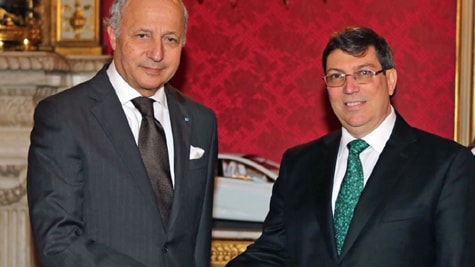 |
| French Foreign Minister Fabius and Cuban Foreign Minister Parilla (photo: VOA) |
The visit took place after Cuba and the European Union agreed to launch talks on normalizing relations between the two sides. The French Foreign Minister did not aim to sign a document as a basis for future cooperation, but it signaled that not only France but also the European Union are ready for concrete steps to improve relations with Cuba.
French motives
First and foremost, the visit of French Foreign Minister Laurent Fabius to Cuba must be placed in the context of the significantly improved relations between Cuba and the European Union (EU) in recent times. The two sides began promoting cooperation exchanges earlier this year.
For its part, of course, France also had its own calculations for this trip. Fabius stated in Cuba that France recognized Cuba's "spectacular changes in implementing economic and social reforms," and he said that Cuba was a "friend" of France, and that even with disagreements, friends can still talk things through.
In fact, besides its political significance, such as being the first French minister to visit Cuba in 31 years, Mr. Fabius's trip also had a major purpose: economic cooperation. We all know that after the recent cabinet reshuffle in France, Mr. Fabius is now not only in charge of the Ministry of Foreign Affairs but also of France's foreign trade. Mr. Fabius himself has repeatedly stated that economic diplomacy will be a major priority for him in the coming period. Therefore, this can also be considered Mr. Fabius's trip in his capacity as the head of France's foreign trade.
France wants to boost economic relations with Cuba. Despite the US embargo, around 60 French companies are currently operating in Cuba, and with the prospect of reforms in Cuba, French investors are eagerly awaiting investment opportunities. French businesses are particularly interested in Cuba's proposed special economic zone project in the Mariel deep-water port area, so Mr. Fabius's trip is seen as an attempt to capitalize on that opportunity. Furthermore, France's overall economic diplomacy strategy in Latin America and the Caribbean must also be considered. Before arriving in Cuba, Mr. Fabius accompanied the French President on a visit to Mexico to sign a "strategic partnership" and 41 economic agreements. France is placing great emphasis on economic relations with countries in this region, including Cuba.
Moving towards normalizing bilateral relations.
Taking place against the backdrop of the European Union signaling its desire to promote cooperation with Cuba, and receiving a reciprocal response from Cuba last March, the French Foreign Minister's visit to Cuba could be the start of negotiations between the European Union and Cuba aimed at normalizing relations between the two sides.
This is what both sides were hoping for. During his trip to Cuba, the French Foreign Minister declared that "Cuba has no irreconcilable issues with France." As a leading power in Europe, this French stance is seen as part of the European perspective.
Mr. Fabius stated that he welcomed the results of the Conference of Latin America and the Caribbean (CELAC), in which the majority of countries supported Cuba and called on the US to lift the embargo. In fact, relations between Cuba and the EU began in 2008 with dialogues in many areas.
In March 2014, Cuba agreed to the EU's proposal to hold discussions on a new bilateral political agreement. If these discussions progress, it is expected that by 2015, the two sides could move on to discussions on trade and investment agreements. Therefore, this trip by the French Foreign Minister is seen as a new step to lay the groundwork for future discussions.
Europe's intention, through France, is that before political discussions, the two sides can cooperate to better understand each other through joint projects such as the deployment of humanitarian medical activities in Africa, an area where Cuba has strengths. Both sides would benefit from improved relations. Cuba needs foreign investment. Currently, foreign investment in Cuba accounts for only about 8% of its GDP, while calculations show that to achieve a growth rate of 6-8% per year, Cuba needs a foreign investment rate of 25-30% of GDP. Conversely, EU businesses are also looking forward to investment opportunities in a market that is almost entirely new but has great potential in tourism, shipping, and healthcare like Cuba.
Exploration trip
Western media outlets have stated that France and Cuba have no intention of signing any agreement during this visit. Laurent Fabius's trip was politically significant. It marked the end of years of diplomatic estrangement between the two sides and laid the groundwork for future dialogue.
There are still many differences between Cuba and the EU, especially politically, so it is impossible to demand immediate economic cooperation until the political issues between the two sides are resolved. Both sides have set out a specific roadmap, and Mr. Fabius's trip is aimed at moving that roadmap in the right direction and accelerating its progress.
Once political dialogue yields results, economic cooperation is inevitable. France currently has a trade volume with Cuba of 280 million euros; if relations progress, this figure could increase many times over. France and many European countries, such as Spain, are very interested in economic cooperation with Cuba, but these collaborations must be paved politically, specifically through Cuba's reform roadmap and the commitments made by both sides. Furthermore, we cannot ignore the role of the United States in this process. The US is still imposing an embargo on Cuba, so any EU action towards Cuba, a small country situated right next to the US, will have to be cautious and gauge the attitude of the US, its most powerful and important ally.
According to VOV


