
Is the process correct and will it put an end to pollution?!
(Baonghean) - According to experts, pesticides cause serious environmental pollution, such as soil, water, and air contamination, and are one of the causes of climate change. However, for a long time, the people of Tan Long commune, Tan Ky district, have had to live with a "huge" pesticide storage facility left behind by the Vuc Rong State Farm.
(Baonghean) - According to experts, pesticides cause serious environmental pollution, such as soil, water, and air contamination, and are one of the causes of climate change. However, for a long time, the people of Tan Long commune, Tan Ky district, have had to live with a "huge" pesticide storage facility left behind by the Vuc Rong State Farm.
Faced with this situation, in early 2013, the "Project to treat environmental pollution from the pesticide storage facility at Vuc Rong Farm" was launched with a total estimated budget of 11 billion VND. The project was expected to be completed within one year. The people rejoiced, hoping to escape living amidst toxic chemicals. However, during the project's implementation, the construction unit exacerbated the pollution. The storage facility was dug up and overturned, but the contaminated soil was not thoroughly treated, and the drainage system separating the treatment area from residential areas was poorly constructed...
Arriving in Tan Long - Tan Ky at midday, the faint smell of pesticides could be detected even from the center of the commune. According to local residents, in 1968, the Vuc Rong State Farm built a pesticide warehouse (the largest in Tan Ky district) in Tan Long commune. Many types of toxic pesticides used to prevent diseases in short- and long-term industrial crops were stockpiled at the warehouse for many years...
Mr. Hoang Ngoc Phuong from Tan Lap hamlet sadly said: "Two years ago, my mother died of cancer due to radiation exposure from the pesticide storage facility. Look, when it rains, water flows freely from the pesticide storage facility, flooding the hamlet and seeping into the wells. It's terrifying. After each rain, the well water in my house turns yellowish and smells terrible. Currently, my family doesn't dare use the well water for drinking or cooking; we only use it for bathing and washing. We have to go to other hamlets to get water for drinking and cooking. Every time it's sunny, the smell of pesticides rises intensely, enveloping the hamlet and making the air incredibly suffocating." Mr. Phuong also lamented: "My young child has been suffering from stomach aches and difficulty breathing for the past few months and has to be taken to the hospital frequently for treatment."
Furthermore, Mrs. Sau's household is located about 100 meters from the pesticide storage facility. Mrs. Sau confided, "Because our house is so close to the pesticide storage facility, the children have to be moved elsewhere for safety, leaving only the two of us at home." Due to their old age and frailty, Mrs. Sau and her husband cannot go to other neighborhoods to fetch water, so they still use the water seeping from the toxic pesticide storage facility for daily life and cooking. But Mrs. Sau remained very "reassured": "The workers constructing the project here said to rest assured and use the well water; it's not contaminated, nothing to worry about..." Hearing this story, Mrs. Sau's teapot, which she had offered her guests, remained untouched; no one dared to drink from it. The pesticide storage facility is located in the center of the commune, surrounded by hundreds of wells belonging to the villagers and dozens of large and small ponds and lakes. Outside the residential area, the school system, from junior high to elementary and kindergarten levels, is also affected by air and water pollution. According to many villagers, since the construction unit started excavating the pesticide storage facility to treat the pollution, the smell of pesticides has become even stronger and more unpleasant than before. Mr. Trinh Gia Hieu, head of Tan Lap hamlet, said: "Tan Lap hamlet has 84 households with 84 wells, and more than 10 people have died from cancer. The construction unit needs to urgently complete the project; when the rainy season comes, water overflowing from the pesticide storage facility will be very dangerous for the residents here."
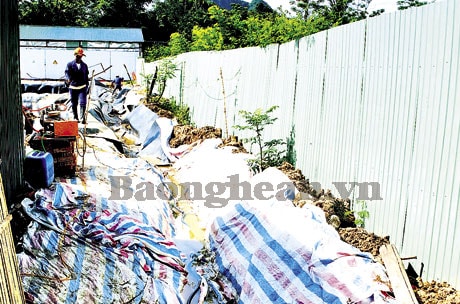
The drainage ditches at the treatment plant are still rudimentary.
Mr. Tran Van Tinh, Vice Chairman of the Tan Long Commune People's Committee, said: "The pesticide storage treatment project has two bidding packages. The first package involves bagging the contaminated soil. The second package is currently underway, but there are no trenches or walls around the construction area, so heavy rain easily allows the toxic substances to seep out. Not to mention that the smell of pesticides becomes even stronger during sunny weather or after heavy rain."
According to the contractor's plan, the process for treating pesticide storage contamination will be as follows: For heavily contaminated soil, it will be excavated, air-dried until the moisture content is less than 20%, then ground into 2 mm particles, mixed with 10% black sand, and poured into treatment pits in layers as designed. A chemical solution will then be added, compacted, grass will be planted, and the area will be sealed. For lightly contaminated soil, it will also be air-dried, ground into small pieces, mixed with a chemical solution, and combined with bio-fertilizer according to the specified ratio before being buried underground.
Witnessing firsthand the construction site where the pesticide storage area is being processed: Mainly using excavators, they're digging up the soil into messy piles. A worker is spraying chemicals onto the excavated soil. Stepping inside the processing area, the pungent, suffocating smell of pesticides is overwhelming, making everyone feel dizzy. None of the workers are wearing masks; they're wading through the soil as if they were working in a rice field. The project started in early 2013, but only now are they digging drainage ditches around the site to retain water. Observing the ditches, it's clear they're only very rudimentary, forming simple trenches. According to standards, concrete ditches should be constructed to prevent water from overflowing.
Many villagers expressed concern about this method of treatment, with some suggesting that the contaminated soil should be moved elsewhere for treatment. If the soil contaminated with pesticides is buried and compacted (if done according to the project's procedures), it will still seep into the village wells and ponds during rainfall, affecting health and causing many serious illnesses.
We spoke with Mr. Chu The Huyen, Deputy Director of the Department of Natural Resources and Environment, about the issues raised by the residents. Mr. Huyen said: “We have already held a meeting. If you have any questions, please meet with Mr. Dung, Director and Head of the Environmental Protection Sub-Department.” Mr. Ho Si Dung, Director and Head of the Environmental Protection Sub-Department, explained: “The construction unit has used corrugated iron sheets to create a perimeter wall, laid tarpaulins, and installed a misting system to reduce odors. The investor has also contracted with a consulting and supervision unit, and there is also community supervision from the commune. It's best if you go there to find out more…”
When asked about community monitoring, Mr. Tran Van Tinh, Vice Chairman of the Tan Long Commune People's Committee, expressed surprise: "We didn't know anything about it. They closed the gates and didn't let anyone in. We only noticed that the smell of pesticides was stronger during construction."
Mr. Nguyen Van Hoa, Chairman of the Tan Ky District People's Committee, requested that the construction unit follow proper technical procedures, avoid causing further pollution to the people, and complete the construction before the rainy season.
According to experts, to effectively address and mitigate environmental pollution caused by residual pesticides, a comprehensive and proper approach is necessary. The chemical should be analyzed into two parts: the raw chemical solution, heavily contaminated soil, and less contaminated soil. The raw chemical solution and heavily contaminated soil should be thoroughly treated by incineration in cement kilns. The less contaminated soil should be treated using biotechnology combined with microorganisms, and completely and permanently isolated in concrete tanks to prevent the spread of pollution into the environment and protect public health.
It is suggested that relevant authorities conduct a comprehensive and objective assessment of the pollution levels (water, air, and soil) throughout the affected area of Tan Long commune. In particular, it is crucial to urgently analyze water samples from drilled and dug wells in all affected areas to issue warnings. According to incomplete statistics, hundreds of households are located in the affected area of Tan Long commune; many have to obtain water from other sources, but the majority are using local well water, which poses a significant health risk. During the current remediation work, if residents continue to use water contaminated with pesticides without any notification or warning, the responsibility of the relevant authorities and the project investor should be reviewed.
Van Truong


