
There is a novel about Ly Cong Uan.
That was the novel "Ly Dynasty" by Pham Minh Kien, published in 1931 in Southern Vietnam. Prior to that, there had been no novels about Ly Cong Uan, so "Ly Dynasty" is considered the first novel, and Pham Minh Kien was the first Vietnamese novelist to write about the enlightened king who founded the Ly Dynasty, ushering in a long period of peace and prosperity for Dai Viet.
(Baonghean)That was the novel "Ly Dynasty" by Pham Minh Kien, published in 1931 in Southern Vietnam. Prior to that, there had been no novels about Ly Cong Uan, so "Ly Dynasty" is considered the first novel, and Pham Minh Kien was the first Vietnamese novelist to write about the enlightened king who founded the Ly Dynasty, ushering in a long period of peace and prosperity for Dai Viet.
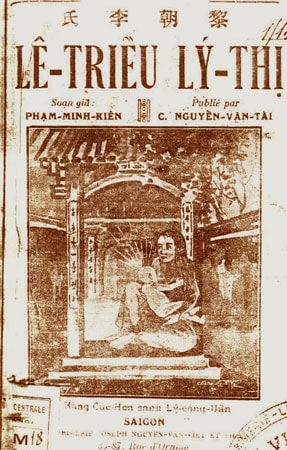 |
Under the pen names Duong Tuan Anh and Tuan Anh, he also left behind insightful articles in newspapers such as Nong Co Min Dam, Luc Tinh Tan Van, Dong Phap Thoi Bao, and Nam Ky Kinh Te Bao…and was considered a leading journalist in the country's press at that time.
Among the historical novels mentioned above, "Ly Dynasty" is an outstanding work about Ly Cong Uan, successfully portraying the life, morality, and career of an ideal king as envisioned by the Vietnamese people.
Công Uẩn was born into a poor family. His mother, Cúc Hoa, was an orphan who worked as a volunteer at Tiên Sơn Temple. One night, Cúc Hoa dreamt that a monk on the mountain gave her a magical peach. She respectfully accepted and ate it, and upon waking, found herself pregnant. A poor farmer named Lý Kỳ Xuân, also an orphan, worked during the day and slept at the temple at night. Kỳ Xuân fell in love with Cúc Hoa, and they married. Seeing Cúc Hoa's belly growing larger, the abbot of the temple, considering their actions impure, expelled them both. The two wandered to an abandoned house. Next to the house was a well. While drawing water, Kỳ Xuân accidentally slipped and fell into the well. Before Cúc Hoa could jump in to save him, a landslide occurred, burying the well. Heartbroken for her unborn child, Cúc Hoa dared not commit suicide. She knelt by the well, weeping, and bowed three times to Kỳ Xuân before passing away.
The abbot of Ung Tam Pagoda dreamt that the Dragon God revealed to him that a king would visit the pagoda the next day. The abbot waited all day but the king did not appear. Late that night, a hungry, ragged pregnant woman came to the pagoda asking for shelter. At three o'clock that night, Cuc Hoa went into labor and gave birth to a handsome baby boy, surrounded by a radiant halo like the sun. After giving birth, she passed away due to postpartum complications. The abbot held the baby and saw the words "mountains and rivers" and "state" inscribed on his hands. Overjoyed, he named the baby Hoang Tri.
Growing up in the temple, Hoang Tri was intelligent, quick-witted, and mischievous. He stole the offerings for the Dragon God and ate the insides. The Dragon God told the abbot, who reprimanded him. Hoang Tri then wrote the four characters "Liu San Qian Li" (Exiled Three Thousand Miles) on the Dragon God's back. That night, the abbot dreamt that the Dragon God came to him, lamenting being exiled three thousand miles by the Emperor, and asked the abbot to intercede for his pardon. The next morning, the abbot had someone wipe the four characters off the Dragon God's back, but they couldn't get them off. The abbot finally asked Hoang Tri for help, and the boy used a wet cloth to clean them completely.
When Master Vạn Hạnh from Tiên Sơn Pagoda came to visit, the abbot of Ứng Tâm Pagoda allowed Hoằng Trí to accompany him to study Buddhist scriptures and martial arts. Later, Master Vạn Hạnh transferred Hoằng Trí to Master Lý Khánh Vân (a cousin and abbot of Cố Pháp Pagoda) for training. Master Lý Khánh Vân adopted Hoằng Trí as his son and named him Lý Công Uẩn. Young Uẩn's first heroic deed was killing a venomous snake to save innocent people. After Master Khánh Vân's death, young Uẩn began a life of chivalry and friendship, defeating a band of robbers led by Tần Mạnh Duy and Đào Quỳ when they attempted to rob the house of a wealthy landowner. However, this band of robbers had an ideal – "robbing the rich to give to the poor" – so Lý Công Uẩn became sworn brothers with the bandit leader and was given his daughter, Trần Bạch Loan, in marriage. Later, Lý Công Uẩn killed a corrupt district magistrate to save innocent people from his clutches. Along the way, after defeating another group of bandits, Lý Công Uẩn befriended the bandit leader Châu Phước Nghĩa. Encountering a band of Nung bandits harassing an innocent girl, Ly Cong Uan killed the bandit leader and rescued her. He learned that she was Xuan Kieu, the daughter of an upright official he had known before. He took her to his uncle's house in Thai Nguyen. That night, sleeping in a roadside shrine, he dreamt of a divine being who gave him three pills to cure his misfortunes and a copy of the Heavenly Book to keep as a treasure. The deity also revealed that Xuan Kieu was the one he would marry. On his journey, Ly Cong Uan killed a ferocious tiger and rescued Dao Cam Moc, the Minister of War. Thanks to this, he and his sworn brothers were recruited by Cam Moc to fight the southern invaders and assist King Le Dai Hanh.
Lý Công Uẩn was presented with a set of silver armor and helmet, a heavy tree trunk weighing eighty or ninety kilograms that had just been unearthed by a local resident, who told him: "Tomorrow you will meet someone who needs these things." Lý Công Uẩn wholeheartedly supported Lord Lê Đại Hành: he defeated the Southern invaders, Lỗ Trí Viễn and Thiên Oai Cave Master, and rescued Princess Liên Hoa, the younger sister of Lord Lê Đại Hành. Upon his victory, Lý Công Uẩn was granted the title of Duke, Commander of the Left Royal Guard, Grand Marshal, and Governor-General of the entire army. Lord Lê Đại Hành married his sister to him. Lý Công Uẩn requested to take back his two betrothed wives: Trần Bạch Loan, the daughter of Viên Ngoại, and Xuân Kiều, the woman he had rescued and brought to his uncle's house in Thái Nguyên.
King Lê Đại Hành passed away, and Crown Prince Trung Tôn ascended the throne. Trung Tôn was then murdered by his younger brother, Long Đĩnh. Long Đĩnh was excessively debauched and cruel, reigning for only two years before his death. Lý Công Uẩn returned to mourn, and upon arriving at the city, he was greeted with shouts of "Long live the King!" from high-ranking officials like Đào Cam Mộc and Phạm Cự Lượng, and from all the civil and military officials. They urged Công Uẩn to become king to bring peace to the kingdom. Unable to refuse, Công Uẩn ascended the throne and proclaimed himself Lý Thái Tổ. The king, grateful for the king's benevolent rule, expanded the country, and "from then on, the four seas were calm and peaceful, with no more storms or turmoil breaking through the borders."
The novel "Lý Dynasty" by Lê Triều Lý Thị follows the Chinese episodic novel genre. The story is captivating from beginning to end, with many interwoven characters, numerous factions fighting each other, and a continuous cycle of conflict and events. There are virtuous people being persecuted, the helpless suffering, and chaste women facing hardship; there are acts of rescue and protection (fighting bandits, killing wild beasts, pacifying border rebels, etc.). As a primarily fictional historical novel, it relies only on a few pages about Lý Công Uẩn found in historical chronicles such as Đại Việt Sử Ký, Đại Nam Thực Lục Tiền Biên, Việt Nam Sử Lược, and biographical works like Nam Hải Dị Nhân by Phan Kế Bính. The fictional nature of the novel overshadows historical accuracy. It can be said that "Lý Dynasty" by Lê Triều Lý Thị is "two parts fact, eight parts fiction." Thanks to its fictional nature, the work vividly portrays the image of the heroic and wise ruler Ly Cong Uan, who endured many hardships, achieved numerous accomplishments, ascended to the throne, ushered in a long period of peace and prosperity, and laid a solid foundation for building a powerful and civilized nation in the South. The story is written in the simple, robust language of the common people of Southern Vietnam, reminiscent of Do Chieu's earlier work, Luc Van Tien, and the novels of Ho Bieu Chanh, Tran Chanh Chieu, Nguyen Chanh Sat, and others of the same era.
The fact that Pham Minh Kien and several other Southern writers of his time wrote novels about national history is a special phenomenon, different from the previous literary tradition. In Southern literature from the 19th century onwards, the awareness of national unity was very strong, but the inspiration about national origins was still vague. Meanwhile, the history of the nation before the Nguyen dynasty was discussed extensively in the works of authors from the Central and Northern regions such as Cao Ba Quat, Pham Van Nghi, Nguyen Xuan On, Nguyen Quang Bich, Phan Dinh Phung, Chu Manh Trinh… Therefore, the fact that Southern writers from the 1920s onwards wrote extensively about national history is a novel and interesting phenomenon. When writing about national history, these writers were very aware that their work aimed to disseminate national history to the people, thereby fostering patriotism and national pride. In the preface to the novel "Ly Dynasty," Pham Minh Kien wrote: "The extraordinary story of Ly Cong Uan is no different from that of Trieu Khuong Dan in China: Trieu Khuong Dan has been embellished and arranged into long stories and plays to glorify his name; but our Ly Cong Uan remains buried deep within the national history."
In short, at the beginning of the last century, Southern Vietnamese writers drawing inspiration from national history demonstrated a significant shift in their thinking. Behind this seemingly entertaining genre lay a profound awareness and passionate sentiment about national origins and unity. This was also one of the important contributions of Southern Vietnamese historical novelists to national thought and literature. Among the historical novelists of the time who left their mark on the literary scene, writer and journalist Pham Minh Kien holds the most prominent place in the hearts of readers.
Compiled and edited by Mai Thach Anh


