
Con Cuong: The effectiveness of the Van Du orange variety.
(Baonghean) - Con Cuong was once famous for its traditional orange variety. However, for various reasons, this traditional orange variety has "disappeared". Currently, the district is focusing on restoring it using the domestically grown Van Du traditional orange variety, which brings economic value.
The village elders in Yen Khe shared: The traditional orange variety in Con Cuong has existed for a very long time. Locals often call it "the ring fruit," with its thick, slightly yellow peel that, when cut open, reveals a bright yellow color and a distinctive, delicious aroma. This variety is mainly grown from seeds; however, it takes 7-8 years to bear fruit. In the past, many families cultivated it for self-sufficiency, resulting in low yields. For a time, people cut down this orange variety and replaced it with other crops. Along with many other reasons, this orange variety has now disappeared.
Mr. Vi Van Dau, Chairman of the People's Committee of Yen Khe commune, said: From 2004 to the present, Con Cuong district has implemented the "Orange Tree Restoration Project giai đoạn 2004-2015". Yen Khe commune mainly planted the Van Du orange variety (a domestic orange variety), which has initially yielded clear results. Many households have risen out of poverty, and some have even become wealthy, thanks to orange cultivation.
Along the road to Tan Huong village, beside the rocky cliffs, stretches an endless expanse of green orange trees. Mr. Lo Van Cu, from Tan Huong village, is cheerfully tending his orange orchard: "According to the district's orange restoration project, in 2007 my family borrowed money to invest in planting 1 hectare of Van Du orange variety. The district subsidized 70% of the cost of the seedlings, so I decided to plant a large area of oranges in this land around the foot of the limestone mountains, where the soil layer is very suitable for growing oranges. After 4 years, I can confirm that the Van Du orange variety in Yen Khe is growing quickly, has good disease resistance, and is now bearing its first fruits. Van Du oranges are round, have thin skin, and a sweet, refreshing taste."
In 2011, Mr. Cu's orange orchard yielded an income of over 300 million VND, and in 2012, it exceeded 400 million VND. Looking at the orchard laden with fruit, Mr. Cu boasted: "Orange trees only reach high yields when they are 5-6 years old or older. This season will surely be a big one, with an estimated yield of over 50 kg of fruit per tree. 400 trees will yield 20 tons, selling at 20,000 VND/kg, bringing in 800 million VND." According to Mr. Cu, the market for oranges is very favorable, as Con Cuong oranges have long been famous throughout the region. During the harvest season, traders from all over come to the orchard by motorbike and car to buy them at prices ranging from 20,000 to 22,000 VND/kg. After deducting investment costs, he expects to earn around 600 million VND this year.
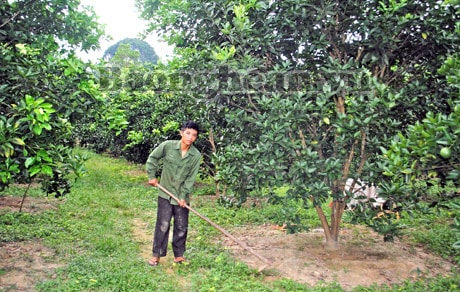
The Vân Du orange orchard of Mr. Lương Văn Hải's family in Tân Hương village, Yên Khê commune, Con Cuông district.
Next door is the orange orchard of Mr. Luong Van Hai. Just over two years ago, Mr. Hai's family was struggling, but now they have become millionaires. Mr. Hai recounted: "Previously, we had planted mandarin oranges on this land, but it failed. We considered switching to tea cultivation, but in 2006, with encouragement from the district and commune, my family boldly planted 1.2 hectares of Van Du orange trees (500 trees). Thanks to proper care and technical procedures, we have achieved an average income of over 300 million VND per harvest in three seasons."
The 2013 orange harvest, expected around October of the lunar calendar, is progressing well. The trees are producing over 50 kg of fruit each. The projected income is over 900 million VND, with a net profit of 500-600 million VND after deducting expenses. According to Mr. Hai, the Van Du orange variety is relatively easy to grow, but requires strict adherence to proper care procedures. Excessive nutrient intake leads to premature canopy closure and reduced fruit yield. Orange trees require sufficient water for growth, but the Yen Khe area frequently experiences drought. To cope with the drought, Mr. Hai's family, along with hired laborers, focuses on mounding soil around the base of the trees and covering them with leaves to provide shade. They also use ox carts to transport barrels to the streams to irrigate the orange trees.
Mr. Vi Van Dau, Chairman of the Yen Khe Commune People's Committee, said: "To date, Yen Khe has over 50 hectares of oranges (mainly the Van Du variety), of which nearly 10 hectares are commercial oranges already yielding harvests. Initially, the Van Du variety has proven to be highly economically valuable and a completely reasonable replacement for the old local variety. To diversify orange varieties, Yen Khe is currently planting over 2 hectares of the V2 variety (late-ripening orange) to meet the market demand for the Lunar New Year. In 2012, the Provincial People's Committee approved an investment of nearly 15 billion VND to repair and upgrade the irrigation system serving tea and orange production, combined with providing water for daily life. This is good news for the people of Yen Khe; the completion of this irrigation project will ensure a water supply for the oranges, creating conditions for farmers to 'dare' to invest in intensive farming to increase orange yields."
Mr. Nguyen Ngoc Thai, Head of the Con Cuong Agricultural Extension Station, said: "To date, the entire district has planted over 90 hectares of Van Du oranges, mainly concentrated in Yen Khe and Bong Khe communes... The Van Du orange variety has proven its advantages in Con Cuong, yielding good productivity and quality. Customers prefer it, and during harvest season, traders come directly to the farms to buy it, sometimes leading to shortages. This variety was selected from seedlings of the Sunkist orange variety at the Van Du Orange Research Farm (Thanh Hoa), which was widely planted in farms in the Thanh-Nghe-Tinh region in the 1970s and 1980s. The trees are of medium height, with a compact canopy and thorns on the branches, and are highly adaptable. They have high yields, with an average fruit weight of 180-200 grams/fruit, containing 10-15 seeds/fruit, and are delicious and fragrant. Harvesting takes place in October-November."
According to the plan, Con Cuong district aims to plant over 250 hectares of oranges by 2015, thus failing to meet the target. The reasons are: Investing in orange cultivation requires significant capital. Although the district has provided support in terms of mechanisms and policies, such as subsidizing orange seedlings and interest rates on loans of 20 million VND per household, many households still lack the resources to plant oranges. Currently, Con Cuong is implementing the planting of 30 hectares of oranges: 28 hectares in Yen Khe and the remainder in Thach Ngan. Of this, 4 hectares are planted with V2 oranges (2 hectares in Yen Khe and 2 hectares in Thach Ngan), with the rest being Van Du oranges. Regarding mechanisms and policies, the district provides technical support and 25,500 VND per seedling.
To overcome financial difficulties, many households in Con Cuong have joined forces and pooled capital to plant oranges. Hopefully, in the not-too-distant future, Con Cuong will become a famous orange-growing region, and the orange crop will help people stabilize their lives and become wealthy.
Text and photos:
Van Truong


