
The craze for burning paper offerings in Hong Kong.
The best-selling item at Hong Kong's paper offerings shops this year is stacks of glittering, iridescent $1 trillion banknotes. Besides money, mansions, and cars, gifts for the deceased also include high-tech gadgets like iPhones and iPads.
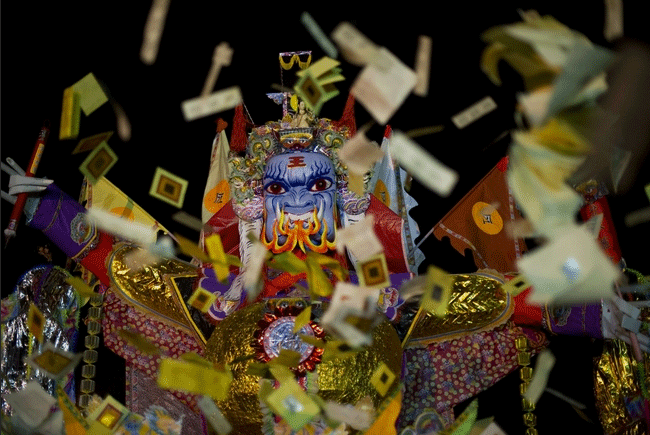 |
| A model of a deity made from paper offerings. Photo: WSJ |
Previously, "ghost money" in China typically came in small denominations, but this has changed in the last few decades. The value of these coins has increased from millions, billions, to trillions. Many experts explain this phenomenon by saying that even the deceased want to show off their wealth, and their descendants continue to believe that their ancestors always needed a lot of money to buy houses, cars, and technology gadgets.
This year during the Vu Lan festival, Hong Kong residents witnessed the influx of new types of paper offerings, paper offering shops, and stacks of "ghost money" with denominations reaching trillions of USD.
"We're witnessing runaway inflation," Timothy Hau, an economist at the University of Hong Kong, joked. "It's just like in Zimbabwe."
The inflation in both the underworld and the mortal world is expected to worsen during this year's Hungry Ghost Festival, when (according to belief) the gates of the underworld are opened, allowing spirits to return to the mortal world. Over the next few weeks, city dwellers will come together to hold traditional music and dance performances to entertain the departed. They even leave the front rows empty for the ghost audience, alongside preparing offerings and burning mountains of paper money.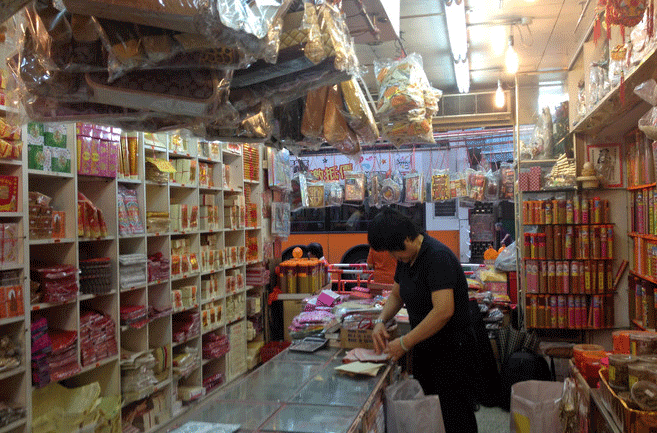
A shop selling paper offerings in Hong Kong. Photo: WSJ
What happens in the earthly realm is reflected in the spiritual realm.
Inflation in the underworld accurately reflects what is happening in the mortal world. In recent years, people in both Hong Kong and mainland China have been able to feel the negative effects of rising prices.
And as an inevitable consequence, the market for votive offerings has also not escaped this whirlwind. Shops supplying offerings for religious ceremonies have sprung up everywhere, overflowing with models of villas, luxury cars, air conditioners, and DVD players, all made of paper.
Near a funeral home in Hong Kong is a long row of shops catering to funeral needs. Although many of these shops have been operating there for decades, they are preparing to close. "The rent is very expensive, it's very difficult to maintain a business," said Tony Tai, 62, one of the owners of the funeral supplies shops.
"Inflation is everywhere, so of course it's present in the underworld too," said Li Yin-kwan, 42, another shop owner. The trillion-dollar bills are the best-selling item in her shop, "because they help spirits buy a lot of things, like houses and cars."
However, Ms. Li said there is still room for smaller denomination coins. "The elderly also need small change to buy daily necessities, like clothes and food," she said.
Before the full moon of the seventh lunar month, Mrs. Li's shop had sold out all the stacks of 1 trillion yuan banknotes.
"I'm very sorry," Ms. Li told a customer, "but there's still some money left, about 100 billion USD."
At Ms. Li's place, there are even credit cards from the Underworld Bank, some decorated with pink diamond patterns, while others are mint green like American Express cards. The lives of the underworld inhabitants are just as luxurious as those of the mortal world, thanks to tablets, flat-screen TVs, 3D glasses, and sports cars.
According to economic experts, the problem lies in the fact that real money is used to buy paper offerings and underworld currency. The more paper offerings are burned, the more inflation increases. Mr. Hau humorously suggested that the King of Hell should learn from the Zimbabwean government, dollarize the underworld economy, and use green banknotes.
Fortunately, not all Hong Kong residents believe they need to burn a lot of paper money for the afterlife. Kenny Cheung, 50, manager of the Cheung Kee funeral service company, said he prefers burning cups of bubble tea and suits for his ancestors, as those are things they never enjoyed when they were alive. "There's no need to burn so much money," he said.
"I don't think it's a good habit," Kee said of the East Asian custom of burning large quantities of paper offerings.
The Hong Kong Monetary Authority (HKMA) said it was almost powerless to address the situation. "We are unable to quantify the amount of money being poured into the spiritual world, nor to regulate activities in this sector," an HKMA spokesperson said.
From the people's perspective, they explain that because there are corrupt officials in the underworld as well, money is absolutely essential, even if it has been burned to ashes.
"There's also corruption down there," said Maria Tam, an anthropologist at the Chinese University of Hong Kong. "Look, if you send a house to your ancestors, you have to send money too. Because some corrupt officials there will try to extort money," Tam explained, "so you need money to bribe them."
Besides bribery and shopping, money is used for many other purposes.
"Even in the underworld, the ancestors need money to gamble," Cheung said. "Without money, it's no fun."
According to VnExpress - TH


