
Formulas for identifying counterfeit and fake goods.
(Baonghean) - Every Lunar New Year, the market enters its busiest season of the year, which is also the time when the production and distribution of counterfeit, fake, and substandard goods explodes.
Every Lunar New Year, the market becomes its busiest season of the year, but it is also the time when the production and distribution of counterfeit, fake, and substandard goods explode. In the market, especially for consumer goods, products are often imported from many places with unclear origins, making it difficult for consumers to distinguish between genuine and fake products, and easily affecting both their wallets and health…
For a product to be considered reliable, its product and company information must be complete and clear. Therefore, distinguishing genuine from counterfeit goods using barcodes is becoming increasingly common. A popular method on the internet for identifying counterfeit goods is the formula: "The sum of odd numbers plus even numbers multiplied by three plus the last digit must be 0."
According to the principle, "Each manufacturing enterprise is only assigned one unique enterprise code, and each product has only one barcode throughout its entire product lifecycle." A barcode is a type of barcode that must be registered and licensed by the GS1 barcode organization. It consists of digits that represent information related to the product, including: country code, enterprise code, product code, and finally, a check digit. There are two types of barcodes: 8-digit and 13-digit; the first three digits indicate the country of origin. For example, if the first three digits are 893, the product is manufactured in Vietnam; if it is 690, 691, 692, or 693, it is from China; 880 is from South Korea; 885 is from Thailand; and 000-019 is from the USA, etc.
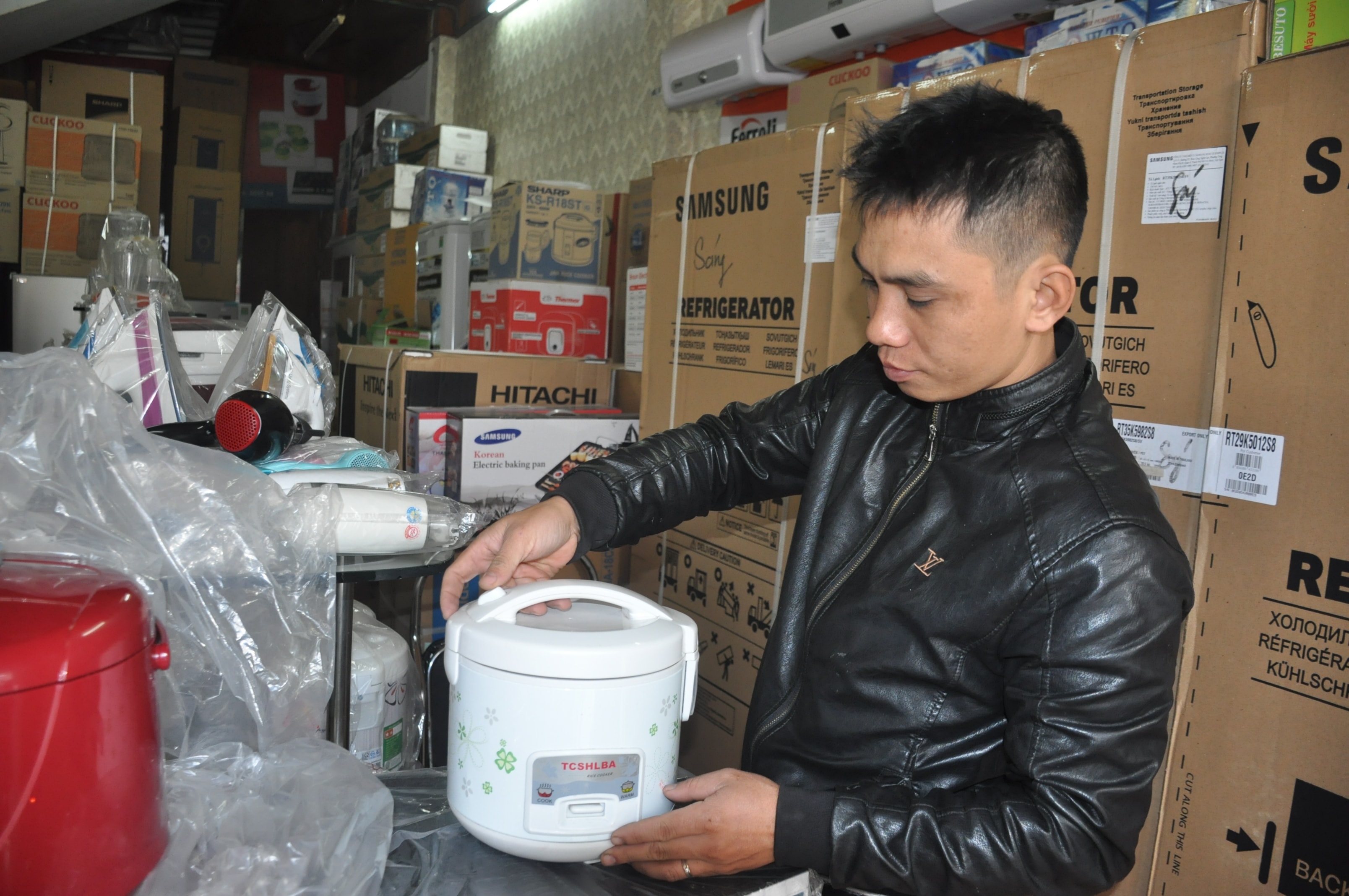 |
| Counterfeit Toshiba rice cookers are being sold on Quang Trung Street (Vinh City). Photo: Viet Phuong |
Businesses and individuals may produce counterfeit goods, but they usually don't dare to counterfeit the barcodes of genuine products. If they do, the manufacturer of the genuine product will sue them for theft and copying of barcodes, with very heavy penalties, especially in countries with strong, independent judicial systems where it's difficult to influence the outcome.
To identify genuine or counterfeit products, using the general barcode calculation formula above, take the sum of the even-numbered digits and multiply it by 3. Then add this to the sum of the odd-numbered digits (excluding the 13th digit, which is a check digit). Finally, add the last digit. If the sum ends in 0, it's genuine; otherwise, it's counterfeit!For example: Check if a Korean product is genuine by looking at the following 13-digit barcode: 8809013350421
Sum of the odd-numbered digits (excluding the last digit): A = 8 + 0 + 0 + 3 + 5 + 4 = 20
Sum of even-numbered digits: B = 8 + 9 + 1 + 3 + 0 + 2 = 23
C = A + B x 3 = 20 + 23 x 3 = 109
D = C + 1 (the number 1 in the last position 13) = 109 + 1 = 120;
The result 120 has a last digit of 0. So this is a genuine product.
Furthermore, genuine, high-quality products always have the characteristic quality, color, hardness, softness, elasticity, and scent according to standards publicly announced by the manufacturer, and buyers can distinguish them by observation, comparison, and even by requesting a sample.
To combat counterfeiting, protect consumers, and ensure a healthy business environment, it is necessary to have a correct and unified understanding and synchronized involvement of the political system, the proactive participation of functional agencies and the people, creating pressure to force businesses and traders to consider ensuring consumer rights, the rights of citizens and customers as both a goal and a driving force and a decisive solution for their sustainable business development and that of society.
On the one hand, the State needs to strengthen the capacity of formal and informal institutions, both state-owned and non-state-owned, from the central to local levels; streamline the apparatus and clearly define responsibilities, strengthen connections and close coordination, promote propaganda, inspection and supervision, establish and introduce hotlines, telephone numbers, and information websites to promptly identify, report, and handle violations of the law protecting the rights of consumers and legitimate businesses.
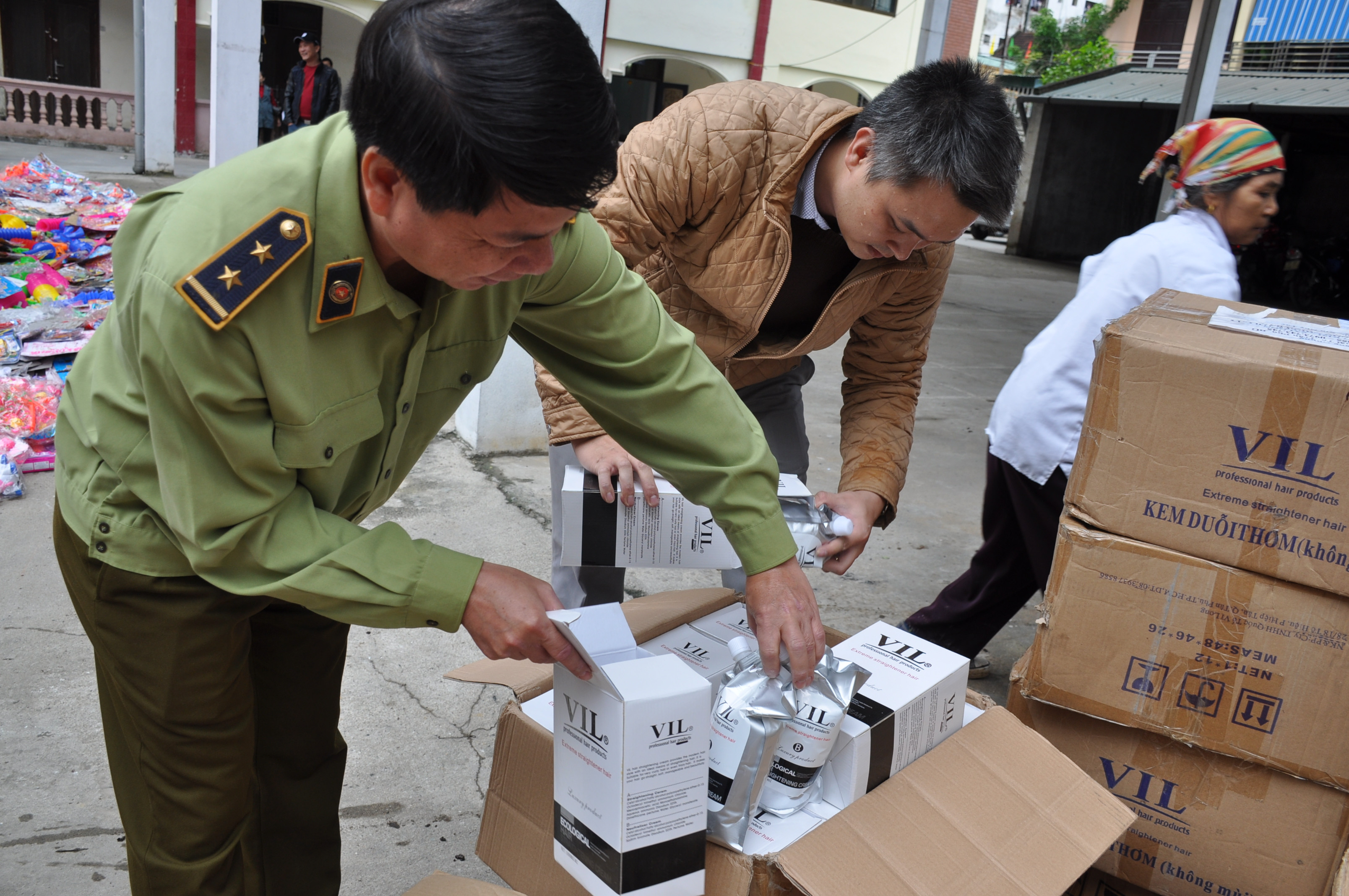 |
| Smuggled cosmetics seized by Nghe An Market Management Force. Photo: Viet Phuong |
On the other hand, citizens also need to be fully aware of their rights and obligations, overcoming the reluctance to complain, the fear of bureaucratic procedures, lengthy resolution times, and high costs... to proactively file complaints, denunciations, disseminate information, and exercise their consumer rights. This will create sufficient social and market pressure to prevent and severely punish wrongful acts by businesses and traders who intentionally violate the law and disregard social interests.
Furthermore, associations and individual businesses need to uphold their business ethics, culture, and social responsibility by providing complete, transparent, and easily accessible information about their goods to consumers, ensuring consumer rights, and considering this as a driving force for the stable and sustainable development of businesses and the country…


