
Cua Lo aims to become a civilized and modern coastal tourist city.
(Baonghean)With a coastline stretching 10.2 km, a gentle slope, fine white sand, clear blue water, diverse flora and fauna, and featuring the Lan Chau peninsula and two large islands (Ngu Island and Mat Island) associated with numerous legends, historical relics, and spiritual culture, Cua Lo has been recognized by the World Tourism Organization as the most beautiful beach in Northern Vietnam. Furthermore, Cua Lo boasts comprehensive transportation options including road, rail, air, and sea, facilitating trade and economic development.
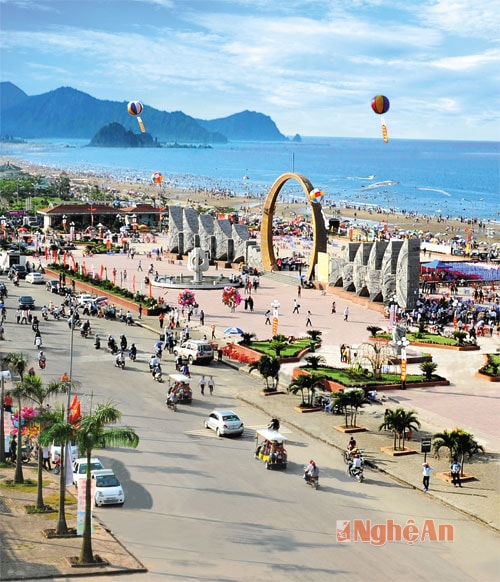 |
| Sunrise Square (Cua Lo Town). Photo: Sy Minh |
Potential and development
The place name Cua Lo has existed for a long time, but tourism in Cua Lo only began to be known in 1907 when the French discovered its potential and decided to build a resort area there. To create momentum for the development of the overall economy and tourism in Cua Lo, on August 29, 1994, the Government issued Decree 113/ND-CP establishing Cua Lo Town, Nghe An Province, comprising Cua Lo Town and four communes: Nghi Thu, Nghi Huong, Nghi Hoa, and Nghi Hai; and a part of Nghi Quang commune, Nghi Loc district.
Following the reform policy, immediately after its establishment, the Party Committee, government, and people of Cua Lo Town united, worked together diligently, and actively maximized the advantages of a coastal tourist town to build and develop. Cua Lo Town has a natural area of 28.2 km2, a population of nearly 60,000 people, comprising 7 wards; infrastructure has been planned and invested in for comprehensive and modern development. Cua Lo beach is green, clean, beautiful, and friendly; the people of Cua Lo are warm, hospitable, and tourism has become a brand and one of the top attractive destinations for domestic and international tourists. As a result, Cua Lo's economy has experienced high and sustainable growth (in 2013, growth reached 9.8%), and the economic structure has shifted in the right direction with a focus on services and tourism (in 2013, the proportion of the service and tourism sector in the economy reached 62.5%). Annual budget revenue and expenditure consistently exceeded targets (in 2013, Cua Lo Town's budget revenue ranked second in the province). Culture and society have made significant progress, and the material and spiritual lives of the people have improved (average per capita income increased from approximately 5 million VND in 1994 to nearly 52 million VND/year in 2013; the poverty rate decreased to 5.7%. Annually, the town creates jobs for over 1,000 workers); communication and behavior in tourism services have improved; 21 out of 22 schools meet national standards, and 5 out of 7 wards have health stations that meet national standards; national defense, security, and social order are always ensured. In 2009, Cua Lo Town was awarded the Second Class Labor Medal by the President and recognized as a Type 3 urban area by the Ministry of Construction.
In the tourism sector, the infrastructure has made remarkable progress. From having only 7 hotels when it was first established, Cua Lo town now has 248 accommodation establishments (with a capacity of over 18,000 tourists staying per day/night), including 20 hotels with 2-4 stars; over 350 restaurants meeting standards; and many key projects have come into operation and are proving effective (National Highway 46, Provincial Road 535 connecting Vinh City with Cua Lo town; Nam Cam - Cua Lo road; Binh Minh Square; Drainage and Wastewater Treatment Project funded by the Kingdom of Belgium - Phases I and II; Cua Lo Golf Course; Van Xuan University of Technology; Nghe An College of Tourism and Trade; the system of lawns and trees in the forest park and beach area... are important highlights that make Cua Lo increasingly modern and civilized).
 |
| Comrade Nguyen Nam Dinh (second from the left) listens to the exchange with investors from Song Ngu Son. Photo: Sy Minh |
With the determination to become a friendly and hospitable seaside tourist destination, Cua Lo Town has effectively implemented state management of tourism, most notably the "5 No's" policy (no price gouging; no harassment or soliciting of tourists; no massage or street vending; no disruption of security and order; and no environmental damage). As a result, Cua Lo Town has increasingly gained the trust and goodwill of tourists from near and far. In 2013, Cua Lo tourism achieved the highest results in all three criteria: number of visitors (2,120,000 visitors, including 1,345,000 overnight guests and 5,400 international visitors); revenue reached 1,460 billion VND; and tax contributions exceeded 24 billion VND.
Building the brand "Cua Lo Coastal Tourist City"
Cua Lo Town is actively preparing for the opening of the Cua Lo Tourism Year 2014, celebrating the 20th anniversary of the town's establishment (August 29, 1994 - August 29, 2014) and receiving the First-Class Labor Medal awarded by the President of Vietnam. Resolution No. 26/NQ-TƯ dated July 30, 2013, of the Politburo, 11th term, identified the goal of "Building Cua Lo Town into a green, clean, beautiful, prosperous, and civilized coastal tourism city, together with Vinh City, to develop into an economic growth pole and a leading growth engine of Nghe An province"; and Decision 2161/QĐ-TTg dated November 11, 2013, of the Prime Minister approving the overall plan for tourism development in the North Central region until 2020, with a vision to 2030, designates Cua Lo Town as a coastal tourism city of the region. And in Notice No. 881-TB/TU dated September 18, 2013, of the Standing Committee of the Provincial Party Committee on the results of 7 years of implementing Resolution 05-NQ/TU dated September 26, 2006, of the Standing Committee of the Provincial Party Committee on building and developing Cua Lo town into a tourist city by 2015 with a view to 2020, it was affirmed that the policy of continuing to focus on building Cua Lo town into a tourist city has created new momentum and impetus for Cua Lo tourism to develop to a new level.
The highlight of Cua Lo tourism in 2014 was the continued improvement in planning and management, focusing on environmental protection and fostering a positive visitor-friendly culture. Urban beautification and the development of tourism infrastructure were accelerated to meet and exceed planned targets (including key projects celebrating the 20th anniversary of the town's establishment; expansion and upgrading of Binh Minh Square and the outdoor stage; commencement of the Lan Chau Island - Ngu Island Eco-tourism Complex Project; Muong Thanh - Cua Lo Hotel; a Food Center and souvenir shop in Thu Thuy ward; and the construction of additional restaurants, parking lots, public restrooms, and waste collection points...). Many activities have been and will be organized to celebrate the opening of the Cua Lo Tourism Year 2014 and the 20th anniversary of the town's establishment, including: the "Cua Lo Sunrise" art program; fireworks displays on April 30th and May 1st; the "Connecting Hands by the Sea" arts festival organized by Nghe An Radio and Television Station in coordination with radio and television stations from more than 10 provinces and cities nationwide and the Lao National Radio and Television Station... The goal for 2014 is for Cua Lo town to welcome 2,250,000 visitors; achieve revenue of 1,750 billion VND and contribute 26.5 billion VND to the state budget.
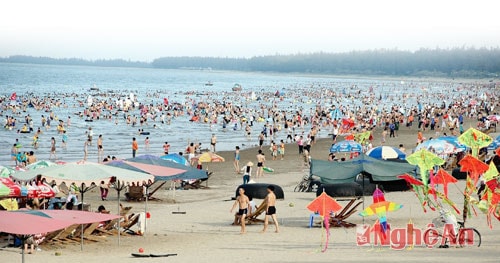 |
| Cua Lo beach. Photo: Xuan Nhuong |
Breakthrough and sustainable development
In the coming years, the overall development goal of Cua Lo Town is to achieve breakthroughs and sustainable development based on the principle of "Economic development must be linked to ensuring social welfare and protecting the environment." In economic development, tourism continues to be the leading economic sector, accounting for the largest proportion (approximately 65%). The development orientation for Cua Lo tourism will focus on the following basic contents:
Firstly, planning and expanding development space, and building infrastructure based on the town's location, potential, and advantages, while maintaining connections with other localities within the province, region, nation, and internationally. The implementation of the Lan Chau Island - Ngu Island Eco-tourism Complex Project (following the model of Nha Trang's Hon Ngoc Viet Project, which has been operating effectively for the past 10 years) will enable Cua Lo town to expand its reach to the sea, exploiting the potential of Ngu Island and further afield, Mat Island, to attract tourists and implement a maritime strategy that effectively combines economic development with national defense and security. Strengthening linkages with key tourism areas in the province such as Vinh, Nam Dan, Dien Chau, Con Cuong, Quy Chau...; Vinh, Nghi Loc, and the Southeast Nghe An Economic Zone (included in the general plan for the construction of Vinh City until 2030, with a vision to 2050, and one of the province's three growth poles). The connection through the existing, relatively developed, and synchronized transportation infrastructure (Vinh - Cua Lo Boulevard, Provincial Road 535, Lam River embankment road, National Highway 46, Vinh Airport, etc.) will create conditions for Cua Lo town to diversify its tourism products, extend the length of stay for tourists, and reduce seasonality, thus extending the tourism exploitation period throughout the year.
Secondly, restore, maintain, and develop traditional crafts (fishing, aquaculture, and seafood processing in Nghi Tan, Nghi Thuy, and Nghi Hai), and build and replicate new production models that are environmentally friendly (growing green vegetables and fresh flowers in Nghi Thu, Nghi Huong, and Nghi Hoa) to both create a source of products for tourism, build a green belt to protect the urban environment, and create jobs and income for the workforce not directly involved in tourism business activities.
Thirdly, preserve historical, cultural, and spiritual relics; restore traditional festivals and revive unique rituals and customs of the coastal region, focusing on the Van Loc Temple Festival; the Song Ngu Pagoda Festival; the Cau Ngu Festival...; organize community activities such as the marine culture week, the sea market... in a socialized manner and link these types of tourism with resort tourism.
Fourth, focus on training to develop human resources, especially in the tourism business sector, by improving career guidance at high schools and colleges and universities in the area (at existing university and college training facilities and within the development plan of the cluster of universities and colleges in the Vinh and Cua Lo area).
Fifth, focus on attracting all resources for development by significantly improving the investment and business environment, promoting administrative reform, rectifying public service ethics, and resolving administrative procedures quickly, conveniently, and in accordance with regulations for investors, businesses, and citizens. Improve state management of tourism, disseminate information to the business community, especially travel agencies, hotels, restaurants, and the public, and continue to maintain and promote a friendly and courteous approach towards tourists.
With the above approach, we believe that the coastal city of Cua Lo will increasingly develop into a green, clean, beautiful, civilized, modern, friendly, and hospitable place!
Nguyen Nam Dinh
Secretary of the Cua Lo Town Party Committee


