
Diversifying investment forms for market construction in Vinh City.
(Baonghean.vn) - To increase investment capital for markets, ensuring modern facilities, sufficient trading space for traders, maintaining the city's aesthetics, and increasing budget revenue, Vinh City has promoted the diversification of market types, linked with the transformation of organizational, management, exploitation, and business models for diverse markets.
Diversify investment options.
Vinh City currently has 19 markets, including 2 Class 1 markets. In fact, over the past five years, the city has "socialized" the investment and operation of markets through various models such as: Business models where enterprises manage and operate markets through bidding or transfer, which can be organized as state-owned enterprises, joint-stock companies, limited liability companies, cooperatives, or private enterprises; models where enterprises or cooperatives invest in market construction, then organize business operations and management (applicable to newly constructed markets); and models where market management boards are self-financing public service units with legal personality, their own seal, and separate accounts at the State Treasury.
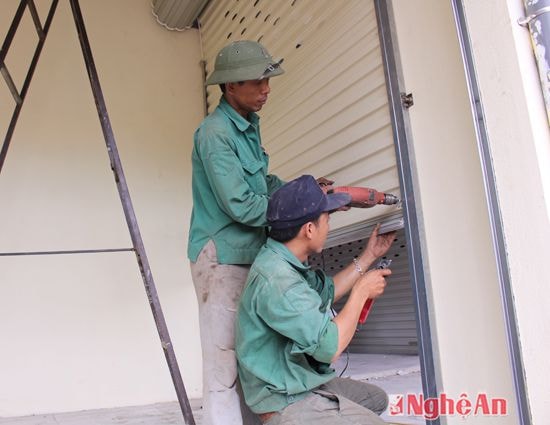 |
| Investment in the construction of the West Market by Song Tien Trading Company. |
In the current business-invested and managed market model, there are Cau Thong Market (Trang Anh Company), Tecco Vinh Tan Market (Tecco Central Vietnam Joint Stock Company Branch), Truong Thi New Market (Kim Truong Thi Company), Nghi Kim Market (Truong Son Construction Joint Stock Company), and Song Tien Construction and Trading Joint Stock Company investing in the agricultural product area west of Vinh Market. These markets have seen businesses invest capital, creating new market infrastructure to meet the shopping needs of the people. For example, the Tecco Vinh Tan Market has been completed, and the company has finalized its management system, regulations, and operating procedures. After the market was built, the City People's Committee proceeded to dismantle the temporary Vinh Tan market to relocate businesses to the new market. To date, there are over 80 households with 80 people doing business at the market.
The Truong Thi New Market was constructed by the Dong Duong Song Hong Joint Venture Company and put into operation in 2012. Currently, the market is operating stably with a total of 116 stalls and 120 vendors. The agricultural market west of Vinh Market is currently under construction to expand the western agricultural market area. This market is being developed by Song Tien Construction and Trading Joint Stock Company under a BOT (Build-Operate-Transfer) investment project. The project has been approved by the People's Committee of Vinh City, the Standing Committee of the City Party Committee, the People's Committee of Nghe An Province, and the Ministry of Planning and Investment. The People's Committee of Nghe An Province has issued a Decision approving the feasibility study report and a Decision approving the results of the investor selection under the Build-Operate-Transfer (BOT) contract. The investor has signed a contract with the People's Committee of Vinh City to invest in the construction of the agricultural market on a planned land area of 9,290 m2.
The project's operating period is 25 years (including 2 years of construction and 23 years of management, operation, and use). Currently, Song Tien Construction and Trading Joint Stock Company has invested in the construction of various facilities including stalls, roads, lighting, and sales booths, in accordance with the approved plan. Mr. Thai Ba Nghia, Director of Song Tien Construction Joint Stock Company, said: “The project has an investment of 20 billion VND, entirely funded by the company. The operating mechanism is to lease stalls to business households. The expected monthly rent for a stall is approximately 1-1.2 million VND. After the stipulated period, the market will be handed over to the state for management. Song Tien Company has completed phase 1 with a total investment of 12 billion VND, putting 400 business locations into operation.”
The above models show that markets invested in by businesses are quite effective, reducing budget costs while creating modern infrastructure. This form of investment separates state management from business management, resulting in a very streamlined market structure.
Regarding the cooperative model for investing in, managing, and operating markets: Phong Toan Market, Coi Market, Quyet Market, Nghi Lien Market, etc., this is a form of creating jobs and income for households and cooperatives whose land has been reclaimed by the state. In the past, the city has directed the transfer of investment in the construction of some markets to cooperatives for investment, management, and operation, based on consideration of investment plans and the cooperatives' ability to mobilize capital. Phong Toan Market in Ha Huy Tap ward was quite deserted when we visited recently; some stalls were still unoccupied. The Phong Toan Cooperative mobilized capital, developed a construction plan, and commenced construction in October 2009, putting it into operation in 2012 with a total investment of over 21 billion VND. The market has 398 business locations and a total of 250 business households.
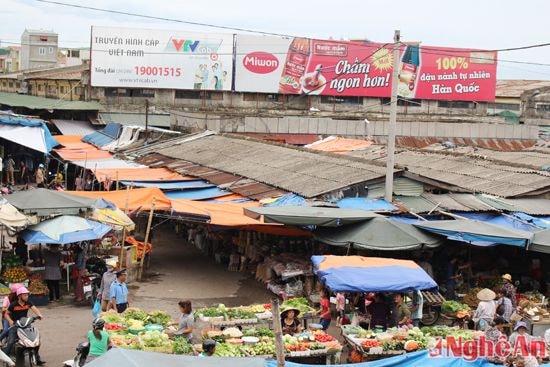 |
| The area outside Vinh Market still needs investment for upgrading. |
Another model the city is implementing is the conversion of existing markets into cooperative markets, including the Ben Thuy Cooperative Market, the Kenh Bac Cooperative Market, and the Cua Bac Cooperative Market. These markets have a relatively large number of stalls and generate substantial fees. For example, the total fees collected by the three cooperative markets in 2010 was 3.1 billion VND, reaching 2.3 billion VND in 2014. The three cooperative markets contributed 657 million VND to the state budget in 2014 and provided employment for 2,398 workers.
The transition from a market management board model to a cooperative model through transfer has yielded clear and positive economic results. Market cooperatives have created new jobs for cooperative members and workers by organizing services such as parking, electricity, water, security, loading and unloading, and cleaning. However, the implementation process has faced many difficulties and uncertainties, lacking high consensus from local Party committees and authorities due to a lack of clear understanding of the model transition.
Due to their specific characteristics, Vinh Market and Vinh Train Station Market are currently still managed by the city through legally recognized market management boards.
To make the market operate efficiently
Given the diverse forms of market management and investment, and the focus on transforming markets into new management models, the effectiveness remains unclear. For example, markets managed and invested in by cooperatives are one solution to strengthen and innovate cooperatives towards multi-sectoral and multi-occupational production and business, leveraging the internal strengths of cooperatives and creating jobs for their members. However, the market management apparatus is limited in capacity, professional expertise, and sensitivity to market mechanisms.
Evaluating the effectiveness and future solutions, Mr. Nguyen Van Chinh – Vice Chairman of the City People's Committee – stated: “After 5 years of implementing the projects and plans, the City has achieved some important initial results in terms of responsibility and ideological awareness; in planning, construction, and transforming the investment, management, and business operation models of markets, mobilizing resources, meeting the business needs of small traders, ensuring commercial civility, and increasing revenue for the budget. State management has been given attention, and infrastructure has been gradually invested in to become more spacious and modern. The process of transforming investment, management, business, and operation of markets ensures democratic and transparent rights for small traders doing business in the markets.”
However, some shortcomings remain. The process of transforming the organizational, management, business, and operational models of markets from the city level down to the wards and communes is still hesitant and lacks experience in directing implementation. Therefore, to make markets operate more effectively, the city's direction in the coming time is to continue mobilizing resources, upgrading and renovating market infrastructure, especially attracting investment from businesses, including foreign investment, to increase the number of attractive brands and products for buyers. At the same time, markets built with state budget support according to policy, with the remaining portion contributed by economic entities, will be established as limited liability companies or joint-stock companies; the state capital will be transferred through auction or by selecting a model for transformation, depending on the scale of the market.”
In reality, Vinh City currently has many markets, many of which have not fully utilized their potential and strengths, resulting in wasted resources. The city needs to focus on reviewing the market network plan to add or remove unsuitable markets, and eliminate illegal and sidewalk markets. Furthermore, no new markets should be built. For markets invested in by businesses, the rental fees for stalls are still high, affecting the income of small traders. The reality is that even with markets, high fees and stall prices mean many small traders remain outside the markets, impacting traffic and urban order. State management becomes more difficult when other economic sectors invest in markets. The city needs to attract large, reputable, and capable investors to develop markets, so that a significant portion of the city's workforce can have opportunities to do business, have stable and long-term business locations at reasonable prices, and create a competitive environment in terms of pricing both within and outside the province, especially as Vinh is developing into an economic, commercial, financial, and cultural center of the North Central region.
Chau Lan.


