

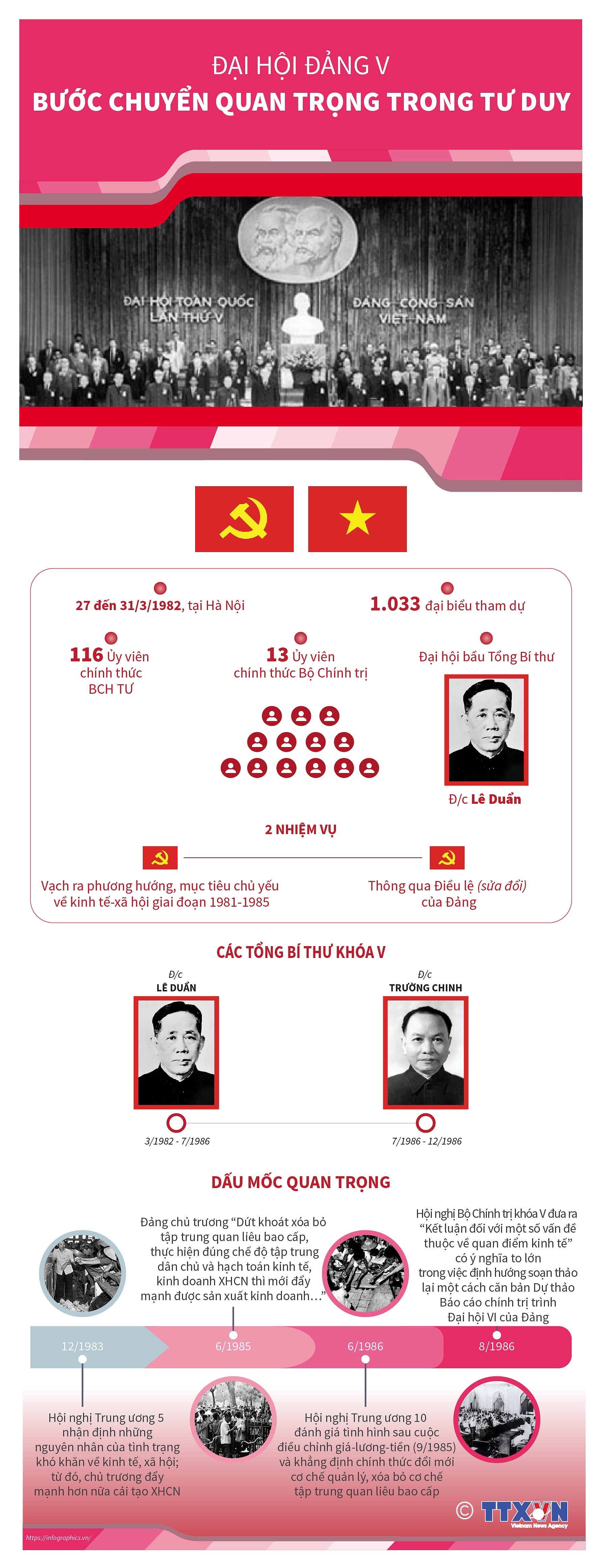
Fifth Party Congress: A crucial shift in thinking
The 8th Conference of the 5th Central Committee of the Communist Party of Vietnam (June 1985) decided on a crucial shift in the Party's thinking regarding the abolition of the centralized bureaucratic subsidy mechanism and the complete transition of the economy to socialist business accounting.
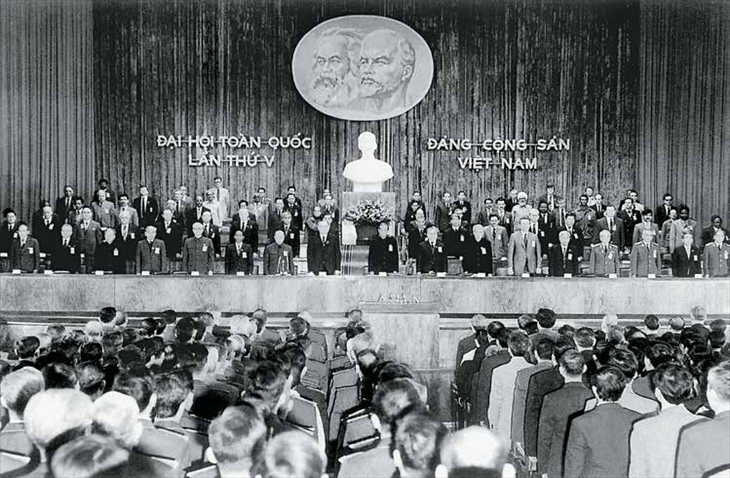
FIFTH PARTY CONGRESS
Time:March 27-31, 1982
Location: Capital CityHanoi
Number of delegates attending the Congress:1,033
Number of party members in the country:Over 1.72 million
Forty-seven international delegations attended.
The congress elected:
- General Secretary: ComradeLe Duan
- Central Executive Committee: 116 full members and 36 alternate members
- Politburo: 13 full members and 2 alternate members
GENERAL CONTEXT:
- The socio-economic situation in the Soviet Union and the Eastern European socialist countries was difficult, gradually falling into crisis.
The economic and social reform policies in China (since 1978) have initially yielded positive results.
In Southeast Asia, international reactionary forces are intensifying their efforts to interfere, dominate, and exert influence. In particular, they are stepping up their activities to undermine the Vietnamese revolution.
- Vietnam is in a situation where it enjoys peace while simultaneously facing a multifaceted form of sabotage warfare... and must also be prepared to deal with the possibility of a large-scale invasion by the enemy. The US continues to implement its policy of encirclement and embargo against Vietnam.
BUILDING SOCIALISM AND DEFENDING THE SOCIALIST FATHERLAND
The Congress heard the Political Report of the Central Committee of the Party and many other important reports. The Congress pointed out the objective and subjective causes of difficulties and weaknesses. The Congress frankly stated the subjective causes, namely mistakes in leadership and economic and social management. There were shortcomings and errors in understanding the actual situation, in concretizing and implementing the Party's guidelines. The difficulties and complexities of the path to socialism, starting from an economy where small-scale production was still prevalent, maintaining an administrative, bureaucratic, and subsidized management mechanism for too long, and being slow to change policies, were not fully recognized.
Based on that, the Congress set forth the main directions, tasks, and objectives for socio-economic development from 1981 to 1985 and the 1980s; affirming the continued implementation of the socialist revolutionary line outlined by the Fourth Congress of the Party.
The Congress determined that the years 1981-1985 were years of further development, restructuring, and accelerating the socialist transformation of the national economy.
These three aspects are closely interconnected, aiming to fundamentally stabilize the economic and social situation, meet the most urgent and essential needs of the people's lives, alleviate the most serious imbalances in the economy, significantly overcome the abnormal situation in distribution and circulation, and create the foundation and conditions for stronger and more stable progress in the years to come.
Based on that, the Congress outlined the main directions, tasks, and objectives for socio-economic development from 1981 to 1985, setting forth two strategic tasks: building socialism and firmly defending the Socialist Republic of Vietnam.
The Congress approved:
+ Resolution on the direction, tasks, and objectives of the 1981-1985 five-year plan and the 1980s of the 20th century;
+ Resolution on Party building;
+ Supplementing the Party Charter.
The Congress elected the Central Committee, and Comrade Le Duan was re-elected as General Secretary of the Party. On July 10, 1986, General Secretary Le Duan passed away. The Central Committee held a special session on July 14, 1986, and elected Comrade Truong Chinh as General Secretary of the Party.
DOMESTIC EVENTS
- May 1, 1981: In Vientiane (Laos), a high-level delegation of the Vietnamese Party and State, led by Comrade Vo Nguyen Giap, awarded the Gold Star Order - the highest award of the Vietnamese Party and State - to Comrade Kaysone Phomvihane, General Secretary of the Lao People's Revolutionary Party.
- June 19, 1981: The Vietnam-Soviet Joint Venture (Vietsovpetro) was established based on the Intergovernmental Agreement between Vietnam and the Soviet Union on cooperation in geological exploration and oil and gas exploitation on the southern continental shelf of Vietnam.
- November 27, 1981: The State Council decided to ratify the Convention on the Elimination of All Forms of Discrimination Against Women (this Convention was adopted by the UN on December 18, 1979).
- January 18, 1982: The Ministry of Foreign Affairs of the Socialist Republic of Vietnam published a white paper entitled: "The Paracel Islands and the Spratly Islands - Territories of Vietnam".
- March 1982: Noi Bai International Airport terminal was inaugurated.
- July 7, 1982: Signing of the Agreement on the Common Historical Waters between the Socialist Republic of Vietnam and the People's Republic of Cambodia.
- September 28, 1982: The Chairman of the Council of Ministers (now the Government) signed a decision designating November 20th of each year as Vietnamese Teachers' Day.
- December 9, 1982: The Council of Ministers decided to establish Truong Sa District under Dong Nai Province and Hoang Sa District under Quang Nam - Da Nang Province (now part of Da Nang City). On December 28, 1982, the National Assembly decided to transfer Truong Sa District from Dong Nai Province to Phu Khanh Province (now Khanh Hoa Province).
INTERNATIONAL EVENT
- January 20, 1981: Ronald Reagan was sworn in as President of the United States.
- April 14, 1981: The first American space shuttle, named Columbia, landed safely, marking a significant turning point in space travel science.
- July 16, 1981: Mahathir bin Mohamad assumes office as Prime Minister of the Federation of Malaysia.
- August 12, 1981: IBM announced the IBM Personal Computer 5150, ushering in a new concept: the personal computer.
- October 6, 1981: Egyptian President Sadat is assassinated.
- March 25, 1982: Canada adopted its Constitution, after gaining full independence from Great Britain.
- June 6, 1982: Israel attacks Lebanon
- August 19, 1982: Svetlana Savitskaya became the second Russian woman to fly into space aboard the Soyuz T-7 spacecraft, along with two cosmonauts.
- November 5, 1982: The Itaipu hydroelectric dam was inaugurated. At the time, it was the world's largest hydroelectric dam and a symbol of cooperation between the neighboring countries of Brazil and Paraguay.
- November 10, 1982: General Secretary of the Communist Party of the Soviet Union, L. Brezhnev, passed away (1905-1982)
- November 12, 1982: Comrade Iu.V. Andropov was elected General Secretary of the Central Committee of the Communist Party of the Soviet Union.
- December 10, 1982: The United Nations Convention on the Law of the Sea was adopted. The Convention on the Law of the Sea was ratified by 107 countries in Montego Bay (Jamaica).


