

10th Party Congress: Changes in perception and thinking
The 10th Party Congress affirmed the significant progress in the Party's understanding after 20 years of reform, demonstrating a breakthrough in the shift in thinking of the Communist Party of Vietnam.
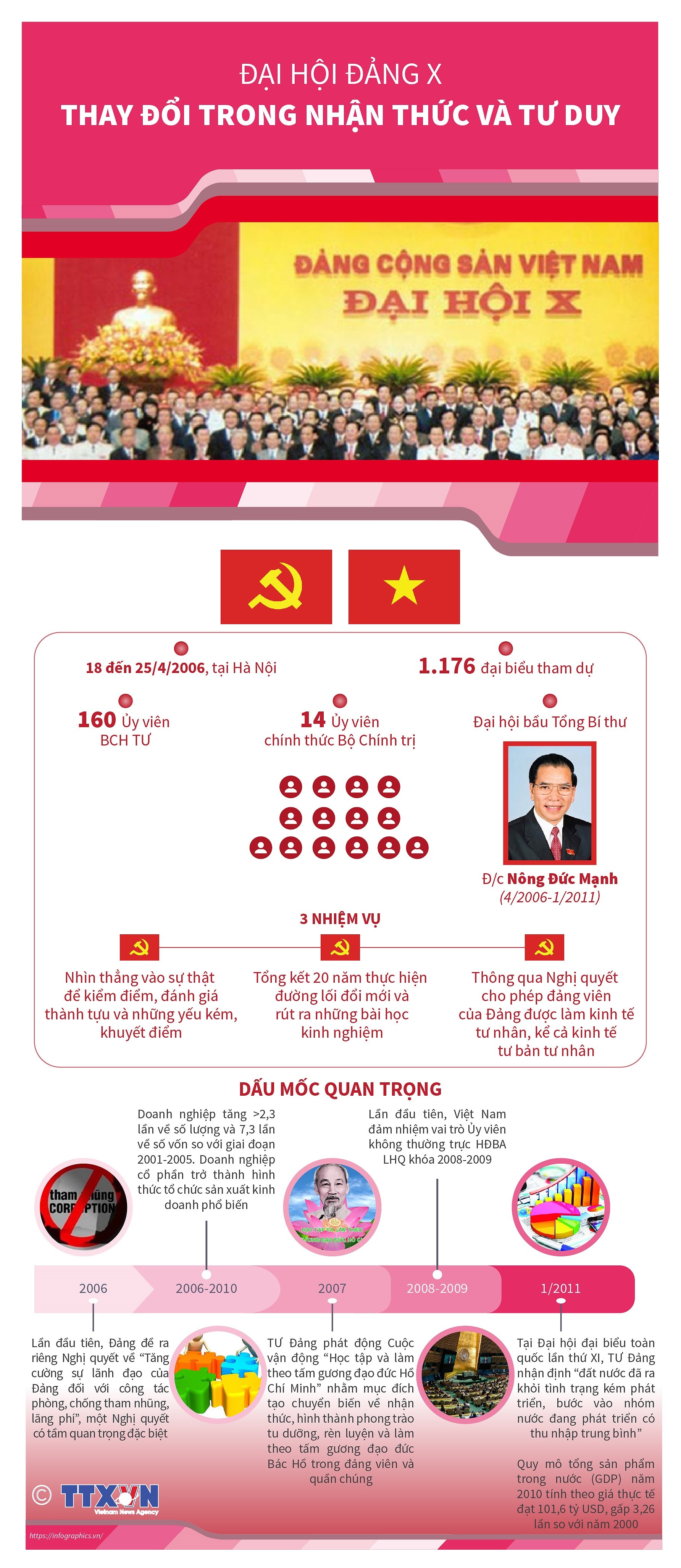
10TH PARTY CONGRESS
Time:April 18-25, 2006
Location:Hanoi, the capital city
Number of delegates attending the Congress:1,176 delegates
Number of party members in the country:3.1 million
The congress elected:
- General Secretary: Comrade Nong Duc Manh
- Central Executive Committee: 160 full members and 21 alternate members.
- Politburo: 14 members
GENERAL CONTEXT
Economic globalization creates opportunities for development but also contains many elements of inequality, posing significant difficulties and challenges for countries, especially developing countries.
Economic and trade competition between countries is becoming increasingly fierce.
- Local wars, armed conflicts, ethnic and religious conflicts, arms races, interventionist activities, subversion, separatism, terrorist activities, and disputes over borders, territories, islands, and natural resources continue to occur in many places with increasing complexity.
- Domestically, after 20 years of reform (1986-2006), our country's strength and position have grown stronger. Expanding international cooperation, actively and proactively integrating into the international economy, and maintaining a peaceful environment have created many favorable conditions for our people to innovate and develop socio-economic activities at a faster pace.
However, our country faces many major challenges: the risk of falling further behind economically compared to many countries in the region and the world; the decline in politics, ideology, morality, and lifestyle among a segment of cadres and Party members; and hostile forces continuing to carry out the "peaceful evolution" plot, instigating riots and overthrowing the government, aiming to change the political regime in our country.
HARNESSING THE STRENGTH OF THE ENTIRE NATION, LET'S QUICKLY LIFT OUR COUNTRY OUT OF ITS UNDERDEVELOPED STATE
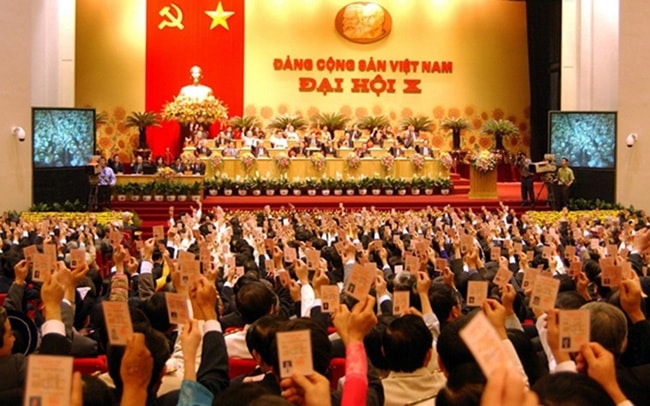
The Congress reviewed and objectively and comprehensively assessed the achievements and weaknesses and shortcomings, while drawing lessons learned from the implementation of the Party's Ninth Congress Resolution, looking back at 20 years of reform, thereby continuing to develop and perfect the guidelines and viewpoints, defining the direction, goals, and tasks for national development in the next five years (2006-2010); the direction and tasks for Party building; and supplementing and amending some points in the Party Charter.
The Political Report adopted by the Congress was titled: "Enhancing the leadership capacity and fighting strength of the Party, unleashing the strength of the entire nation, comprehensively accelerating the reform process, and quickly lifting our country out of underdevelopment."
The Congress affirmed: Over the past twenty years, with the strenuous efforts of the entire Party, the entire people, and the entire army, the renovation process in our country has achieved great and historically significant achievements. The country has emerged from the socio-economic crisis, undergoing fundamental and comprehensive changes. The economy has grown quite rapidly; the cause of industrialization, modernization, and the development of a socialist-oriented market economy is being accelerated. The people's lives have improved significantly. The political system and the national unity bloc have been consolidated and strengthened. Political and social stability has been maintained. National defense and security have been upheld. Our country's position in the international arena has continuously improved. The overall strength of the nation has increased considerably, creating new momentum and strength for the country to continue moving forward with bright prospects.
Understanding of socialism and the path to socialism is becoming increasingly clearer; the system of theoretical viewpoints on the reform process, on socialist society, and on the path to socialism in Vietnam has been formed in its basic aspects.
The Congress adopted the goals and directions for national development for the five years from 2006 to 2010 as follows: To enhance the leadership capacity and fighting strength of the Party, to unleash the strength of the entire nation, to comprehensively accelerate the reform process, to mobilize and effectively utilize all resources for industrialization and modernization of the country; to develop culture; to achieve social progress and equity; to strengthen national defense and security, to expand foreign relations; to proactively and actively integrate into the international economy; to maintain political and social stability; to quickly lift our country out of underdevelopment; and to create a foundation so that by 2020 our country will basically become a modern industrialized nation.
The Congress elected a Central Committee consisting of 160 full members and 21 alternate members. Comrade Nong Duc Manh was re-elected as General Secretary of the Party.
DOMESTIC EVENTS
- June 20-25, 2005: Prime Minister Phan Van Khai visited the United States. This was the first visit by a Vietnamese Prime Minister to the US in 30 years since the end of the war and 10 years since the normalization of relations between the two countries.
- November 25, 2005: UNESCO recognized the Gong Culture Space of the Central Highlands as a masterpiece of oral and intangible cultural heritage of humanity.
- November 29, 2005: The Law on Practicing Thrift and Combating Waste; and the Law on Prevention and Combatting Corruption were passed at the 8th session of the 11th National Assembly.
These two laws officially came into effect on June 1, 2006.
- November 28, 2005: Construction begins on the Dung Quat Refinery - Vietnam's first oil refinery.
After more than five years, on January 6, 2011, the Dung Quat Oil Refinery was inaugurated.
- December 2, 2005: Construction begins on Son La Hydropower Plant.
After 7 years of construction, the Son La Hydropower Plant was inaugurated on December 23, 2012, becoming the largest hydropower plant in Vietnam and Southeast Asia at that time.
- In 2005: The diaries of martyrs Dang Thuy Tram and Nguyen Van Thac were published.
- November 7, 2006: Vietnam was admitted as the 150th member of the World Trade Organization (WTO), after 11 years of negotiations.
- November 12-19, 2006: Vietnam successfully hosted the APEC-14 (Asia-Pacific Economic Cooperation) Summit Week.
- December 8 and 9, 2006: The US House of Representatives and Senate passed Permanent Normal Trade Relations (PNTR) status for Vietnam, marking the full normalization of bilateral relations.
- Foreign direct investment (FDI) into Vietnam in 2006 reached a record high of over US$10 billion. This was the highest level of FDI attracted since the enactment of the Law on Foreign Investment in Vietnam in 1997, demonstrating that Vietnam has truly become a promising destination for many large investors.
INTERNATIONAL EVENT
- January 20, 2005: U.S. President George W. Bush takes office for his second term.
- January 18, 2005: Airbus officially introduced the A380, the world's largest commercial aircraft.
- February 16, 2005: The Kyoto Protocol on reducing greenhouse gas emissions officially came into full effect.
- March 9, 2005: Thaksin Shinawatra was elected Prime Minister of Thailand for a second term.
More than a year later, on September 19, 2006, a military coup overthrew the government of Prime Minister Thaksin Shinawatra.
- April 2, 2005: Pope John Paul II died. Pope Benedict XVI was elected the new Pope of the Vatican.
- July 7, 2005: Bombings targeting the London Underground and bus systems killed 52 people and injured nearly 800.
- November 22, 2005: Angela Merkel was approved by the German Parliament as Chancellor, becoming the first female Chancellor of the Federal Republic of Germany.
- Late 2005: A severe outbreak of avian influenza spread across continents.
- February 1, 2006: Seven newspapers in France, Germany, the Netherlands, Italy, and Spain republished several caricatures of the Prophet Mohammed, which had first appeared in a Danish newspaper in January 2006, causing a wave of outrage in the Muslim world.
- May 27, 2006: A 6.3 magnitude earthquake in Java, Indonesia, killed 5,800 people and injured 45,000.
- August 1, 2006: Cuban President Fidel Castro fell seriously ill and temporarily transferred power to Vice President Raul Castro.
- October 9, 2006: North Korea conducted its first nuclear test, declaring possession of nuclear weapons, shocking public opinion and bringing negotiations to a standstill.
- October 13, 2006: South Korean Foreign Minister Ban Ki-moon was elected the 8th Secretary-General of the United Nations.
- November 5, 2006: The Iraqi Special Tribunal sentenced former President Saddam Hussein to death.


