
Public awareness, democracy, and social criticism
In our country, social critique has long been understood as commenting, evaluating, suggesting, consulting, and criticizing... While critique does encompass these characteristics, it differs fundamentally. Critique is the discovery of errors, the argumentation of those errors, and ultimately the compelling of the subject to explain and defend its viewpoint and demonstrate its feasibility. Without this compelling argument, critique cannot be called true critique!
(Baonghean.vn) -In our country, social critique has long been understood as commenting, evaluating, suggesting, consulting, and criticizing... While critique does encompass these characteristics, it differs fundamentally. Critique is the discovery of errors, the argumentation of those errors, and ultimately the compelling of the subject to explain and defend its viewpoint and demonstrate its feasibility. Without this compelling argument, critique cannot be called true critique!
Examining human society since the emergence of the state, classes, and ruling parties, scholar Nguyen Tran Bat logically argues that social critique, in general, creates a buffer phase for the natural process of social strata and interest groups; this is the phase of discussion and agreement between the social community and the ruling party with the state they represent. According to Bat, social critique makes political, economic, and social actions less subjective, and conflicts between social strata, interest groups, and the state are resolved through discussion and agreement.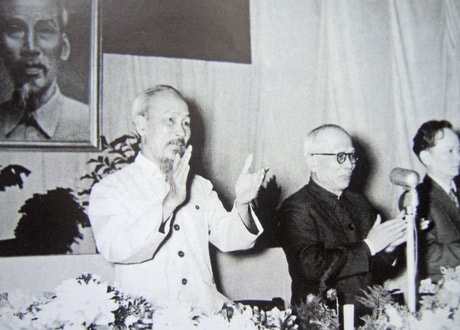
On December 29, 1956, the First National Assembly unanimously elected President Ho Chi Minh as the head of the committee to revise the Constitution promulgated in 1946.
At its 10th National Congress, the Communist Party of Vietnam put forward the view on building regulations and mechanisms for social criticism: "Establishing regulations for social supervision and criticism by the Vietnam Fatherland Front, political and social organizations, and the people regarding the formulation of guidelines, policies, major decisions of the Party, and their implementation, including organizational and personnel matters."
The aforementioned viewpoint of our Party, stemming from Vietnam's ongoing reform process, aims to eliminate bureaucracy and overcome the irrationalities of the government system at all levels... One of the effective solutions is to awaken and promote democracy, openness, and transparency - and social criticism is the most effective method, especially in a political system ruled by a single party.
Book cover image: “Social Criticism and the Promotion of Democracy and the Rule of Law”.
In 2006, Da Nang Publishing House released the book "Social Critique: Questions Arising from Life" by author Tran Dang Tuan. Building upon these achievements and developing new ones, in 2009, the National Political Publishing House published "Social Critique and the Promotion of Democracy and the Rule of Law." This book was compiled by a team of authors, co-edited by Dr. Ho Ba Tham and Nguyen Ton Thi Tuong Van. It addresses a series of questions such as: What is social critique (concept, nature, characteristics)? What are the subjects, objects, targets, principles, and methods of social critique? What is social critique in the current democratic and rule-of-law system in Vietnam? What are the characteristics, problems, and current difficulties in social critique in a specific area like Ho Chi Minh City? The appendix provides readers with additional reference materials on social critique in modern Western democracies, primarily in ancient Greece, England, France, and the United States...
A survey of social criticism in Ho Chi Minh City across five areas—corruption, land, environmental pollution, education and healthcare, and traffic accidents—has yielded several noteworthy conclusions that deserve widespread consideration, such as: The need to establish a specific mechanism to encourage citizen participation in decision-making; the need for transparency and public disclosure of information, especially regarding negative impacts, when implementing projects; and the need to strengthen two-way dialogue and criticism between the government and citizens in resolving emerging issues.
In various forms of social critique, the press always plays an indispensable role, as public opinion critique is one of the important sources of information that helps the government make decisions that are appropriate to social realities and the will of the people. Gathering public opinion information is done through many "channels," including print newspapers, radio, television, and online news. Public opinion is a dialogue between the opinions of citizens in society and the responses of leaders. Currently, there are two quite clear forms of this dialogue, welcomed by officials and workers: dialogue in the press with the participation of leaders, and direct dialogue between leaders and the people, broadcast live on television. However, it is necessary to distinguish between acts of critique and acts of protest to demand rights. These are two issues with two different ways of expression, leading to two different goals.
Stemming from real-life experiences, aiming to answer the questions raised, and combining theoretical research perspectives with practical summaries, the work "Social Critique" issued by the Party, State, and related organizations, with the goal of development, shows that each of us still needs to think, act, and dare to do much more.
Abandoning the "arrogant" mindset that felt no need to learn from anyone, including in politics and technology, the Party and State of Vietnam have recently opened their doors to consulting and critical review organizations from several countries and international organizations, inviting them to invest in and provide feedback on our policies. This is a very encouraging sign in Vietnam, helping to gradually eliminate outdated habits and create a new breakthrough in thinking about openness, integration, and building a civilized and modern way of doing business and behaving!
Kim Hung


