
The mark of a respected figure among ethnic minority communities.
(Baonghean) - With 442,787 ethnic minority people (accounting for 15.2% of the province's total population and 36% of the population in mountainous areas), in recent years, Party committees and authorities at all levels in the province have paid attention to implementing policies for influential figures among ethnic minorities. As a result, the significant role of these influential figures in economic, cultural, and social development, as well as in ensuring national defense and security in the locality, has been enhanced.
Bridging the gap between the Party's will and the people's hearts.
Mr. Xong Va Tu, from Huoi Nhao village, Nam Can commune (Ky Son district), is nearly 60 years old but has served as village head for 20 years. He is a respected figure loved and trusted by the villagers. He says that the "secret" to his reputation is his exemplary conduct and the principle of "saying what you mean and doing what you say."
Before promoting the initiative to the villagers, the villagers themselves and their families must lead by example. Seeing the practical results, the villagers will follow suit immediately. In Huoi Kha village (Huoi Tu commune), the people also hold the village elder Zau Chong Lau, born in 1930, former Chairman of the Commune People's Committee, and a veteran Party member with 50 years of Party membership, in special respect.
Despite his advanced age, he remains an exemplary Party member, attentive to the movements and activities of the people in his village, from sharing his experience on what crops to plant and what livestock to raise to develop the economy and alleviate poverty, to combating social evils, caring for children's education, and preserving traditional culture. For his contributions, he was awarded a Certificate of Merit by the Chairman of the Provincial People's Committee for his achievements in promoting the role of a respected figure among ethnic minorities.
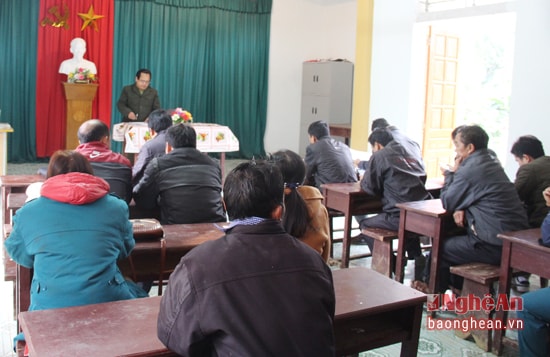 |
| Vu Va Chong, Secretary of the Party Branch of Trung Tam village, Huoi Tu commune (Ky Son district), presides over the Party branch meeting. Photo: KL |
Ms. Ha Thi Cuong, a specialist at the Fatherland Front Committee of Ky Son district, said: "Currently, there are 193 influential individuals in 193 hamlets and villages in the district. This is a core force and an important bridge between the Party committees, the government, and the people; they are an active team in disseminating information and mobilizing ethnic minorities to comply with the Party's guidelines and policies, the State's laws, and the policy of national unity; they contribute many ideas to building the Party committees and local governments, and monitor socio-economic development programs and projects in the locality."
Many respected individuals serve as shining examples in economic development and poverty reduction, encouraging their descendants to diversify crop and livestock structures, apply scientific and technological advancements to production, and eliminate outdated farming practices.
A prime example is Mr. Vu Va Chong from Trung Tam village (Huoi Tu commune), with his integrated economic model including a 3-hectare tea plantation spread across the hillsides, a herd of 3 buffaloes, 15 cows, and over 5,000 cypress and fir trees, yielding 2-3 tons of ginger annually. Not only is he a successful businessman, Mr. Vu Va Chong is also the village Party branch secretary and the commune police chief, and was invited to attend the National Conference honoring outstanding village Party branch secretaries.
In other localities, influential individuals have done a good job of disseminating legal information, mobilizing people to avoid illegal migration, illegal proselytization, and the re-cultivation of opium poppies, promoting family planning, eliminating outdated customs in funerals and weddings, superstitions, resolving internal conflicts, preserving and promoting national cultural identity, harmonizing customs and state laws, and setting a good example in the movement of village elders and influential people doing many good deeds.
For example, in Thanh Son commune (Thanh Chuong district), there is Mr. Vi Tuyen Quynh - a Party member of Tan Lap village with 50 years of Party membership. He is respected by the people in the resettlement area not only for his exemplary conduct, but also for his excellent economic skills with a 1.2-hectare farm, including a 1.8-acre tea garden, a truck for transporting tea, a tractor for rent to the people, and a dedicated area for livestock farming…
Or take Mr. Luong Van Dao (of the Thai ethnic group) - a respected figure, the head of the Elderly Association in Kim Chuong village, who is nearly 80 years old and has been a Party member for 50 years. He remains enthusiastic about village affairs, regularly participates in Party activities, and always supports and encourages his children and grandchildren to strive to join the Party. His family has three generations (4 sons, 2 daughters-in-law, 4 grandchildren, and 2 sons-in-law) who are all Party members...
| In Nghe An province, there are currently 1,334 influential individuals, of which 94.9% are male and 5.1% are female, comprising the following ethnic groups: Thai, Khmu, Mong, Tho, O Du, Nung, Kinh, and Hoa. Of these, 73 are at the provincial level and 4 are at the central level. |
Implement the incentive policies effectively.
Mr. Tran Nhat Phuong, Head of the Policy Department of the Provincial Ethnic Affairs Committee, said: For many years, in order to promote the role of influential figures among ethnic minorities and contribute to the implementation of the Party and State's policies towards ethnic minorities, Nghe An province has focused on directing and implementing Decision No. 18/2011/QD-TTg dated March 18, 2011, of the Prime Minister on policies for influential figures among ethnic minorities, and has achieved many good results.
In 2016 alone, in addition to continuing to implement major policies for ethnic minorities, the Provincial Ethnic Affairs Committee also implemented Decision No. 2085/QD-TTg dated October 31, 2016, of the Prime Minister approving the specific policy to support socio-economic development in ethnic minority and mountainous areas for the period 2017-2020, and a number of other policies through various diverse forms.
Examples include providing urgent information to influential individuals, organizing Tet (Lunar New Year) gift-giving visits, visiting those who are sick; organizing study tours within the country for 35 influential individuals; opening 8 classes to disseminate information to 328 influential individuals; advising the province on organizing a meeting with retired ethnic minority leaders; and holding a meeting to commend influential individuals for their contributions to the movement of doing good deeds...
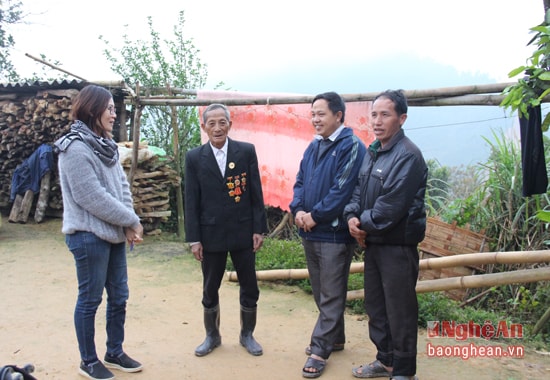 |
| Elder Zầu Chồng Lầu (second from the left), a respected figure in Huồi Khả village, Huồi Tụ commune (Kỳ Sơn district), converses with villagers. Photo: PV. |
In localities, recognizing the importance of promoting the role of influential and exemplary individuals within ethnic minority communities, contributing to socio-economic development, maintaining political security, and social order, policies for these influential figures among ethnic minorities are consistently given attention and care.
Every year, during holidays and festivals, local Party committees and authorities organize visits and gift-giving to influential people in villages and hamlets. They also provide timely support and encouragement when these influential people are ill, sick, or their families face difficulties. Furthermore, they coordinate and organize trips for influential people in the area to visit and learn from successful models and practices, especially those in the economic sector within and outside the province.
For example, in Ky Son district, in 2014, 22 people were sent on trips to the North (Hanoi, Phu Tho, Tuyen Quang) for training; and in 2016, 24 reputable individuals were sent on trips to the North. In addition, Party committees and authorities at all levels have also paid attention to leading and directing the planning, training, and recruitment of ethnic minority cadres.
| During the 2015-2020 term, 7 members of the Provincial Party Committee were from ethnic minorities, accounting for 9.85%. Among cadres and civil servants working in the Party, Fatherland Front, and political-social organizations at the provincial level, 12 out of 429 people (2.8%) were from ethnic minorities; and in the provincial government, 58 out of 1,260 people (4.6%) were from ethnic minorities. |
Fully implementing policies and regulations for respected individuals and their children will contribute to encouraging and motivating them and their families to play a pivotal role in fostering unity within the community.
However, currently, the work of promoting the role of influential individuals still reveals some difficulties and obstacles, namely: Party committees and authorities in some localities have not truly paid attention to the role of influential individuals in the community; the criteria for evaluating influential individuals are not consistent; the decentralization and assignment of management personnel to utilize influential individuals are still lacking in specificity, thus the effectiveness of promoting the role of influential individuals is not high...
Therefore, to promote and enhance the role of influential figures among ethnic minorities, in addition to developing and continuing to implement specific preferential policies, all levels, sectors, and localities need to promptly commend and reward those with outstanding achievements who serve as the core of various movements; regularly provide up-to-date information and policies related to ethnicity, religion, life, production, national defense, and security... to raise awareness widely.
At the same time, it creates conditions for influential individuals to contribute ideas and develop socio-economic development programs and plans in localities. This encourages them to actively participate in building national unity, serving as a spiritual support for disseminating information and mobilizing ethnic minority communities to overcome poverty and build new rural areas.
NPV


