
The legacy of the school that once bore the name Ba To.
(Baonghean) - Following the Tet Offensive and Uprising and the attacks by the army and people of South Vietnam in 1968, the US imperialists were forced to change their strategy from "Limited War" to "Vietnamization of the War," and the national resistance war against the US entered a crucial phase. In the North, the US imperialists frantically escalated their bombing campaign to prevent support for the Southern battlefield. At this time, along with the growing strength of the provincial armed forces, the Nghe An Provincial Military School was established on August 22, 1969.
When it was first established, the school was called "Ba To Military Training Team" with the following tasks: Training platoon and company officers for the armed forces in the province; training and developing officers in charge of guerrilla and self-defense forces in units and localities; and training officers throughout the province.
From its establishment until the end of the war against the US for national liberation, the Ba To Military Training Team (renamed the Nghe An Military School in 1991) trained and educated 1,710 cadres of all levels (infantry); 49 specialized training courses for 1,057 cadres, 520 commune-level militia cadres, 2,705 company-to-battalion local army cadres, and over 3,638 platoon-to-company cadres, meeting the military cadre requirements for the provincial armed forces and contributing to the achievements of the army and people of Nghe An during the country's war years.
Since 1977, in response to the demands of the new situation, the Nghe An Military School has undertaken the task of training and educating non-commissioned officers, reserve officers, and armed forces personnel for districts, cities, and towns in the province. It has provided national defense and security training for target groups 3, 4, and 5; trained local defense and military personnel for grassroots officials in Laos; and trained commune, ward, and town commanders... In particular, the school played a crucial role in training "strong troops" to establish the 441st Division - the Dong Loc Regiment. In addition, with its function of educating military and national defense knowledge, tens of thousands of teachers and university and college students have been trained and educated under the school's roof, maturing during the war and formerly known as Ba To.
Forty years after its establishment, the Nghe An Provincial Military School has trained and educated over 35,000 officers and students. The school has experienced strong and comprehensive development. Initially, it had only 25 administrative staff, teachers, and support personnel. Today, it boasts a well-trained team of administrators, teachers, and support staff with strong political convictions and increasingly high professional qualifications, meeting the demands of a provincial-level military school in the era of reform. From its humble beginnings, the school has relocated four times. Currently, its facilities are spacious, and its environment is increasingly orderly, green, clean, and beautiful. In 2011, the school won first prize in the competition for the most orderly, green, clean, and beautiful military schools organized by the 4th Military Region Command.
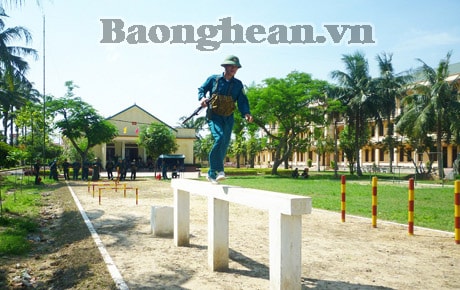
Officers of the Nghe An Military Academy are training at the training ground.
Entering a new phase, upholding the spirit of a victorious unit, the school's collective was awarded the Order of National Defense by the President of Vietnam. To successfully complete the assigned tasks, the school has recently adopted the motto "Fundamental, practical, and solid" in conjunction with the goal of "Teaching well, learning well".
This is considered a breakthrough in improving the quality of training and education. Focusing on innovating leadership methods, work styles, and building a team of truly exemplary and pioneering cadres in terms of character, ethics, and lifestyle – "Actions speak louder than words" – is linked to the implementation of Central Resolution 4 (11th Party Congress) on "Some urgent issues concerning Party building today" and Political Bureau Directive 03 CT/BCT on "continuing the study and emulation of Ho Chi Minh's moral example," building a clean, strong, and comprehensively strong Party Committee within the school, contributing to the successful implementation of the Party's two strategic tasks in the new period.
Colonel: Dinh Xuan Minh (Political Commissar of the school)


