
Strengthening measures to prevent avian influenza outbreaks.
(Baonghean)The avian influenza outbreak is becoming increasingly complex in many localities. Therefore, local veterinary departments are strengthening disease control measures and emphasizing proactive prevention.
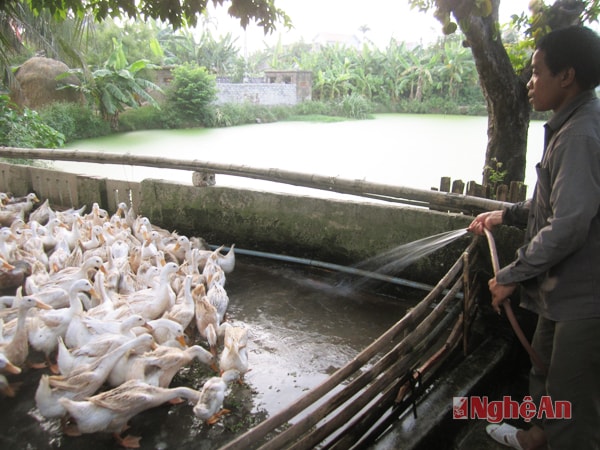 |
| Cleaning poultry farms in Hung Dao - Hung Nguyen. Photo: Phu Huong |
Following an outbreak of avian influenza in the duck flock of Ms. Nguyen Thi Quynh's family in Hamlet 15, Nghi Van Commune, Nghi Loc District People's Committee implemented comprehensive disease prevention and control measures to contain and prevent the spread of the disease. During our visit to Ms. Quynh's family, we learned that they have been raising ducks for many years, averaging over 1,000 ducks per year, earning over 100 million VND annually. However, on February 16th, the family's ducks suddenly exhibited symptoms of head tilting, leg spasms, inability to move, and scattered deaths. Upon discovery, the district veterinary station quarantined the area for treatment and sent samples for testing at the Regional Veterinary Center 3. The results showed that Ms. Quynh's duck flock tested positive for H5N1. She shared: "Our family has been raising ducks since 2005, and we have followed all disease prevention procedures. We don't understand why our flock got infected. Our family hopes that the relevant authorities will provide assistance, as this is the family's asset built up over many years."
In response to this situation, the district veterinary station, in coordination with local authorities, proceeded to destroy all infected poultry and those in contact with infected poultry. Simultaneously, disinfection spraying, containment, and eradication measures were implemented, with vaccination and disinfection carried out in each affected area. Currently, the Provincial Veterinary Department has allocated 10,000 doses of vaccine and 200 liters of Bencot disinfectant to Nghi Loc district for proactive disease prevention and control. Accordingly, members of the Steering Committee for Avian Influenza Prevention and Control are actively monitoring the area, inspecting, supervising, and guiding facilities to effectively implement disease prevention and control measures. Mr. Tran Quoc Cuong, Head of the Nghi Loc District Veterinary Station, said: "To contain and prevent the spread of the disease, immediately after receiving the conclusion from the Regional Veterinary Center 3, the station proceeded to destroy all infected poultry and poultry that had been in contact with infected poultry. At the same time, we assigned staff to closely monitor the area and direct local veterinarians to only carry out disinfection and vaccination of the entire flock."
According to reports from the district veterinary station, Nghi Loc currently has over 600,000 poultry. Due to the extremely complex weather conditions and prolonged severe cold, the risk of an outbreak is very high. Therefore, the Party committees and authorities at all levels in Nghi Loc are proactively implementing comprehensive disease prevention measures. These include focusing on widespread public awareness campaigns about the risks and harmful effects of avian influenza virus and its potential transmission to humans, aiming to improve community understanding; launching a nationwide campaign for general sanitation and disinfection; advising people not to consume poultry meat of unknown origin; and requiring private traders to absolutely refrain from consuming, slaughtering, and selling diseased poultry, and from disposing of poultry carcasses indiscriminately. In particular, in high-risk communes, temporary quarantine checkpoints should be established to prevent the transportation of poultry and poultry products into and out of the area. These checkpoints must have the necessary equipment and disinfectants to sanitize people and vehicles passing through.
Mr. Nguyen Thanh Hai, Vice Chairman of the Nghi Loc District People's Committee, added: To control, contain, and prevent the spread of the disease, Nghi Loc is currently implementing a comprehensive set of disease control measures. Specifically for Nghi Van, the locality has completed vaccination and disinfection. Simultaneously, quarantine checkpoints have been established to prevent the transportation of poultry in and out of the area. In particular, localities without outbreaks have mobilized the entire population to conduct a comprehensive environmental sanitation campaign, disinfecting livestock areas and at markets and slaughterhouses; organizing the signing of commitments with each livestock farmer and trader not to consume diseased poultry; and strengthening public awareness campaigns to improve people's understanding of disease prevention, contributing to the effective implementation of avian influenza prevention and control efforts by the locality.
Not only in Nghi Loc, but avian influenza has also appeared in Quynh Lam (Quynh Luu). Quynh Luu is a locality with a relatively large number of livestock and poultry, annually providing a fairly abundant food source for markets inside and outside the district. Therefore, the district is currently stepping up disinfection measures to protect poultry flocks.
We visited Mr. Truong Phi Hung's house in Hamlet 5, Quynh Dien Commune, Quynh Luu District, and found that he had already sold all his livestock and poultry. Currently, his family is urgently cleaning and sanitizing the feed and water troughs, repairing the barns, and simultaneously spraying disinfectant around the breeding area and spreading lime powder in the manure pits to eliminate potential diseases. Mr. Truong Phi Hung said: "At this time, the family is also preparing feed and capital to continue developing the commercial cattle herd and also expanding chicken and duck farming to support the family's economic development."
The People's Committee of Quynh Luu district has directed relevant departments and veterinary stations to organize disinfection and sterilization campaigns in livestock farming areas; clear drainage ditches; and renovate livestock pens according to proper technical procedures. Along with this, they are building and strengthening the grassroots veterinary network to ensure sufficient quantity and quality to meet the needs of livestock farmers. Mr. Nguyen Xuan Dinh – Head of the Agriculture and Rural Development Department of Quynh Luu district, added: “Currently, we are focusing on effectively carrying out environmental sanitation, disinfection, and sterilization after the Tet holiday. At the same time, we are implementing plans for vaccination and avian influenza prevention.”
In conjunction with closely monitoring poultry flocks in households, authorities in Thai Hoa town are also directing quarantine efforts at markets and live poultry trading points, strictly handling cases of trading poultry without proper documentation or quarantine certificates. All of this aims to proactively monitor the poultry situation and be prepared to respond to the worst-case scenarios. Ms. Nguyen Thi Ngoc, a veterinary officer in Hoa Hieu ward, Thai Hoa town, said, “The trading of live poultry at Hieu market and several smaller markets in the area is quite active. Therefore, we closely monitor this activity, especially during this time. We check by examining documents and origin information… If it is not up to standard, it will be confiscated, destroyed, and penalties will be imposed.”
The avian influenza outbreak is becoming increasingly complex in many localities. Therefore, local veterinary departments are strengthening disease control measures and emphasizing proactive prevention. Leaders of the Department of Agriculture have inspected outbreak sites in Nghi Loc and Quynh Luu districts to promptly implement preventive measures.
Reporters


