
So that all rural people have the opportunity to use reishi mushrooms.
(Baonghean) - A reporter from Baonghean Newspaper spoke with Mr. Le Van Hanh (from Son Thanh commune, Yen Thanh district), the first person to successfully propagate and cultivate reishi mushrooms in Nghe An.
- Hello Mr. Le Van Hanh! We understand that you started cultivating "traditional" mushrooms in 2013, and in 2014 you sold over 35 tons of oyster mushrooms, 45 tons of wood ear mushrooms, and hundreds of thousands of bags of "traditional" mushroom spawn, generating revenue exceeding 260 million VND. Could you please tell us more about how you became involved with reishi mushrooms?
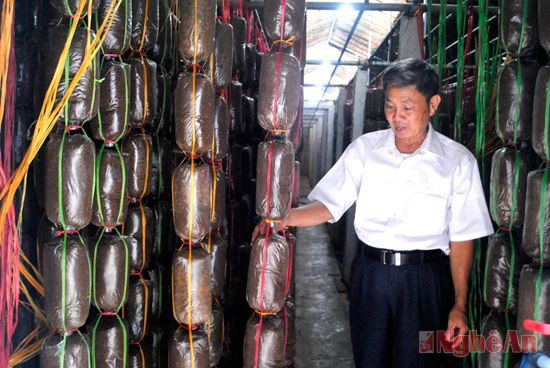 |
| Mr. Le Van Hanh introduces the reishi mushroom production facility. |
- Recently, the trend of using imported reishi mushrooms from South Korea and Japan for disease prevention and treatment has been increasing sharply, while the price of imported reishi mushrooms is high, allowing sellers to make a considerable profit. I thought that to increase economic value, I could also cultivate reishi mushrooms myself. With guidance from my son, a biotechnology engineer specializing in mushroom production, I successfully propagated this mushroom variety myself. In 2014, I produced 6,000 bags of reishi mushrooms for testing, and after 4 months of care, the results exceeded expectations. I harvested 120 kg of dried reishi mushrooms, selling them at 600,000 VND/kg, achieving a revenue of 72 million VND. After deducting expenses, the profit was 3-4 times higher than that of regular edible mushrooms. Reishi mushrooms are very popular in the market; upon hearing that my farm had successfully grown reishi mushrooms, someone in Ha Tinh bought 20 kg. Seeing the positive results, some households in Yen Thanh who had been producing ordinary mushrooms also wanted to grow reishi mushrooms. I sold them the spawn and guided them on how to cultivate them. I hope to have more reishi mushroom farms to create a production area, making it easier to sell the product in the future...
- To date, reishi mushrooms are still considered very difficult to cultivate in Nghe An; could you share your secret?
- Successfully cultivating reishi mushrooms is no easy feat; growers must thoroughly understand the techniques and characteristics of this mushroom species. For example, reishi mushrooms are very sensitive to movement during their growth, so growers must stabilize the mushroom substrate from inoculation to harvest. Microbiological requirements are very high; if the strain is unsuitable, the materials are contaminated, or sterilization is inadequate, failure is very likely. Reishi mushrooms must undergo a process of composting sawdust for over 10 days, using 100% rubber tree sawdust, mixed with lime and DAP fertilizer to disinfect and enhance the mineral content of the mushroom bags. The bags are then sterilized in an autoclave for 18 hours, inoculated with mycelium, and transferred to the cultivation facility. The quality of reishi mushrooms depends on several factors: the strain, the harvesting time, and the post-harvest processing before being marketed. When reishi mushrooms reach maturity, they produce spores, which are a component with very valuable medicinal properties that improve health and fight cancer. However, if the drying process after harvesting is not properly followed, the quality of the mushrooms will be significantly reduced.
- Will your plan to brand Yen Thanh reishi mushrooms as a "miracle cure" be as successful as you believe it to be?
- Success is certain because currently, some countries like South Korea and Japan are focusing heavily on researching and applying medicinal mushrooms and creating many mushroom-based products for sale worldwide. However, imported reishi mushrooms are expensive and their origin is unclear, so high-quality, affordable Vietnamese reishi mushrooms will give people in rural areas the opportunity to use them. My infrastructure and equipment are equipped with advanced technology, ensuring the cultivation of high-quality reishi mushrooms. In this new mushroom season, I will increase the scale of my mushroom production from 6,000 bags of reishi mushroom biomass to over 20,000 bags, plus the production of wood ear mushrooms and oyster mushrooms. I estimate revenue could reach 600-700 million VND/year, providing the capital to invest in the goal of producing high-quality reishi mushroom products.
Thank you for this conversation!
King Tran(Perform)


