
To experience complete joy...
(Baonghean) - October arrives with a whirlwind of emotions. In the cool, crisp autumn breeze, strolling through streets fragrant with the scent of milk flowers, one encounters young couples hand in hand, eagerly searching for the most beautiful locations to capture romantic moments... Suddenly, one wonders about weddings of the past and how they relate to weddings today... How can we ensure that weddings are days of love, and that the wedding season is filled with complete joy?
| RELATED NEWS |
|---|
Traditional weddings
"Our generation belongs to the 'old generation' – that's how Mr. Le Quyet Thang (60 years old) from Hamlet 3, Hung Dao Commune, Hung Nguyen District, puts it. He says that every time he's invited to a wedding, he feels a strange longing for the weddings of the past! Back then, in his village, there was a custom of the bridal procession taking place in the evening. The elders believed that if the bride cried on her wedding day, she wouldn't be embarrassed in front of her neighbors and friends. The bridal procession took place from early evening, followed by a sweet reception with candy, green tea, cigarettes, betel nuts, etc., in the groom's yard until around 9 PM. The youth group usually took care of renting tables and chairs, setting up the wedding tent, receiving guests, decorating the wedding bed, etc. The family took care of the cooking and shopping, with clear assignments: the women prepared the betel nuts, the sisters and mothers went to the market, and the elders supervised any unfinished tasks..."
The young men, in particular, were busy slaughtering pigs from the previous afternoon to ensure they were ready in time for processing into sausages and meatballs… Everyone pitched in, and the whole village was as joyful as during Tet (Vietnamese New Year). Ms. Vo Thi Hong (65 years old) from Nghi Phong, Nghi Loc, recounted: "Weddings in the past were much more modest than they are now, but they were very joyful and full of affection. Ms. Hong got married in 1977, when peace had just been restored. She was a volunteer youth worker and later studied at Hanoi Foreign Language University, so she got married and studied at the same time. Therefore, the wedding was held during the summer in her husband's hometown of Nam Nghia (Nam Dan). Both families were poor, so neighbors, relatives, and the youth union helped with almost everything. Even her wedding dress was bought and given to her by the youth union." The wedding venue consisted of colorful curtains gathered from friends and family, the tables and chairs were borrowed… there weren't even any wedding photos… Back then, weddings didn't have as many invitations as they do now, so being invited was a great honor. People eagerly awaited the day to attend, sometimes even arriving early to chat with the family, making the atmosphere very warm and intimate.
This wedding
I had the opportunity to attend the wedding of the child of a friend who is a leader in a certain industry. The invitation clearly stated: "At 5 PM at the Festival Hall," and I arrived at 4:30 PM hoping to meet some friends and sit together in a friendly atmosphere. I thought I had arrived too early, but upon arrival, I saw guests already standing around, filling both entrances and exits. At exactly 5 PM, as the bride and groom entered the main ceremony room, everyone invited rushed in to find seats (if you were late, there would be no seats left), creating a chaotic atmosphere completely different from the sacredness of a wedding day. The bride and groom went around toasting each table, but looked bewildered, not knowing whose friends the other guests were or who had invited them… When I recounted this story, everyone said: "Weddings are like that now, you just come, eat quickly, and leave, as if you've just completed an obligation."
Mr. Le Xuan Tam (Nam Xuan – Nam Dan), who recently held a wedding for his eldest and only son, said: "In Nam Xuan, a wedding is considered a joyous occasion in a person's life, so people organize it on a grand scale: at least 100 tables of guests, and sometimes 150-200. The number of guests invited depends on the family's circumstances and relationships. Many families who have held large weddings in the city still prepare hundreds of tables of guests when they return to their hometown for a 'celebration.' In my village, for example, the groom's family uses the village's population list to write wedding invitations, to avoid missing anyone! Some people jokingly say: 'It's better to invite the wrong person than to miss someone!' Sometimes, receiving a wedding invitation feels like being 'invited.' It's quite funny!"
That's the parents' opinion, but what about the bride and groom? Nguyen Hoang Anh (from Hung Binh ward, Vinh City), who booked the Saigon - Kim Lien Hotel for her wedding, said: "On our wedding day, my husband and I just want to take lots of photos, then go on a honeymoon trip. We don't pay much attention to inviting guests to the banquet; that's usually decided by both sets of parents. Personally, I still prefer simple, cozy weddings, maybe offering incense and flowers at the square, then taking photos with friends and family from both sides, and then having a light meal at the hotel (maybe just fruit, sweets, and some snacks) to the sound of soothing music. That would be perfect!"
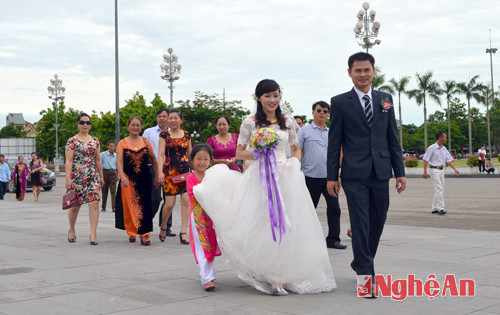 |
| The bride and groom lay flowers at Ho Chi Minh Square (Vinh City). |
Concerns
In recent times, many models of civilized weddings following the new lifestyle have been implemented in the province, contributing positively to building cultural life in the community. However, these models are not numerous, and weddings following the new lifestyle have not received adequate attention. Some officials, Party members, civil servants, and leaders at all levels lack exemplary conduct, still organizing extravagant and wasteful weddings, causing negative public opinion. To overcome these limitations and shortcomings, and to create a strong transformation in implementing a civilized lifestyle in weddings, on September 8, 2014, the Standing Committee of the Provincial Party Committee issued Document No. 3456-CV/TU on strengthening leadership and guidance in implementing a civilized lifestyle in weddings.
In implementing that directive, the Department of Culture, Sports and Tourism has recently coordinated with the Provincial Youth Union to promote weddings according to cultural norms through various forms such as: competitions for the beauty of wedding ceremonies, organizing model weddings, etc. A wedding is considered civilized, dignified, and economical when the invitations are not too extensive, when announcements of the good news are increased, and only those who are truly close and meaningful to the bride, groom, and both families are invited. Traditional attire should be in line with national traditions. In addition, new customs and beautiful traditions should be formed, such as: offering incense and flowers at memorial sites, martyrs' cemeteries, and cultural sites…
In my opinion, marriage is a beautiful cultural tradition that needs to be adapted to suit the conditions of each family and the development of a civilized society, ensuring two principles: respect for the law and conformity with the beautiful customs of the nation, avoiding excessive, hybrid, and awkward forms.
Another wedding season is upon us, and I think families should carefully consider and plan ahead to avoid any negative comments after the wedding. The most important thing is to ensure the wedding is a season of love and beautiful memories in each person's life.
| On September 8, 2014, the Standing Committee of the Nghe An Provincial Party Committee issued Document No. 3456-CV/TU on strengthening leadership and guidance in implementing civilized practices in weddings. Accordingly, it requested Party Committees, Party Groups; provincial-level departments, agencies, and organizations; district, city, and town Party Committees; and subordinate Party Committees to effectively carry out the following tasks: Continue to strictly implement the directives, resolutions, and projects of the Politburo (8th term) and the Standing Committee of the Provincial Party Committee on implementing civilized practices in weddings...; strengthen leadership and guidance for cadres, Party members, civil servants, and public employees, and mobilize all strata of the people to implement civilized practices in weddings; enhance the responsibility of the heads of Party committees and heads of agencies and units in implementing Directive 19-CT/TU of the Standing Committee of the Provincial Party Committee "on implementing civilized practices in weddings for cadres, Party members, and public employees"; Assign responsibility to the head of the unit when individuals violate cultural norms in wedding ceremonies and include this as a criterion for annual performance evaluation; continue to review, improve, and supplement legal documents and regulations... in implementing the Party and State's policies on weddings; strengthen inspection and supervision of the implementation of civilized wedding customs in agencies and units to promptly commend and handle cases of violations. |
Thanh Hien


