
Proposal to eliminate calligraphy and mental arithmetic training.
According to research by a PhD from Hanoi University of Education, practicing beautiful handwriting and quick mental arithmetic only helps children perfect one skill but is very time-consuming; therefore, this content should be removed and replaced with other beneficial parts of the curriculum.
Dr. Vu Thu Huong, a lecturer in the Department of Primary Education at Hanoi Pedagogical University, has dedicated much time to researching primary education. She believes that practicing beautiful handwriting and quick mental arithmetic is a burden for students and should be abandoned because it is time-consuming and not truly useful.
In fact, Ms. Huong noticed that Vietnamese people write beautifully and do mental calculations very quickly. The female doctor believes that, no matter how sloppy her handwriting is, compared to her friends in Europe, her handwriting is still "as beautiful as printed text," and her mental calculation skills would impress them. However, all her friends told her: "We won't study like you; we just need to write correctly and know the principles of arithmetic. If we need accuracy and speed, we use calculators to do calculations and type documents."
Through surveying educational programs in the UK, Germany, Hungary, France, etc., Ms. Huong found that they don't place too much emphasis on mathematics and the mother tongue. First-grade children are taught addition and subtraction within the range of 10 using equipment, and rarely write numbers down. Mathematics from elementary to high school involves very few exercises; theory is the main focus. Therefore, learning mathematics isn't too demanding, and handwriting isn't given much importance either.
European education researchers say that neat handwriting or quick math skills are just the completion of one skill. "It's evident that science subjects like Geography, Biology, Physics, and Chemistry are taught extensively in many countries. Children learn about different cultures, lifestyles, and life skills... This is truly essential because it creates knowledgeable individuals," Ms. Huong said.
In Vietnam, primary school students have limited understanding of the world around them. The authoritarian approach to education and the obsession with academic achievement are deeply ingrained problems in families, from those who are both parents and education officials to other parents. Asking about grades after school is considered a matter of course to show concern for their children.
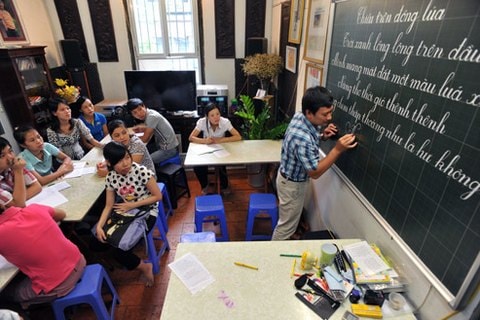 |
| Many calligraphy classes are now popping up and attracting the attention of many parents. |
Even in elementary school grading, neat handwriting is a criterion. Too much time is devoted to practicing beautiful handwriting and quick mental arithmetic. Teachers also place high expectations on students, with handwriting competitions putting immense pressure on them. Those with poor handwriting feel ashamed.
According to Dr. Huong, a serious problem in Vietnamese education is the imbalanced learning approach: too much theory, too few exercises, an overemphasis on Literature and Mathematics, and a neglect of arts, life skills, and cultural values (Biology, History, Geography, etc.). This is evident at all levels, but most clearly at the primary school level. Students have too many Math lessons (5 lessons/week), Vietnamese Language lessons (8 lessons/week), while subjects considered less important only have 1-2 lessons.
Furthermore, the assessment system is highly biased. At the end of the semester, only the scores in Math and Vietnamese are considered to determine whether a student is considered excellent or advanced. Subjects like Social Studies, Art, Music, and Physical Education are merely for show. As a result, teaching these subjects is considered superfluous, leading to a situation where teachers often cut down on these classes to focus on Math and Vietnamese for the children.
"Compared to other countries, I find that the main areas of overload are handwriting practice and quick mental arithmetic. These are two relatively difficult skills, so they take up a lot of teaching time," commented an educator with 20 years of experience training primary school teachers. He suggested that removing these two areas would reduce the pressure on learning Math and Vietnamese. This would allow teachers to respect the learning time allocated to supplementary subjects more, and the quality of learning in those subjects would undoubtedly be much better ensured.
After cutting out unnecessary parts, the Ministry of Education conducts a comprehensive assessment of all subjects. Primary education does not need to be graded as excellent/good/average. Students only need to be promoted to the next grade. The promotion assessment must consider all subjects, including Math, Vietnamese, Natural Sciences - Social Studies, Art, Music, Handicrafts, Physical Education, etc.
Thus, the imbalance in learning will end, teachers will distribute their attention evenly across all subjects, and consequently, students' knowledge will be broader. Families' concern for their children's education will also be more balanced and reasonable. According to Dr. Huong, the next step is for primary education to incorporate life skills and cultural values into its curriculum.
"Handwriting reflects character" doesn't mean that people with bad handwriting are necessarily bad-mannered. While the positive aspects of beautiful handwriting are undeniable, they are just two skills a person possesses, and a slight deficiency won't kill anyone. Therefore, teachers only need to require students to write correctly, neatly, and without confusing different words.
According to VNEXPRESS


