
Khai Long Temple - Preserving the ancient charm
(Baonghean) - On a warm Qingming Festival, we went on a spring excursion to visit Khai Long Temple in Tan Son commune, Do Luong district. About 2 km from Khuon Bridge (National Highway 7), visitors can admire the classic beauty of a rural Central Vietnam countryside, with the temple nestled beside fields and villages, and distant rolling hills.
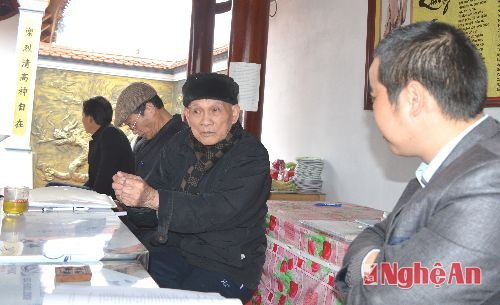 |
| Mr. Dao Cong Than, a "senior elder" of Tan Son commune, is reminiscing about the rich cultural and spiritual activities of the local people associated with the Khai Long temple. |
Our guide on the tour of the temple was Mr. Dao Cong Than, a retired army colonel, now 90 years old but still agile and sharp-minded. Khai Long Temple is currently located in the Boi field.
In front lies the lush green of spring rice paddies stretching all the way to Ong Voi Mountain. Behind, too, are green rice fields, with Cam Thuong hill in the distance. Beside the temple is a village with a dense population, a prosperous countryside.
According to Mr. Than, the Khai Long temple is located beside a stream that carries water from the Van Trang rice fields, so the local people consider it a place that guards the dragon vein, contributing to the peace of the entire countryside.
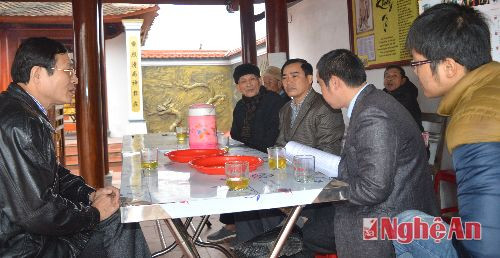 |
| Mr. Tran Nhu Y - Vice Chairman of Tan Son Commune People's Committee (third from the left) said that Khai Long Temple was built during the Late Le Dynasty, dedicated to Ngo Xuong Xi, the son of Ngo Xuong Ngap and grandson of Ngo Quyen. |
According to Mr. Tran Nhu Y, Vice Chairman of the Tan Son Commune People's Committee, based on the records of the former Duy Tan Commune and the rituals and prayers, the Khai Long Temple was built during the Late Le Dynasty, dedicated to Ngo Xuong Xi, the grandson of Ngo Quyen and son of Thien Sach King Ngo Xuong Ngap.
At that time, Ngo Xuong Xi was in charge of the Binh Kieu region, so he was also known as the Binh Kieu Warlord. After the period of turmoil, the Binh Kieu Warlord submitted to Dinh Bo Linh, contributing to helping Dinh Bo Linh (Dinh Tien Hoang) quell the "rebellion of the 12 warlords" and continue to maintain national independence.
According to Mr. Dao Cong Than, when he was growing up, Khai Long Temple hosted five main festivals throughout the year: the Lunar New Year (the first day of Tet), the Opening of the New Year (the seventh day of the first lunar month), the New Rice Festival (the 20th day of the fifth lunar month), the Lower New Year Festival (the fifteenth day of the seventh lunar month), and the Upper New Year Festival. The temple was the venue for many cultural and spiritual activities, as well as traditional cultural events such as traditional opera and folk singing performed by local opera troupes and weaving guilds.
Locals still pass down many stories about the temple's miraculous powers and its role in promoting good and eliminating evil, helping to preserve the temple's customs and traditions. In the past, people passing by Khai Long Temple would remove their hats, and officials had to dismount their horses. For a long time, the temple was a source of pride, closely associated with the image of the homeland and its ancient architecture.
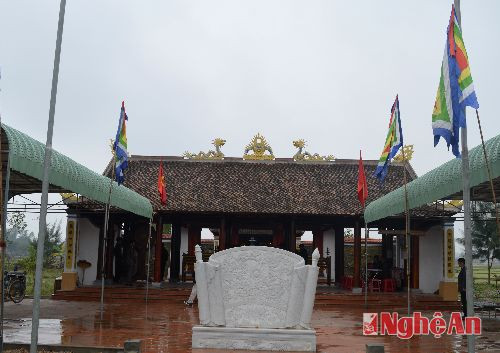 |
| During the 20th century, Khai Long Temple was "evacuated". Since 2014, the temple has been restored through social contributions and has become a cultural and spiritual landmark in the region, along with the revival of many traditional folk cultural activities. |
Mr. Tran Nhu Y, Vice Chairman of the Tan Son Commune People's Committee, said that, having gone through the ups and downs of history, in the last century the Khai Long Temple had to be "evacuated". Thanks to the achievements of the reform process, the lives of the people in the area have become increasingly prosperous, and Tan Son commune has made comprehensive progress.
In 2000, the Party Committee, government, and people of Tan Son commune were among the first three communes nationwide to be awarded the title of Hero of Labor during the đổi mới (renovation) period. At this time, stemming from the legitimate aspirations of generations of Tan Son descendants living everywhere, and based on a proposal from the Tan Son commune and Do Luong district governments, the Department of Culture, Sports and Tourism issued Document No. 1248 dated June 14, 2010, agreeing to the principle of restoring the Khai Long temple.
When the commune decided to mobilize social resources to restore the temple, a voluntary movement calling for donations spread widely. Some families mobilized their children to donate hundreds of millions of dong. Many groups of workers and local people contributed thousands of man-days of labor.
Local residents ceded the land where the temple used to be, covering an area of nearly 7,000 square meters. Within just 14 months of construction, in 2014, an architectural complex comprising three main halls (upper, middle, and lower), along with pillars, was inaugurated.
Since then, many traditional cultural activities have gradually been restored. From 2014 to the present, Khai Long Temple has become one of the cultural activity centers of Tan Son commune, contributing to the "All people unite to build a cultured life in residential areas" movement, becoming a positive cultural and spiritual address contributing to the implementation of the policy of building an advanced cultural life with a strong national identity in the locality.
Text and photos: Tri Duong
| RELATED NEWS |
|---|


