
King Mai Temple - a spiritual tourist destination
(Baonghean) - Mai Hac De, whose real name was Mai Thuc Loan, was born in Ngoc Trung village, Dong Liet commune (now Nam Thai commune, Nam Dan district). In 713, Mai Thuc Loan was part of a group of laborers who went to offer cloth as tribute to Emperor Xuanzong of Tang.
Along the way, the laborers suffered immensely. Being strong, agile, skilled in martial arts, and possessing great talent and ambition, Mai Thúc Loan rallied the laborers to revolt, kill the officials and soldiers escorting the troops, and then together they took an oath, vowing: "We are determined to avenge our country and kill all the invaders to save it," and they all recognized Mai Thúc Loan as their leader. Mai Thúc Loan formed a rebel army, gathering hunters from the surrounding area to strengthen their forces. Choosing Sa Nam as his base showed his foresight, befitting his leadership position, as this location offered both offensive and defensive advantages. Rú Đụn was larger than Rú Vệ, rugged and secluded, surrounded on both sides by the Lam River. He built the Vạn An fortress in what is now Nam Đàn town, housing war elephants, weapons, and reserve food supplies for long-term planning. With a powerful army, a strong base, and the unwavering support of the people, Mai Thúc Loan soon conquered a vast territory. With the country liberated, Mai Thúc Loan was proclaimed King by his army. He led his troops to Vạn An citadel and chose it as the capital. Because the King had dark skin, the people affectionately called him Mai Hắc Đế (Black Emperor Mai).
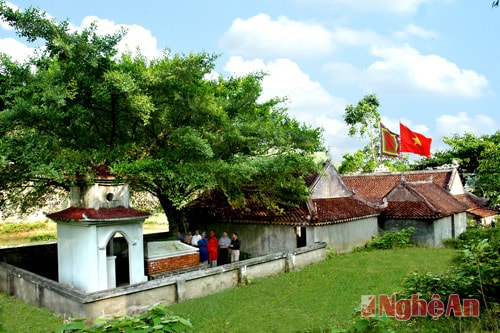 |
| King Mai Temple. Photo: Sy Minh |
After King Mai Hac De's death, the people of Sa Nam (now Nam Dan town) erected temples, mausoleums, and tombs to worship him and his generals. Through the ups and downs of history, the temples, mausoleums, and tombs of King Mai deteriorated and were damaged. In 1990, the Nghe An Department of Culture and Information undertook the restoration and repair of each component of the temple, and in 2005, the Provincial People's Committee continued to invest in its restoration and renovation. Compared to the past, the temple complex is now smaller in scale, but still retains its majestic and ancient beauty within a vast space; it was recognized as a National Historical and Cultural Monument by the Ministry of Culture and Information (now the Ministry of Culture, Sports and Tourism).
The historical site associated with the life and career of Mai Hac De in Nam Dan includes the temple, mausoleum, and tomb of King Mai, his son (Mai Thieu De - Mai Thuc Huy), the tombs of his generals and soldiers (in Van Dien commune), and the tomb of King Mai's mother (in Nam Thai commune). The temple dedicated to King Mai includes a triple-arched gate, the Lower Hall, the Middle Hall, the Upper Hall, the Left Wing, and the Right Wing. Inside the temple are couplets, horizontal plaques, ceremonial artifacts, the royal throne, and statues of generals and ministers, a statue of King Mai... all painted in red and gold, befitting a place of worship for a national hero honored by the people. The mausoleum of King Mai is built right on his tomb, with a shrine on top and two banyan trees over 250 years old on either side. About 300 meters to the right of the mausoleum is the tomb of King Mai's son (Mai Thuc Huy - Mai Thieu De), a general and King Mai's right-hand man in the uprising.
The complex of tombs, mausoleums, and temples dedicated to King Mai is built on the banks of the Lam River. The place of worship and rest for King Mai and his generals is located right in the center of the ancient Van An citadel of the Sa Nam region – where Hung Son (Dun Mountain) forms an arc facing the Lam River, embracing the entire temple complex with its year-round lush forest, creating a beautiful landscape of majestic mountains and rivers, and a poetic scenery. Not far from the temples and mausoleums, on Ru De hill in Ngoc Trung village, Nam Thai commune, lies the tomb of Mrs. Vuong Thi Than, King Mai's mother. This tomb is a small shrine built halfway up the hill, surrounded by a walking path, and can be seen faintly through the trees along National Highway 46. Besides the temples, mausoleums, and tombs of King Mai in Van Dien commune and Sa Nam town, Nam Dan district also has other temples and shrines such as Doc Loi Temple (Nam Giang commune), Chi Thien Temple (Nam Cat commune), and Kha Lam communal house (Nam Thuong commune).
Beyond its historical and cultural value, the complex of King Mai relics in Nam Dan district has become a popular destination for sightseeing and tourism, linked to spiritual culture for visitors from all over. In the minds of the people of Sa Nam region, he manifested himself, becoming a benevolent deity, a saint, and someone to whom they entrust their sacred beliefs. Therefore, even those from this land who work far and wide, whenever they return home, they visit the King Mai Temple to express their gratitude and ask for blessings from King Mai and his generals. Every year on the 15th day of the first lunar month, the people of Nam Dan district organize the King Mai Temple Festival to commemorate the merits of Mai Hac De and his generals. This is a unique way to ensure Mai Hac De's enduring legacy, and it is also a way for future generations to honor the achievements and contributions of the national hero Mai Hac De and his generals to the country.
Mr. Ho Anh Mai, Head of the Culture and Information Department, said: "The King Mai Temple Festival was previously limited to the commune and surrounding areas. Since 1996, it has been elevated to a district-level festival, and in 2005, the People's Committee upgraded it to a regional-level festival. The vibrant activities at the King Mai Temple Festival always attract a large number of people and tourists from all over, who come to participate with the aspiration of connecting with the historical roots of the nation, lighting incense to express their reverence and praying for national peace, prosperity, and happiness for all families. These rituals demonstrate profound spirituality and humanism, with practical actions reflecting the tradition and moral principle of remembering one's roots. The sacredness and faith in the tradition of nation-building and national defense of our ancestors serve as a foundation of belief in the process of building the homeland. This is the unique value hidden within the King Mai Temple Festival." In addition, many important festivals are held annually at the Mai Hac De temple and historical sites: the Lantern Festival on the 15th day of the first lunar month, the commemoration of King Mai on September 16th, the commemoration of Mai Mau on July 4th, and the commemoration of Mai Hoang Hau on July 15th (lunar calendar).
Minh Chi


