
Soft and fragrant Vinh Hoa sticky rice cake
Village at 3 AM
Traveling through Dien Chau district, crossing the Ba Bridge, one's eyes are drawn to a prosperous village, with its towering church, spacious houses, and the bustling atmosphere of commerce along both sides of Provincial Road 38. Vinh Hoa Catholic village is located at the "frontier" of Yen Thanh district, an ancient land associated with the names Con Bi and Chua Bi, with a history dating back to the Late Le Dynasty. According to the renowned scholar Phan Thuc Truc, this was the "waterlogged heartland of the Eastern citadel, with many mangrove and water coconut trees growing in clumps, where the Tam Toa Temple and But Pagoda are located." Through many historical ups and downs, the low-lying, flood-prone Chua Bi area became a settlement for Catholics in Dien Chau, Quynh Luu, and Yen Thanh districts. As a low-lying, flood-prone area, the people of Vinh Hoa have to struggle with various trades to make a living, including the processing of rice-based cakes.
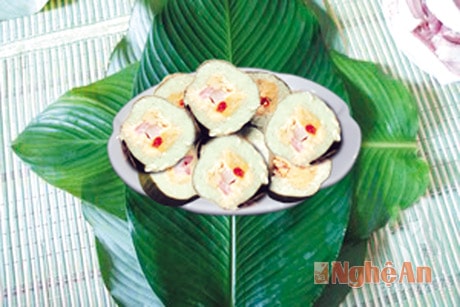
Many say that the craft of making Vinh Hoa sticky rice cakes (banh chung) was "born" from the late Mr. Hien. From the time of the resistance against the French, at his tea stall, Mr. Hien's sticky rice cakes were famous for their delicious taste, known to many passersby. Later, during the time of Mrs. Lanh, Mrs. Ton, and others, all of whom have now passed away. With this craft established, many people in Vinh Hoa village eagerly followed suit, selling their sticky rice cakes (banh chung and banh tet) in markets throughout and outside Yen Thanh district. From then on, Vinh Hoa sticky rice cakes became famous far and wide for their sweet, chewy texture from the beans and glutinous rice, the green color of the banana leaves, the rich flavor of the pork, and the aroma of chili peppers, onions, and other spices.
Stopping at a small roadside stall selling sticky rice cakes (bánh chưng), the young, friendly owner cheerfully invited customers to sample a piece. In the chilly weather of the year-end, biting into the cake, one could feel spring and reunion drawing near. Along a short stretch of Highway 38, passing through the village, there were 7-8 houses both producing and selling sticky rice cakes and peanut candy. Customers varied widely, from women carrying fish sauce and salt from Dien Chau and Quynh Luu to sell in the highlands, stopping by for a sticky rice cake, a piece of peanut candy, and a sip of tea to regain strength for their long journey, to people in cars buying them to take to Vinh, or even Hanoi as precious gifts from their hometown. The sticky rice cakes here were quite cheap, only 25,000 dong per pair, whereas in Vinh they would cost 35-40,000 dong. The cake is firm and dense, and as Phan Duc Hanh (owner of Hanh Tinh cake production facility) proudly describes it, it's "hard inside, soft," meaning the cake is "hard" but still pliable and soft, and doesn't fall apart.
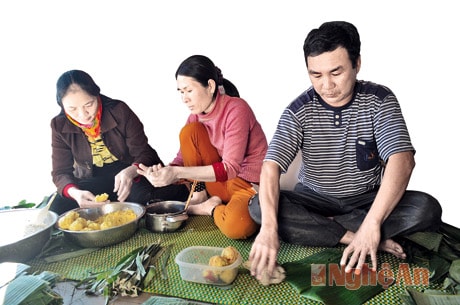 |
| Pham Van Loc's family prepares banana leaves and other ingredients for making banh chung (traditional Vietnamese rice cakes). Photo: NK |
According to many local rice cake makers, there's no special secret to making banh chung (Vietnamese rice cakes) in Vinh Hoa, but it requires putting your heart and soul into it. Mr. Hanh explained: Maintaining a consistent heat and cooking for long enough is crucial for a soft and chewy cake, but the most important factor is the selection of ingredients. Even if it costs more, the glutinous rice must be of the highest quality, ensuring the cake is both soft and firm. Only banana leaves from cultivated plants are used; wild banana leaves are absolutely forbidden as they will make the cake less delicious. In Vinh Hoa, there's a dedicated "team" that goes to the northern communes of Yen Thanh district, such as Quang Thanh, Kim Thanh, Tay Thanh, and even as far as Do Luong, Anh Son, and Tan Ky, to collect these leaves.
The string used to wrap the rice cakes is also sourced by some villagers who travel all the way to Quang Thanh and Duc Thanh to cut and gather it for supply. "Generally, we've formed a whole network supplying all the necessary ingredients. We just focus on making delicious rice cakes, building and maintaining the reputation of Vinh Hoa rice cakes with consumers," Mr. Hanh proudly stated. Most notably, the rice cakes sold here are never kept for more than two days. Every household carefully plans the amount of cakes sold each day to avoid making excess, even though the cakes could last for several days in this cold weather. But every household accepts losses on days when sales are slow to maintain the village's brand, rather than deceiving customers.
Arriving in Vinh Hoa on the last day of the year, a bustling, cheerful, and lively atmosphere was evident in every alley and every corner of the people's homes. In his spacious house, still smelling of fresh paint, Mr. Pham Van Loc (52 years old) nimbly used a knife to split bamboo strips while meticulously wiping clean the banana leaves that had been carefully cut and arranged in layers in the middle of the house with a damp cloth. Outside, his wife carefully stirred the steamed mung beans in a pot, then swiftly tore banana leaves, using a small bowl to scoop rice and meat to wrap the sticky rice cakes (banh chung). Mr. Loc confided that his grandfather and father had been making banh chung since their time. His grandmother and mother used to carry the cakes on their backs, cycling to Do Luong district, to Cho Dung, Cho Rang, and even up to Anh Son district to sell them. In times of poverty, those pots of banh chung sustained his entire family.
From the age of five, Mr. Loc knew how to select banana leaves, strip banana leaves, split bamboo strips, and wrap banh chung and banh tet (traditional Vietnamese rice cakes). After growing up and starting a family, he continued the family trade. His wife, from a neighboring village, also learned the craft of making and selling these cakes at the market. Their work schedule begins at 3 a.m., before the rooster even crows. They get up to drain the cakes, load them onto their carrying poles, and start selling them at the market at 4 a.m. For families who travel further to markets in Hoang Mai, Quynh Luu, Thanh Chuong, and Anh Son, they have to leave an hour earlier. While the wives take the cakes to the market, the men in Vinh Hoa stay home, taking care of the children's meals before they go to school and preparing the ingredients for the afternoon's cake-making session.
 |
Around 2 PM is the busiest time of day in Vinh Hoa. This is when the whole village gathers to wrap banh chung (traditional Vietnamese rice cakes). From children after school to the elderly, young people, and women, everyone pitches in. Some prepare the leaves, others grind the rice, split the bamboo strips, wrap the cakes, light the stoves, and change the water. The sounds of slicing meat, chopping onions, and grinding flour blend with the lively chatter of people calling out to each other, asking about the morning market, and the cheerful music of Christmas songs, making Vinh Hoa as vibrant as any city. Life in Vinh Hoa continues through the night, when the pots of banh chung are placed on the stoves, boiling vigorously and emitting thick smoke. Around 3-4 AM, the entire village of Vinh Hoa wakes up, its lights shining brightly like day. Cars and motorbikes arrive in droves to pick up the cakes to distribute them far and wide. Because of this, for the past few years, Vinh Hoa has also been known as the "3 AM Village."
Bringing spring to every corner.
The people of Vinh Hoa never worry about unemployment because their brand of banh chung and banh tet (traditional Vietnamese rice cakes) is well-known. For many years, Vinh Hoa's cakes have been sold throughout Vietnam, from the South to the North, and even in neighboring Laos. Especially during the end of the year, when Tet (Vietnamese New Year) approaches, the whole village becomes a bustling, noisy factory. People work day and night to meet customer orders. Each family produces 8-9 quintals of high-quality glutinous rice along with a large quantity of mung beans, pork belly, onions, garlic, chili peppers, and black pepper. Last Tet, Mr. Loc's family made 3,000 pairs of banh chung, and they expect orders to increase this year as well. “In the past, Vinh Hoa's banh chung and banh tet (traditional Vietnamese rice cakes) helped villagers escape poverty, but nowadays, making these cakes for Tet (Vietnamese New Year) is no longer simply a means of livelihood. For us, it's a custom, a tradition of springtime. We produce a product that is both simple and sacred, the soul of the nation during Tet, so wrapping the banh chung to serve our neighbors during Tet requires much more care and attention than before,” shared Ms. Nguyen Thi Xuan, a resident of Vinh Hoa hamlet.
Normally, Mrs. Phan Thi Binh's family, with 30 years of experience making banh chung (traditional Vietnamese rice cakes), only has five stoves. However, in the days leading up to Tet (Vietnamese Lunar New Year), she has to add several more makeshift stoves, with glowing charcoal burning day and night, and military-style pots that can hold up to 70 pairs of banh chung boiling vigorously. Through these banh chung and banh muot (another type of Vietnamese rice cake), she has raised five sons, all of whom are working abroad. On normal days, she makes the cakes herself, selling them at Hop Thanh market with the help of her daughters-in-law. But from around the 27th of Tet onwards, when orders pour in, her three daughters-in-law come to stay at her house. The three of them take turns working continuously from morning to night, and from night to morning, until the afternoon of the 30th, before finally resting to prepare for Tet. For decades now, Mrs. Binh has been a constant presence at the market. “My children have grown up, and we no longer lack money. They all want me to rest, but I can’t give up this profession,” Mrs. Binh shared. Like many people in this Catholic neighborhood, these small sticky rice cakes are not only a lifeline during their hard work, but have become a part of their love, their soul, their bond, their shared community spirit, and a unique characteristic of their homeland that is not easily abandoned or forgotten.
According to Mr. Luu Duc Bang, head of Vinh Hoa hamlet, almost all of the 320 households in the hamlet follow traditional crafts such as making banh chung (sticky rice cakes), banh da (rice crackers), banh it (sticky rice cakes), banh cuon (rolled rice cakes), and banh muot (steamed rice cakes). Currently, only 17 households remain poor, while many others are well-off or wealthy, having established companies selling goods produced by the local people. Thanks to the dynamism and hard work of generations of people, Vinh Hoa banh chung has become a well-known brand, found everywhere from small rural markets to bustling commercial areas in Hanoi and Saigon. From the rice grown in the low-lying delta region, under the meticulous, skillful hands and hard work of the people here, Vinh Hoa banh chung and banh tet (sticky rice cakes) have found their way into many families, bringing with them the spirit of spring, the flavor of traditional Tet (Lunar New Year), and the genuine affection of the people of this rice-growing countryside.
Leading us to see families making traditional rice cakes and then around to the parish church, Mr. Hoang The Nhan – Vice Chairman of the Pastoral Council of Vinh Hoa Parish – shared that it is thanks to the rice cake that the people of Vinh Hoa are changing every day. Vinh Hoa children are able to go to school, study at colleges and universities, and the people are working together to build national unity, loving and cherishing God and their country. As a result, the once poor and ancient village has now become a prosperous, peaceful, and thriving area.
Meanwhile, Mr. Hoang Van Ly, Chairman of the People's Committee of Hop Thanh commune, jokingly remarked that in Vinh Hoa, almost every day is Tet (Vietnamese New Year), and every season is spring. The skillful hands and family secrets of the people of Vinh Hoa are breathing life into banh chung and banh tet (traditional Vietnamese rice cakes), bringing Tet to every corner.
Nguyen Khoa - Phu Huong


