
Leading the movement to build new rural areas.
(Baonghean)Flower gardens and ornamental plants awaiting Tet (Lunar New Year), green vegetable fields producing safe produce, high-quality rice production belts, organic poultry farming programs, invested canals and ditches, hardened concrete roads, clean water reaching villages… this is the picture of the new rural areas of Vinh City after 2 years of implementing the new rural development program.
In Nghi Kim, Nghi An, and Nghi Lien during the last days of the year, farmers are busily pouring concrete and building greenhouses in preparation for planting clean vegetables. Flower villages in Hung Dong, Nghi An, Dong Vinh… are lighting lamps to heat the flowers and encourage faster blooming. Figures are bent over diligently tending to rows of flowers, onions, and lettuce… The city has seen the emergence of successful models for raising pheasants, black velvet ferrets, and seahorses. Fields that were once left fallow are now lush green with vegetables, corn, and rice.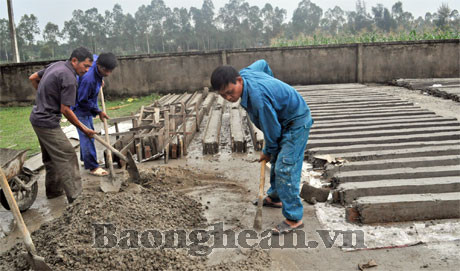
Farmers in Nghi An pour concrete to build greenhouses for growing clean vegetables.
Mr. Nguyen Van Quyen, Head of the Agriculture Department of Nghi Kim commune, took us to visit the safe vegetable fields produced according to VietGAP standards. The fields were a vibrant green, with various vegetables grown by the farmers in preparation for Tet (Lunar New Year). Eighty-five households registered to grow safe vegetables, receiving support from the city. Some families have up to 4 sao (approximately 0.4 hectares) like Ms. Nguyen Thi Thanh, and 3 sao like Mr. Duong Van Toan and Mr. Duong Dinh Tuu… Ten families registered to build greenhouses with a total area of 8,060 square meters. Farmers are shifting from protecting vegetables from pests by direct spraying to preventative measures, which involve soil treatment and the use of organic biological fertilizers.
In Nghi An, the two clean vegetable fields of Kim Binh and Kim Tan are also "transforming" into safe vegetable production with the support of science, technology, and city policies. The Kim Chi ornamental plant village has begun to bustle with activity, with flowers starting to bloom to welcome spring. Many households have built properties worth billions of dong from ornamental plants.
Besides growing flowers and vegetables, Nghi An has also built a kindergarten worth 5 billion VND, a multi-functional school building for the secondary school worth 1.6 billion VND, completed over 3 km of asphalt roads with a total estimated cost of over 5 billion VND, and installed a lighting system on National Highway 46 to Nghi Trung with an investment of 3.7 billion VND. Nghi An is preparing to invest in building the Kim Chi flower and ornamental plant market, the Kim Chi craft village road, and installing a lighting system on National Highway 46 to Nghi Truong, and the Duc Thiet to Nghi Truong road, which is 1.2 km long…
Vinh City is a first-class urban area, but it still has 9 suburban communes where the lives of most people depend on agriculture. In recent years, due to urbanization, land has been left fallow or developed into urban areas, but this has also brought social problems and the risk of unemployment. Therefore, building new rural areas in Vinh City aims to help the city develop sustainably.
Besides indicators related to infrastructure, education, and security, production and job creation are crucial criteria for demonstrating the practicality of this policy. A plan for developing suburban agriculture has been developed and approved by the City People's Committee; communes are proceeding with the development of production plans to increase people's income. Currently, all 9 communes have completed their agricultural production and income-generating plans (in intensive farming areas), aligning with the city's objectives.
The city has planned a safe vegetable production area of 370 hectares. This includes 120 hectares in Hung Dong commune, 80 hectares in Nghi Kim, 80 hectares in Nghi An, 80 hectares in Nghi Lien, and 10 hectares in Dong Vinh. These planned safe vegetable production areas are implementing programs to expand production linked to product consumption and to build the VietGAP safe vegetable brand of Vinh City. In addition, a flower and ornamental plant production area is planned for 260 hectares, including 45 hectares in Hung Dong commune, 100 hectares in Nghi An, 55 hectares in Nghi Lien, 50 hectares in Nghi Kim, and 10 hectares in Dong Vinh. Based on the results of developing industries, trades, and villages specializing in flowers and ornamental plants, as well as market demand and the production experience of the people, the city has organized vocational training courses for farmers. In particular, we are collaborating with the North Central Agricultural Science and Technology Institute in transferring scientific and technological advancements into production, such as the high-quality chrysanthemum model, and preparing to build the Nghi An wholesale market for flowers and ornamental plants.
A 400-hectare high-quality rice production area has been planned in Hung Hoa, Hung Chinh, Nghi Lien, and Nghi Kim communes, expanding the application of high-quality rice varieties in production to increase income per unit area. The city has implemented various mechanisms and policies to support people in this endeavor, such as Decision 05/2012, and collaborated with businesses and scientific institutions in the supply and management of seeds.
The planned aquaculture area covers 245 hectares, including 105 hectares in Hung Hoa, 50 hectares in Hung Loc, 60 hectares in Nghi Kim, and 30 hectares in Hung Chinh. Based on successful aquaculture models in Hung Hoa, Hung Chinh, etc., the city continues to direct the expansion of production of specialty aquatic products such as striped catfish, spotted catfish, and sea bass. Policies supporting people in investing in ponds and initial breeding stock create stable production areas.
The planned area for short-term industrial crops covers 500 hectares in Nghi An, Nghi Duc, Nghi Lien, and Nghi Kim districts, primarily focusing on peanuts and sesame, applying new and improved varieties and cultivation techniques to achieve yields exceeding 30 quintals/hectare, such as L144, L20, and TB 25…
Livestock and poultry farming areas are focused on clean, concentrated production, with 350,000 poultry and 22,000 pigs in the communes of Hung Hoa, Nghi An, Nghi Kim, Nghi Lien, and Hung Chinh. Over the past two years, the city has successfully implemented a program to reduce poverty through organic chicken farming across nine communes, including Vinh Tan, Hung Loc, Hung Dong, and Hung Yen. The city provides 50% of the feed costs, totaling nearly 700 million VND.
In 2011 and 2012, Vinh City constructed many important socio-economic infrastructure projects under the New Rural Development program. These included inter-communal roads, irrigation canals serving agricultural production, village cultural centers, and schools meeting national standards. The total number of planned projects was 145, of which 73 have been completed or are underway, including 31 transportation projects, 22 irrigation projects, 5 cultural centers, 8 schools, and 1 market. The total value of completed construction was 164,249.8 million VND, of which: 7,843 million VND was paid by the central and provincial budgets; 72,968.6 million VND by the city budget; and 72,820 million VND by the commune budgets. The city's residents contributed 7,618 million VND to the construction of new rural areas, averaging 846 million VND per commune and 570,000 VND per household.
As a result of two years of joint efforts to build new rural areas, two communes, Nghi Lien and Hung Loc, achieved 13 to 16 criteria; Hung Chinh, Nghi Kim, Hung Hoa, and Nghi Phu achieved 10 to 12 criteria; and Nghi Duc and Nghi An achieved 5 to 9 criteria.
From improved economic models and infrastructure, to the public's awareness of protecting public property and ensuring security and order, and the effective implementation of integrated programs and projects linked to the city's policies, Vinh City has proven to be the leading locality in the province in terms of new rural development indicators. This is an advantage stemming from the city's resources and the people's efforts, but it also presents further challenges for Vinh City's rural areas to differentiate themselves from those of the midland and mountainous districts, and to achieve sustainable development.
Chau Lan


