
Historical and Cultural Relic of Ba But Pagoda
Situated in a lush, beautiful, and auspicious area, with the picturesque, clear, and winding Lam River in front and the majestic Hoi Mountain behind, forming a solid defensive wall, this is the land where King Uy Minh Ly Nhat Quang chose to establish his administrative center during his time as the governor of Nghe An. There stands a sacred temple that has endured through time, its official name being Tien Tich Tu, but commonly known by the locals as Ba But Temple.
Ba But Pagoda is located in Thuong Tho village, Bach Ngoc commune, Do Luong district, Anh Son prefecture (now Lam Son commune, Do Luong district, Nghe An province). Originally, Ba But Pagoda covered an area of about 10 acres, including structures such as: courtyards, lotus ponds, a triple gate, a rest house, a boathouse, a front hall, and a main hall. Lush greenery surrounded the area in a tranquil setting amidst picturesque mountains and rivers, yet it was not completely isolated from the outside world.
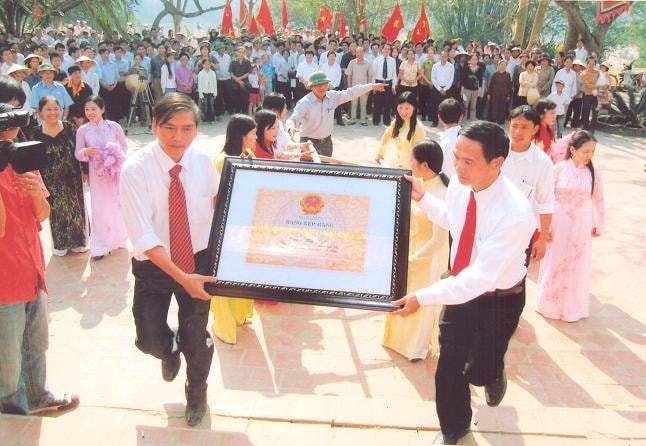 |
Ceremony to receive the certificate recognizing Ba But Pagoda as a Historical and Cultural relic. |
Having endured numerous historical events, harsh natural disasters, and devastating wars, the temple's structures are no longer as complete as they once were. Currently, only some elements remain, such as the temple garden, courtyard, front hall, and main sanctuary. In recent years, the local people have added the Hữu Vu house (a guesthouse located west of the temple courtyard).
The temple still preserves many artifacts such as bronze bells, couplets, large inscriptions, plaques, signatures, and many Buddha statues. These are valuable documents and artifacts, especially the ancient statue of the Goddess of Mercy. In addition, the front hall and the main hall are decorated with intricate carvings on various parts such as the beam ends, brackets, and rafters, featuring rich and diverse carvings...
According to legends and historical records, during the time when Ly Nhat Quang (the eighth son of King Ly Thai To) was appointed Governor of Nghe An, he organized land reclamation, construction, and economic development. The Bodhisattva Quan Am at Ba But Pagoda helped Ly Nhat Quang to experience many favorable circumstances and good fortune.
During his conquest of Champa, Ly Nhat Quang received divine assistance from the Bodhisattva Quan Am, helping him to victory. Legend says that Ly Nhat Quang, while fighting against the Lao Qua rebels, was severely wounded. Upon returning to Bach Duong, near Thuong Tho (now Lam Son commune), a fairy (from Tien Tich Temple) informed him: "Qua Son is a sacred place; one can be reborn there for generations."
Following the fairy's advice, he returned to Quả Sơn and passed away. The officials then built a tomb and a temple on Quả Sơn. Therefore, every year on the 20th of January, there is a tradition of "welcoming spring," carrying the statue of Lý Nhật Quang from Quả Sơn Temple to Bà Bụt Pagoda for a grand thanksgiving ceremony. This thanksgiving ceremony is one of the largest part of the festival, attracting many dignitaries, local people, and tourists from all over...
The thanksgiving ceremony at the temple takes place every two years on the 20th and 21st of the first lunar month. The thanksgiving ceremony at Ba But Temple has its own unique characteristics and long-standing tradition. This cultural activity is meaningful, serving as an opportunity to recall the glorious traditions of our ancestors and to demonstrate the people's moral principle of "drinking water, remembering the source." Furthermore, Ba But Temple has witnessed many other important historical events related to the locality during the two resistance wars.
Every month, on the auspicious days of the lunar calendar, the full moon days, and the Buddha's Birthday celebration in the spring, Ba But Pagoda attracts a large number of local people and tourists from all over. With its historical values and significance, Ba But Pagoda has been recognized as a historical and cultural relic by the People's Committee of Nghe An province, providing the legal basis for its preservation and promotion.
Nguyen Trong Cuong


