
Translator Nguyen Duy Binh: A man who doesn't "halfway"
(Baonghean) - After completing his doctoral dissertation in France, Nguyen Duy Binh received an invitation to teach at the University of Leuven in Belgium, and had the opportunity to work in Hanoi, Hue, Ho Chi Minh City... but Binh chose to return and stay in his homeland; despite the limitations in the use of French and the position of translated literature in the country in general and Nghe An in particular…
(Baonghean) - After completing his doctoral dissertation in France, Nguyen Duy Binh received an invitation to teach at the University of Leuven in Belgium, and had the opportunity to work in Hanoi, Hue, Ho Chi Minh City... but Binh chose to return and stay in his homeland; despite the limitations in the use of French and the position of translated literature in the country in general and Nghe An in particular…
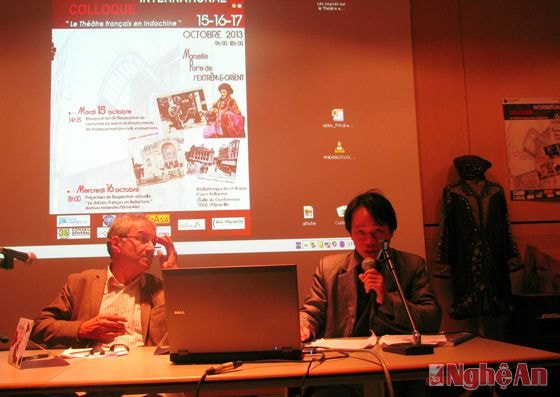 |
| Nguyen Duy Binh (right) at the French Drama in Indochina Workshop (held in France, 2013). |
Go away to come back.
Nguyen Duy Binh has been passionate about Literature and French since childhood, a passion that has grown stronger and stronger, becoming the motivation for him to overcome all difficulties and obstacles. He is from Thanh Phong commune (Thanh Chuong district), and has never been there before.
 |
| Translator: Nguyen Duy Binh |
Throughout his high school years, Bình single-handedly managed cooking, laundry, and battling hunger, yet every year he achieved top honors in French and Literature at the provincial level. In 1991, his Literature teacher, Nguyen The Quang, cycled from Dung to Vinh City to submit Bình's poem "The Teacher's Bicycle" to the Nghe An newspaper. Meanwhile, his homeroom teacher, Nguyen Huu Quyen, who wholeheartedly supported and encouraged Duy Bình throughout his studies, would read aloud to the entire school whenever his favorite student wrote a good poem.
Having passed the entrance exam to Hue University of Education, Binh consistently excelled as a student in the French language department. In 1995, Binh participated in a French language competition organized by the French Embassy and became one of the top five contestants nationwide to win a scholarship to study in France for two months (from July to September 1995). Binh's love for the French language and his success were celebrated in an article dedicated to him by the newspaper Ouest France. In his third year of university, Binh was already an officer in charge of French language majors sponsored by the Aulpelf-Uref organization: he participated in organizing French language extracurricular activities for students majoring in French at Hue University. In 1997, immediately after graduation, Nguyen Duy Binh was hired as an assistant to Mr. Jean-Pierre Raveneau, Director of the Hue French Language Center, under the French Embassy in Hanoi. In 1999, Duy Binh continued to win first prize in the literary translation competition organized by the French Embassy. This success further fueled his desire to explore the world of French literature right in the homeland of great authors such as Molière, Victor Hugo, Alexandre Dumas, Albert Camus, and others.
With that success, Duy Binh was awarded a scholarship by the French government to pursue a master's degree at Aix-Marseille 1 University, France. Duy Binh recounted that after completing his first year of master's studies and returning to Vietnam, he was invited to lecture at Vinh University and later became a full-time lecturer. At that time, his wife was unemployed, and the lecturer's salary was meager. To earn money to pay for tuition to continue his doctoral studies in France, he had to tutor students every night. After defending his doctoral dissertation in France, Professor José Lambert, a member of the dissertation review team, invited him to teach at the University of Leuven (Belgium), but Duy Binh chose to return to Vietnam. Hue University always welcomed Nguyen Duy Binh back, and Hanoi National University had decided to accept him as a full-time lecturer in the International Faculty; however, his hometown of Nghe An was where Duy Binh chose to return.
Perseverance and passion
From his time as a student in the French Department, Nguyen Duy Binh embarked on a career in translation. His most memorable early experiences included collaborating with Jean-Pierre Raveneau to translate Trinh Cong Son's songs such as "Let the Wind Carry It Away," "Sea of Memories," and "A Realm to Return To." While working at the Hue French Language Center, Duy Binh actively participated in organizing Trinh Cong Son's music nights in French. On one occasion, when Trinh Cong Son visited Hue, Duy Binh and Jean-Pierre Raveneau met him at the Saigon Morin Hotel. Trinh Cong Son was delighted to hear his familiar songs translated into French. With the enthusiastic support of talented and dedicated teachers such as translator Buu Y (Hue University of Education), Inès Oséki-Depré, Alain Guillemin, and Trinh Van Thao (Aix-Marseille 1 University), Nguyen Duy Binh had the opportunity to systematically and thoroughly study French-Vietnamese literary translation.
Thanks to his fluent French, broad and up-to-date knowledge, and numerous reputable scientific connections, Nguyen Duy Binh, despite being at Vinh University, is able to "globalize" his research and translation work. While teaching, supervising master's theses, and holding positions such as Vice-Director and Director of the Institute of Culture and Language at Vinh University; and Deputy Director and Head of the Editorial Board of Vinh University Publishing House, he still actively participates in translation and contributes to international scientific conferences on literary exchange.
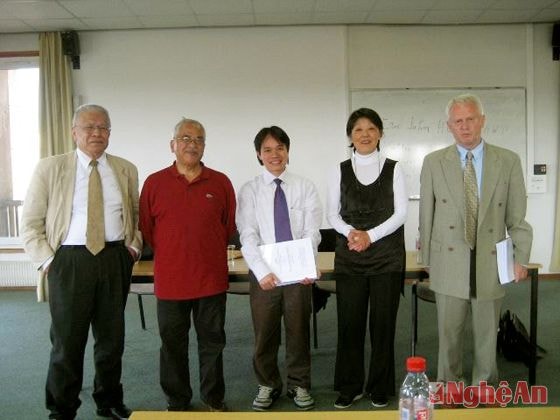 |
| Nguyen Duy Binh (center) with professors at his doctoral thesis defense in France (2008) |
Despite earning his master's and doctoral degrees in France and attending at least eight study trips and conferences in Europe, Nguyen Duy Binh, along with his wife and two children, still lives in his wife's parents' small apartment in Block 12, Quan Bau Ward (Vinh City). From the outside, few would guess that the man who commutes daily from his apartment to Vinh University on his old motorbike is making a significant mark in the field of translated literature with six novels: *Gray Souls* (Philippe Claudel, Women's Publishing House, 2008), *The Promise at Dawn* (Romain, Literature Publishing House, 2009), *The Garden of Love* (Marcus Malte, Literature Publishing House, 2010), *The Fall of Rome* (Jérômme Ferrari, Literature Publishing House, 2013), *Nam and Sylvie* (Pham Duy Khiem), and *See You Up There* (Pierre Lemaître)...
Among his works, two of his translated novels have been used by students as topics for master's theses in literature. In addition, he has collaborated on the translation and publication of numerous short stories, poems, and literary research papers from French into Vietnamese for many newspapers and magazines both domestically and internationally. Translator Nguyen Duy Binh is a familiar face in interviews about the field of literary translation in contemporary literary life in newspapers and magazines such as Van Nghe Tre, Tia Sang, Thanh Nien, and Tuoi Tre... When we visited his home, Nguyen Duy Binh was working on translating short story collections by Nguyen Vinh Nguyen and poetry by Nguyen Huu Hong Minh into French.
Despite his deep understanding of the difficulties and hardships of the translation profession, Nguyen Duy Binh remained steadfast in his chosen work. In his essay on literature and translation titled "Halfway Through Babel" (Vinh University Publishing House, 2014), he reflects: "I looked up at the Tower of Babel and saw the shadow of the Other. I looked halfway up and caught a glimpse of the Other. I am a weak pack horse struggling to carry the burden of literary ambition and trudging to the top of the tower to witness the potential existence of the Other in the absence of myself. I erased my own shadow with words written in blurriness."
"I saw the Tower of Babel shrinking and transforming into an ivory tower for me to take shelter in." In the Bible, the Tower of Babel was built by people who came after the great flood, with the aspiration that its peak would reach heaven. Fearing that there would be only one people and one language on earth, and that building the tower to the top would be within their reach if they were determined, Jehovah and the angels confused the languages of mankind and scattered them across the earth. From then on, people were divided, languages diverged, people did not understand each other, and the Tower of Babel was never completed, remaining unfinished. This places the mission of translators on the task of continuing to "crawl up to the top of the tower," climbing the tower and building it—a truly difficult task! In "Halfway to Babel," Duy Binh only identifies himself as "a weak pack horse struggling to carry the fervent ambition of literature," a humble yet resolute way of speaking, knowing the difficulties but not giving up.
At the vibrant age of 40, looking back at what Nguyen Duy Binh has overcome to achieve on the path he has chosen, it is clear that translator Nguyen Duy Binh is not someone who has ever wavered!
Ngo Kien


