
A cultural and spiritual highlight in the heart of the city.
(Baonghean) - Dung Quyet Mountain in Vinh is considered a gem and the green lung of the city. Notably, the Quyet Mountain Forest Park is located within the historical site of Phuong Hoang Trung Do Citadel, where in 1789 Emperor Quang Trung - Nguyen Hue, the outstanding son of Nghe An province, chose to build the capital of Vietnam.
According to legend, in the beginning of time, 100 phoenixes flew to this land. 99 flew to the southern bank of the Lam Giang River, where the 99-peak Hong Linh mountain range was formed. The remaining phoenix stopped on the northern bank, and that is the present-day Dung Quyet – Phuong Hoang mountain. During his great undertaking, the national hero Quang Trung – Nguyen Hue recognized this as a sacred land, a place of auspicious energy, a meeting point for establishing an imperial dynasty. Therefore, after marching north to defeat the 290,000 invading Manchu troops and their puppet Lê and Trịnh lords, Emperor Quang Trung ordered the construction of Phuong Hoang citadel to realize his ambition of establishing a strategic capital on the North-South highway. Today, within the Phuong Hoang – Trung Do historical complex, there are still traces and cultural and spiritual values that Emperor Quang Trung envisioned and created.
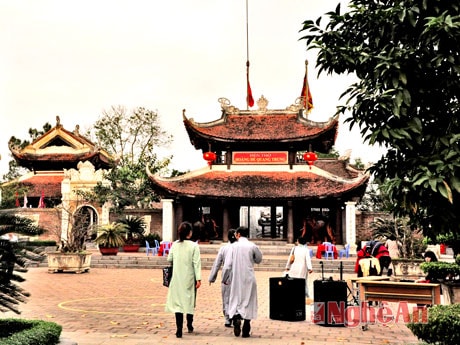 |
| Temple dedicated to Emperor Quang Trung. |
In 2005, the Quang Trung Emperor Temple project was invested in and constructed by the Vinh City People's Committee. The project had a total investment value of nearly 24 billion VND. On May 7, 2008, the Quang Trung Emperor Temple was completed and put into use, coinciding with the 220th anniversary of Phuong Hoang – Trung Do, when Vinh City became a Class 1 urban area. According to Mr. Tran Ngoc Lu, former Director of the Vinh City Cultural Center, who has been involved with the Quang Trung Temple project from its inception to the present day, the biggest goal when the city decided to invest in building the temple was to express gratitude for the immense contributions of the national liberation hero and outstanding political and military leader of the country. Mr. Lu said: “225 years ago, when Emperor Quang Trung chose the sacred land of Phuong Hoang to establish his great empire, and even though his work remains unfinished, his descendants and the people of today have not forgotten his contributions. Building the temple of Emperor Quang Trung on Dung Quyet mountain is fulfilling his wish for a capital city in a land imbued with the sacred energy of rivers and mountains…”
With its distinctive architectural style reminiscent of the Nguyen Dynasty, the entire temple is constructed of ironwood, creating an ancient and majestic appearance. The temple consists of three main sections: the upper, middle, and lower halls. The roof is covered with double-layered curved tiles. The walls are built of brick, and the doors and windows feature a screen-like design with upper and lower panels. The temple has two entrances on either side, and the four-pillar ceremonial gate is designed in a two-story, eight-roofed style. The front hall, considered the center of the temple, is designed in the traditional Vietnamese folk architectural style with three bays and two wings, supported by four rows of columns. The temple not only worships Emperor Quang Trung but also his parents.
Every year, the Quang Trung Emperor Temple becomes a cultural destination for visitors from all over. Here, visitors can experience the solemn and respectful atmosphere of religious belief while immersing themselves in the ecological tourism space amidst the picturesque landscape of one of the most historically significant and sacred places in Nghe An province. Mr. Tran Ngoc Lu said that before 2011, the Quang Trung Emperor Temple – Nguyen Hue attracted an average of 50,000 to 70,000 visitors annually for worship and sightseeing. Since 2011, the number of tourists visiting the temple has more than doubled. Every year on the 5th day of the first lunar month, the Quang Trung Emperor Temple holds a festival commemorating the victory at Ngoc Hoi - Dong Da - the most glorious achievement of Emperor Quang Trung and the Tay Son rebels in the struggle to defend the country in the spring of 1789. This year marks the 225th anniversary of that momentous event, and in Vinh City, the People's Committee and the Management Board of the Quang Trung Emperor Temple have organized many cultural activities to celebrate. Notably, this year, for the first time, the temple is issuing amulet cards to visitors from all over. These amulet cards are believed to be a talisman from Emperor Quang Trung, blessing the people with peace and prosperity, ensuring a year of favorable weather, and providing protection so that everyone can live in peace and prosperity.
On the opening day, thousands of people gathered at the temple, yet remarkably, there was no crowding or pushing. There were also no instances of vendors scrambling to buy or sell offerings. Furthermore, despite the temple dedicated to Emperor Quang Trung being located on the summit of Dung Quyet mountain, 97 meters above sea level, there was ample parking for visitors coming to offer incense and admire the scenery. The temple management also provided free incense for everyone wishing to pay their respects. There were also no beggars or panhandlers, unlike in many other places.
It can be said that, along the Central Vietnam heritage route, the Phuong Hoang - Trung Do complex of relics and the temple of Emperor Quang Trung have become known as a highlight of history, culture, and spirituality that is not found everywhere. And within that colorful space, the temple of Emperor Quang Trung will forever remain a place where the sacred spirit of the mountains and rivers converges for generations.
Peach Blossom Garden


