
A foundation for sustainable poverty alleviation.
(Baonghean) - Thanks to support from the "Cattle Bank" Project of the Vietnam Red Cross Central Committee, many poor people in the mountainous district of Ky Son have gradually risen out of poverty sustainably and improved their lives...
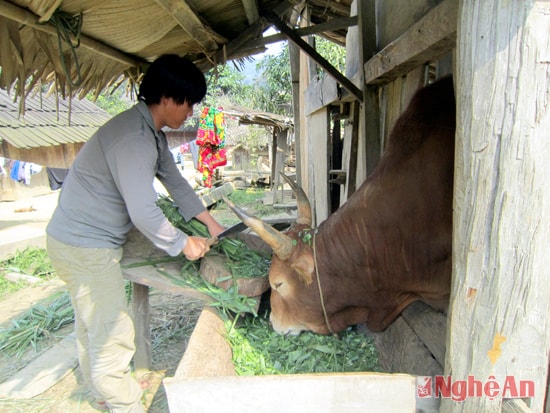 |
| Cattle farming in confinement in Nam Khien village, Nam Can commune (Ky Son district). Photo: Cong Kien |
With 700 million VND in support since 2010, 100 poor households in the two communes of Huu Lap and Bao Nam each received one breeding female calf, valued at 7 million VND. After receiving the directive from higher authorities, the District Red Cross Society assigned local branches to coordinate with the government to directly purchase local breeds suitable for the local climate and weather conditions, easy to care for, and with good growth potential. At the same time, the District Association coordinated with the Department of Agriculture and Rural Development and the Veterinary Station to organize training and provide hands-on technical guidance to the people on livestock farming, animal care, barn construction techniques, and how to detect and treat common diseases. After handing over the calves, the commune authorities guided the people to sign a commitment with the Village Management Board so that the people would be responsible for caring for the calves and fulfilling the project's objectives: when the calves give birth to their first calf, the beneficiary households will raise them for 6 to 12 months and then hand them over to the Red Cross to be transferred to other poor households. After that, they will fully own the calves and continue to care for and expand the herd.
The selection of recipients for the cattle support program was discussed and evaluated openly and democratically, creating high consensus among the people. The households receiving the breeding cattle were enthusiastic and responsible in their care. Thanks to the hard work and diligence of the poor households receiving the cattle, the leadership of the Party committee and government, and the attention of various associations, after four years, the initial 100 breeding cows have produced an additional 80, which have been transferred to 80 other poor households. Of these, 39 are in Huu Lap commune and 41 in Bao Nam commune. The initial cattle provided by the project are being well cared for by the households. Continuing this cycle, the number of breeding cattle will increase, meaning that more and more poor households in difficult circumstances will benefit.
Mr. Chich Pho Van, a Khmu ethnic minority, one of the 12 people in the commune who received breeding cows in 2014, shared: "My family is very poor. There are six of us, and my wife is often ill. Last year, we had to sell a cow to pay for her treatment at the provincial hospital. The whole family's expenses depend on slash-and-burn farming, which only produces one crop a year, and the yield is low. Every year we are short of food and have to rely on government assistance rice, which makes me feel very guilty. This year, receiving a cow from the project, my family has a cow to raise. My hometown has a lot of land and plenty of grass, which is favorable for livestock farming. I'm dedicating land to growing elephant grass to feed the cows, learning more about how to take good care of them, and when the cows give birth, I will give the calves to other poor households." We parted ways with Mr. Van with a firm handshake; in his smile, his eyes shone with faith and hope.
Mr. Hoa Pho Nhun, Vice Chairman of the Ky Son District Red Cross Society, said: "The 'Cattle Bank' project's support is very practical. Besides providing breeding stock and giving people 'fishing rods,' it also teaches them how to fish (providing guidance on livestock farming techniques), thus fostering a sense of responsibility among the people towards the support funds. In particular, the project has helped many families realize that traditional farming methods slow down livestock growth and lead to many diseases; they have switched to a combined farming method of grazing and growing elephant grass for feed, learned how to build shelters for livestock, and learned disease prevention, resulting in higher economic efficiency; the village environment is cleaner, and crops are better protected... And most importantly, people have gradually changed their mindset of waiting and relying on government support, actively exploiting the potential of land and labor to develop the economy and help each other escape poverty..."
Tran Van Duc
Vice Chairman of Ky Son District Party Committee


