
Dien Chau: Providing vocational training that meets the needs of the people and the local community.
(Baonghean) - Based on surveys of people's vocational training needs and the labor demands of local areas, Dien Chau district has oriented vocational training and education accordingly. As a result, most laborers who have completed vocational training have found stable jobs and decent incomes…
The vocational training course on fish fillet processing, implemented by the Dien Chau District Vocational Training Center for 60 students in Dien Ngoc commune, has entered its third month. Currently, the skills of the students have shown significant improvement. Student Thai Thi Hoa, despite having more than two years of experience in fish processing, still finds the training practical because, as she says: “Before, I only worked out of habit, not knowing how to hold a knife to slice fish correctly and quickly… Now, with the training and specific guidance, I have grasped the techniques and skills, so my work efficiency is higher.”
Observing the instructors guiding the women, Ms. Hoang Thi Dung, owner of the Dong Loc seafood processing facility, was very pleased, as most of the trainees in the class were her workers. The fact that the workers were learning and practicing right in the processing plant helped her maintain production levels. The most noticeable effect was that since the training, processing productivity at her family's facility had increased from 3 tons to 5 tons per day, and it also helped her family save on raw materials, preventing fish waste as before. The workers also benefited from increased productivity and higher wages.
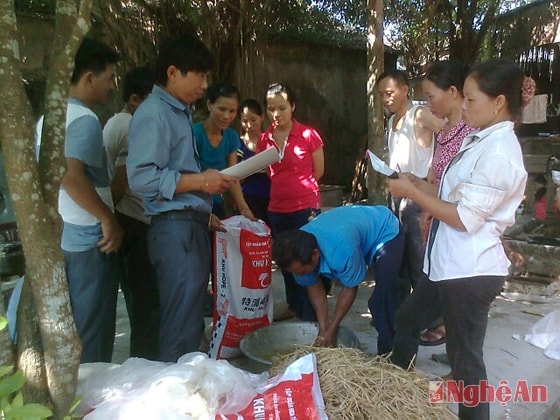 |
| Practical training in animal husbandry and veterinary medicine in Dien Thai commune (Dien Chau district). |
The fish filleting industry is a high-income profession and a newly developed occupation in Dien Chau district in recent years. In Dien Ngoc commune alone, according to Mr. Nguyen Van Hung, Chairman of the Farmers' Association, the fish filleting industry provides employment for over 500 workers per day, with an average income of 150,000 VND per person per day. The fish used is mainly grouper, a seafood with high catch yields, low prices, and year-round demand, ensuring ample work. However, due to a lack of formal training, workers primarily rely on apprenticeship, resulting in low productivity and wasted materials. This is why, during surveys of vocational training needs, many residents in the commune registered to learn how to process fish fillets.
Choosing the right vocational training program that effectively meets both the aspirations of the people and the demands of the labor market is a major concern for the leaders of Dien Chau district in their vocational training efforts. When Project 1956 was implemented, the district established a steering committee with the participation of various departments, agencies, and local authorities. Based on this, vocational training centers and agricultural extension stations were tasked with coordinating with communes and towns to survey the vocational training needs of individual households; from there, plans were developed to teach suitable trades and professions. The district also intensified propaganda efforts through newspapers, radio, television, and other mass media. Simultaneously, free consultations were provided to farmers on vocational training, employment, establishing businesses, farms, and production and business establishments. Information was printed and leaflets were distributed to every residential area. Furthermore, experienced teachers, such as agricultural extension officers and aquaculture engineers, were invited to share their knowledge. For professions requiring modern techniques and practical equipment, teachers from reputable vocational schools in the province are invited to provide direct instruction.
The most noticeable effect is that the trainees are enthusiastic and interested in the lessons, with virtually no dropouts, and the quality of the classes is consistent. Mr. Nguyen Nha Son, Director of the Dien Chau District Vocational Training Center, said: "While a few years ago, the center only opened 10-12 vocational training classes each year, this year it has increased to 45 classes. To meet the aspirations of the people, in 2014, the Vocational Training Center requested an additional quota of 3 classes. Among the various trades, the most effective are tailoring and electrical work. Besides that, agricultural trades such as seafood processing, hotel services, food processing and cooking, and crop cultivation are also developing very well."
The center also pays special attention to creating jobs for its graduates, therefore it always focuses on finding employment opportunities for its students after graduation. Currently, the center is collaborating with many businesses in the area to supply and train labor, such as: Namsung Vina Company of South Korea in the Thap-Hong-Ky Industrial Cluster, Vinh Quang Company in Dien Ngoc, and Dien Hoang Private Production Enterprise. In particular, when job orders become available, the center boldly advises the District People's Committee to provide financial support to facilitate students and promote labor export. Through this approach, nearly 2,000 rural workers have improved their skills and gained access to science and technology. More than 90% of them have found stable employment and income in industrial, handicraft, and service establishments in the district. Others have boldly established businesses and cooperatives, creating jobs for themselves and hundreds of other workers in the region, such as Ms. Nguyen Thi Thom's freshwater fish farming model in Dien Phuc, Mr. Nam's pig farming in Hamlet 3, Dien Thai Commune, and Tung Phuong Company in Dien Phong... The number of people escaping poverty and the number of people with decent incomes are increasing, initially creating a shift in the economic and labor structure in rural areas, contributing to the implementation of the new rural development program of the entire district.
The achievements of Dien Chau district in vocational training in general, and vocational training for rural laborers in particular, have opened a new direction for other localities. The most important thing is to accurately understand the vocational training needs of the people and the locality. Attention must be paid to the quality of training, prioritizing quality over quantity. In addition, to effectively implement vocational training, it requires the involvement of all levels, sectors, and organizations, as well as intensified propaganda and awareness campaigns to gain the support of the people.
My Ha


