(Baonghean.vn) - The mulberry cultivation and silkworm rearing industry in Dien Kim commune (Dien Chau district) flourished most strongly from 1982 to 1990. By 1992, with the loss of the "support system" due to the bankruptcy of the Nghe An Silk and Mulberry Company, the price of cocoons on the market dropped, and the lack of a market for the product caused many households to lose interest in this traditional occupation. However, from the beginning of 2012 until now, the price of silkworm cocoons in the province has increased and there is a stable market, creating motivation for many families to return to the traditional profession; the area under mulberry cultivation has gradually been restored and expanded..
In particular, thanks to the silk and textile value chain development project jointly implemented by the Vietnam Handicraft Export Association (VietCRAFT) and the Vietnam Institute for Rural Industry Research and Development (VIRI), which focuses on supporting mulberry growers and silkworm breeders, the Dien Kim silk and mulberry village has been revived...
As one of the three communes in Nghe An province benefiting from the project, Dien Kim received support including a mini silkworm reeling machine with 16 threads, 1 kg of VH13 mulberry seeds, and participated in training courses on mulberry tree cultivation and silkworm rearing techniques. The project was implemented over a period of three years, from 2013 to 2016.
According to Mr. Nguyen Van Truong, Chairman of the Fatherland Front Committee of Dien Kim commune: Since 2010, with positive signs in the mulberry market throughout the province, and in line with the policy of restoring and developing the traditional mulberry cultivation and silkworm farming industry of Dien Chau district, the 20th Party Congress of the commune issued a Resolution to restore and develop the traditional mulberry cultivation and silkworm farming industry.
Following the land conversion under Directive 08, the commune has implemented zoning and planning for concentrated mulberry cultivation areas; at the same time, it has converted low-yield arable land to mulberry cultivation and expanded the area from 40 hectares in 2010 to 65 hectares in 2014...
Currently, all the cocoons and silk produced are sold as soon as they are made. The key to increasing the economic efficiency of the Dien Kim silk industry is for people to boldly invest in the new VH13 mulberry variety to replace the local variety, and to apply techniques and methods to increase breeding capacity and cocoon quality.
Here are some images of the mulberry cultivation and silkworm farming village in Dien Kim commune:
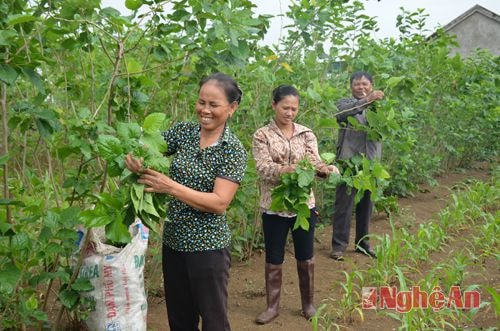 |
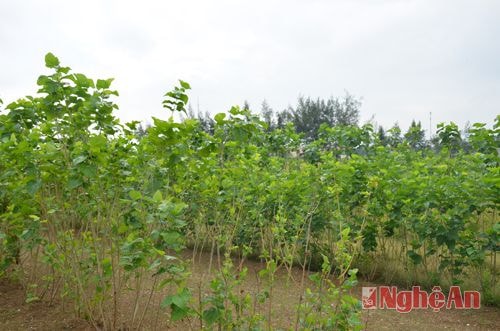
| Ms. Nguyen Thi Tinh's family (in Hoang Chau hamlet) has invested in planting 4 sao (approximately 0.4 hectares) of VH 13 mulberry variety, replacing the local variety (Ha Bac mulberry). This new mulberry variety yields 450-500 kg of leaves per sao, 2-3 times higher than the local variety... According to Ms. Tinh: Mulberry trees can be grown in many types of soil, and leaves can be harvested after only 4-6 months; one planting can yield harvests for 10-15 years. Furthermore, mulberry trees can be intercropped with short-term crops such as peanuts, soybeans, and corn, making care easier and allowing for investment in soil improvement. |
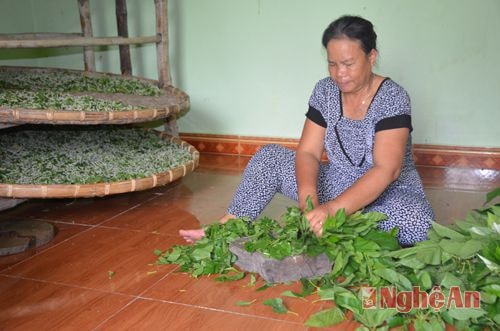 |
| When feeding silkworms, the size of the mulberry leaves used varies depending on the silkworm's age. Each year, after harvesting the last batch of silkworms, the mulberry tree is cut down to the base and fertilized with nitrogen and manure so that it will sprout and produce leaves after the Lunar New Year. The silkworm season runs from February to November in the lunar calendar; the silkworm's life cycle is short, only about 20-21 days, so each season typically yields 9-11 batches, depending on the weather each year. |
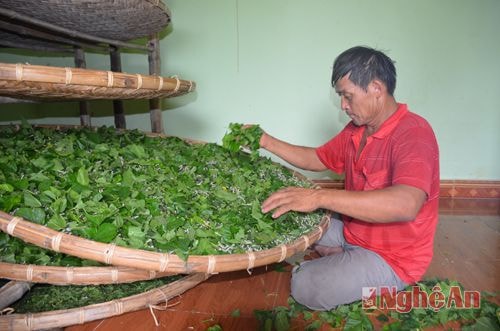 |
| Silkworm rearing is the most crucial step, determining the yield and quality of cocoons and silk products. The silkworm's life cycle, from hatching to cocooning, involves four sleep cycles. Silkworms eat continuously for three days and nights, then sleep for one day and night. During the final sleep cycle, they eat continuously for about 6-7 days before spinning their cocoons. According to experienced silkworm farmers, after each sleep cycle, silkworms must be fed every two hours to ensure consistent silk spinning and cocooning. |
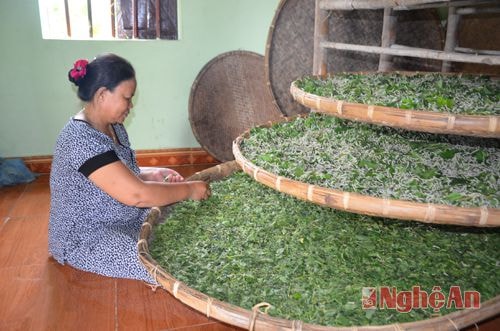 |
| Ms. Nguyen Thi Mo, from Xuan Chau hamlet, is sorting silkworms from good to bad; her family's silkworm trays are currently in the 3-8-day dormancy stage. |
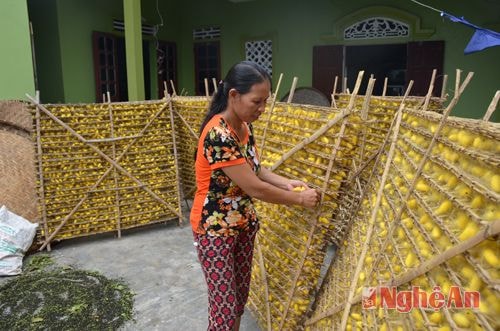 |
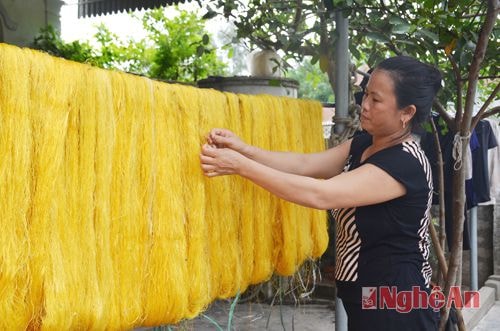
| While silkworms are spinning their cocoons, breeders must dry them in the sun to make them fragrant and prevent them from disintegrating during reeling, resulting in lustrous golden silk threads that are beneficial for silk reeling. |
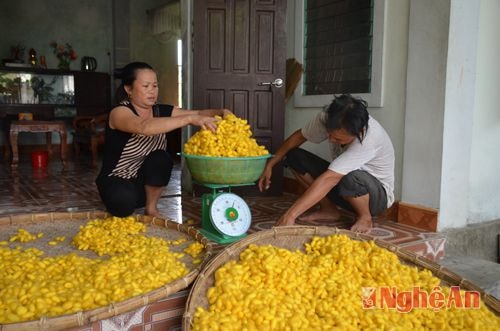 |
| Ms. Hoang Thi Xuan's family (in Xuan Chau hamlet) has been raising silkworms for four generations. Raising one cycle of silkworm eggs yields an average of 12 kg of cocoons. With the current selling price of 65,000 - 70,000 VND/kg, Ms. Xuan's family earns an average of 2.5 - 3 million VND per month. |
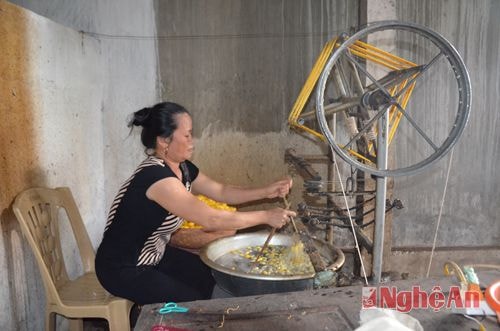 |
| Currently, the entire commune has 10 silk reeling machines, with the smallest household owning one machine and the largest owning four; each machine has a silk reeling capacity of 20kg/day. In 2014 alone, the total cocoon production in Dien Kim commune reached 30 tons, producing 3.6 tons of silk. |
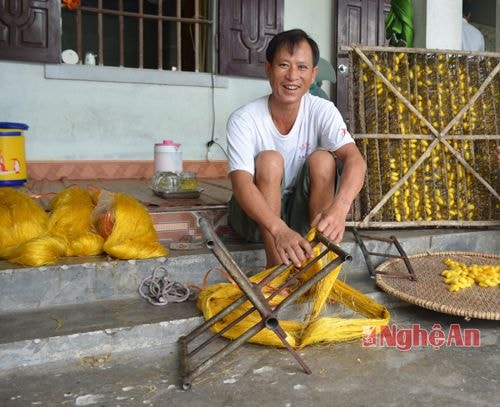 |
| Mr. Nguyen Van Hanh from Xuan Chau hamlet, a long-time silkworm farmer and silk reeler, said: "In the 2014 season, my family raised 10 batches of silkworms for silk reeling; after deducting expenses, we earned a net profit of 6-7 million VND per month. Compared to pig farming, silkworm farming is many times more profitable." |
 |
| Currently, Dien Kim commune has over 100 households engaged in mulberry cultivation and silkworm rearing, covering an area of 65 hectares; mainly concentrated in four hamlets: Thai Thinh, Tien Tien, Xuan Chau, and Dai Thanh. The locals cannot recall exactly when this "standing while eating" profession began. Despite experiencing ups and downs, and at times seemingly on the verge of extinction, they have persistently preserved the traditional craft passed down from their ancestors. |
 |
To develop the traditional mulberry cultivation, silkworm rearing, and silk reeling industry in a sustainable manner, Dien Kim has planned mulberry growing areas suitable to the soil conditions of each region to ensure a stable supply of raw materials. The return of mulberry cultivation and silkworm rearing is welcome, providing employment for the people while preserving the cultural identity of the craft village. This is not only significant in reviving a traditional craft village but also represents a suitable step in the local economic development. |
Ngoc Anh



