
Quang Thai Village Temple
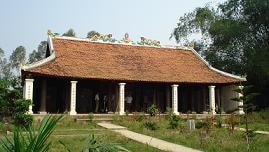 |
The Quang Thai village communal house has been |
Like many other Vietnamese villages, Dong Chau village was once a small village located on the banks of the Lam River. Its inhabitants engaged in a variety of occupations, from farming to crafts and trade, with bustling activity on both land and sea. The village boasts a communal house dedicated to the tutelary deities who served the nation and its people throughout various dynasties. Built over 200 years ago, the communal house still preserves 11 royal decrees dating from the late Le Dynasty to the Nguyen Dynasty. Among these 11 decrees, 8, dedicated to the deities Cao Son and Cao Cac, remain intact, their silk fabric adorned with beautiful golden dragon patterns. Construction of the Dong Chau communal house began in 1772 and was completed in 1789 through the contributions of money and labor from the villagers. In the villagers' memories, the communal house served as a logistical support station, providing a temporary stop for many military units before continuing their fight in the South. It was also under this communal house that countless sons of Quang Thai village held their farewell ceremonies before enlisting in the army, ready to fight to the death for their country. Anyone who grew up during the war against the Americans will know about Quang Thai ferry landing – where the American forces dropped thousands of tons of bombs, burning down half the village, yet the village temple remained intact, as if protected by the blessings of the sages. For over two centuries, the Quang Thai village temple had a thatched roof for more than 100 years, only being re-roofed with tiles in 1951. Due to the war, the temple was moved several times, but the royal decrees remain intact, and most notably, it still preserves an ancient incense burner dating back to 1789.
Mr. Tran Xuan Dinh, the caretaker of the communal house, said: "In 1981, the communal house was converted into a market hall, becoming dilapidated and unsightly, which saddened the villagers. In all the meetings, there were many suggestions to restore this ancient communal house. Besides its value as a cultural and spiritual heritage, the communal house also marks the development of the village over time. Thinking it over, a fundraising committee was established with the aim of appealing to the generosity of the villagers and those who had left to work elsewhere. With little contribution, the Quang Thai communal house was finally rebuilt on the same site, but more spacious and beautiful, thanks to the contributions of those who grew up in this land rich in traditions of unity."
It is known that from the beginning to the completion of the new communal house – exactly two years – people from afar contributed money, while those at home abandoned their seasonal farming work to participate and contribute. The women and mothers divided up the tasks of boiling water and preparing betel leaves, the men and boys did the heavy work, and the weaker ones did the lighter tasks... the whole village was bustling like a great festival. Through their efforts and unity, the Quang Thai communal house was completed in the spring of 2007.
Text and photos: Thuy Hien


