
Unity between Catholics and non-Catholics, a deep sense of brotherhood.
(Baonghean) - Building national unity is a major policy of the Party and State, and religious unity is one of the overarching tasks in all stages of development. Currently, there are approximately 250,000 Catholics in the province, accounting for 8.2% of the total population. The work of building unity between Catholics and non-Catholics is given attention and nurtured by Party committees, authorities, and people in localities.
Examples
These days, the Christmas spirit permeates the Christian community, filling everyone with joy and excitement. In Block 5, Thu Thuy Ward, Cua Lo Town, we observed the enthusiastic and bustling preparations for Christmas. Young people in the neighborhood are meticulously working on reconstructing the Nativity scene, the birthplace of the Baby Jesus, to offer to God on Christmas Day. Block leader Vo Huy Tich said: “Christmas Day has now become a shared celebration. Most non-Christian households in the neighborhood are joining hands to decorate for the holiday. Christmas Eve is not only a sacred night for the Catholic community but also a night of joy, unity, and friendship between the Catholic and non-Christian sides.” Block 5 has 124 households, 95 of which are Catholic. There seems to be no distinction or separation within the community here. It has become a tradition that when a family faces a crisis, the people in the block, regardless of their religious beliefs, wholeheartedly care for and help each other, respecting each other's cultural and religious practices. Mr. Vo Huy Tich said that last year, when the son of a Catholic family unfortunately met with an accident on the river, the people of Block 5 took turns searching and assisting the family. The spirit of community and neighborly solidarity has erased all boundaries, blending together to form a strong and enduring community.
The solidarity between Catholics and non-Catholics is not only demonstrated through the emotional bonds mentioned above, but also through their efforts to build a civilized life together and fulfill their duties as exemplary citizens. Mr. Nguyen Dinh Nhung, Head of Block 6, Thu Thuy Ward, Cua Lo Town, proudly mentioned the voluntary and proactive contributions of the people in building the 300-meter-long inter-block road to celebrate the 20th anniversary of the town's establishment.
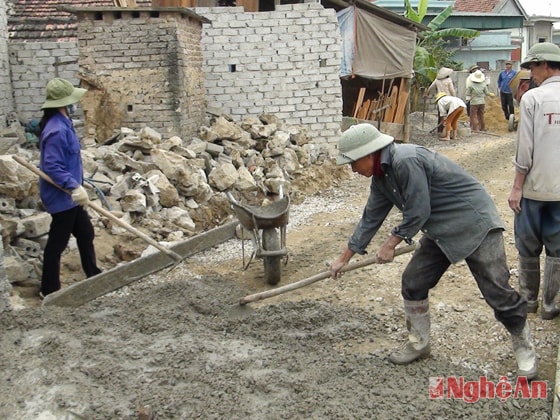 |
| Parishioners of Thuan Giang Parish, Quynh Hung commune (Quynh Luu district) build rural roads. Photo: Nhu Thuy |
Similarly, in Tan Ky district, parishioners donated 6,000 square meters of land, contributed over 20 million VND and 150 man-days of labor to build roads. In Hong Phuc parish, Nghia Phuc commune, three parishioners donated 2,500 square meters to build a kindergarten complex. In Quynh Luu, parishioners donated 25,428 square meters of land, 1,470 meters of boundary walls, dismantled many auxiliary structures and perennial trees, contributed 2,310 man-days of labor, and donated 2.84 billion VND to build roads according to the new rural development criteria. In Do Luong district, parishioners donated 14,587 square meters of land and contributed 324 million VND, completing 6 km of rural concrete roads and 27 km of internal field roads. In the Vinh My and Tan Yen parishes (Vinh Tan, Vinh City), parishioners donated nearly 600 square meters of land to build two flood control roads, contributed nearly 50 million VND and hundreds of man-days of labor, and constructed 200 meters of concrete road. In addition, there are many exemplary models of solidarity between Catholics and non-Catholics in building new rural areas, such as in Hamlet 5, Hoa Son Commune; Hamlet 7, Hung Son Commune; Hamlet 11, Tuong Son Commune (Anh Son District); Phu Long Hamlet, Hung Long Commune; Ke Gai Parish, Hung Tay Commune (Hung Nguyen District)...
Nuclear diffusion
In localities where strong solidarity between Catholics and non-Catholics is evident, the presence of core groups is readily apparent in fostering connections between the two communities, as well as between the people and the Party committee and government. First and foremost, we must mention organizations and associations at the neighborhood and hamlet levels, such as the veterans' association, farmers' association, youth association, women's association, and senior citizens' association. In Block 6, Thu Thuy Ward, Cua Lo Town, the Veterans' Association is at the forefront of the movement for solidarity between Catholics and non-Catholics. Block leader Nguyen Dinh Nhung is also the chairman of the Veterans' Association. Members of the association are committed to being exemplary figures who revere God and love their country, fulfilling their duties to society and the church. Therefore, the Block Veterans' Association always takes the lead in implementing the policies and guidelines of the Party and State, while actively promoting and mobilizing the people to participate.
According to Mr. Nhung, to build trust, besides being a good role model, one must genuinely care for and look after the lives of the people. As one of the first families in the block whose children went abroad for work, he helped many families access the government's policies and support programs for loans, even personally lending money to help their children go abroad for work, increasing their income and improving their living standards. Thanks to this, the lives of the people in Block 6 are now stable, and they understand the Party and State's guidelines, policies, and concern. As a result, everyone is working hard to strengthen solidarity and fulfill their civic duties and responsibilities.
In Anh Son district, the Women's Union, with its "religious community branch" model, is the core of building solidarity between Catholics and non-Catholics. Catholic laywoman Nguyen Thi Thuan, head of Branch 11, believes that both worldly and religious matters are equally important. Whenever she participates in branch meetings, the "Family Raising Healthy Children, Teaching Good Behavior" club activities, or the "5 No's, 3 Cleanliness" movement, she always finds ways to integrate the dissemination of the Party and State's policies and guidelines. Thanks to her effective work, the "Heart of Compassion" fund, launched by the Central Women's Union in Hamlet 11, has proven effective over the past year, providing women with capital to increase production, improve their lives, and strive for prosperity.
To achieve exemplary models of solidarity between Catholics and non-Catholics as mentioned above, local Party committees and authorities have intensified efforts to meet with and encourage Party members in Catholic areas and mass organizations to actively engage with the community and share with the people. Comrade Phan Trung My, Secretary of the Party Branch of Block 5, Thu Thuy Ward, Cua Lo Town, shared: “As the only Catholic in a Party branch with 18 members, I am always aware of my role and responsibility in absorbing and implementing the policies and guidelines of the Party and State, thereby leading the block's movements comprehensively. In addition, it is necessary to maximize democracy, collective intelligence, and the influence and prestige of associations and mass organizations. These are the extended arms of the Party and government to strengthen the bond between Catholics and non-Catholics right from the neighborhood and residential area…”
Respect, understanding, and love.
Religious unity is a crucial element in building national unity. This has been the guiding principle of our Party throughout all periods. Even in the first meeting of the Provisional Government (September 3, 1945), President Ho Chi Minh affirmed: “Colonialists and feudalists implemented a policy of dividing religious and non-religious people to facilitate their rule. I propose that our Government declare: Freedom of belief and unity between religions.”
For this correct and humane viewpoint and policy to truly be implemented, it is necessary to correctly understand the core of building solidarity between religious and secular communities. The first and most sustainable foundation is mutual respect between religious and secular people, and between Party committees and authorities and the people. Religion is only one of many factors that contribute to cultural and ideological diversity, thereby driving social progress. However, in this area, it is necessary to clearly recognize that differences in beliefs do not contradict each other. This means that each person has the right to preserve their own values and ideologies – whether religious, ethnic, or traditional – but this must be based on respect for the rights of individuals and communities, while also harmonizing with the common good. Party committees and authorities need to pay attention to and listen to the aspirations and opinions of the people to ensure freedom of belief and religion. To explain questions and resolve issues and conflicts thoroughly and transparently, based on respect for religious doctrine and adherence to the law.
While expressing such viewpoints might seem somewhat "philosophical," in reality, the issues involved stem from seemingly ordinary matters in life. A prime example is the incident where parishioners of Quan Lang Parish in Anh Son District questioned the disappearance of eight flags during a parish ceremony. However, when the Party committee, local government, and people clarified the situation, misunderstandings were resolved, strengthening community solidarity. This is what the Anh Son Party committee and government have achieved, laying the foundation for unity between Catholics and non-Catholics to build a more prosperous and civilized homeland.
The key to building national unity is our clear understanding of the "blood ties of our race" from the very beginning, when Au Co's egg gave birth to the nation. For a Catholic, there is no need to ask: which identity came first, Vietnamese citizen or Christian believer? Because these two things inherently coexist in a unified whole, blended together in the common flow of faith and national spirit. The 1980 Pastoral Letter of the Vietnamese Bishops' Conference also affirmed: “Regarding the first task of actively contributing with the people of the whole country to protect and build the Fatherland, we want to affirm that: loving the Fatherland and loving our fellow citizens, for Catholics, is not only a natural feeling, but also a requirement of the Gospel, as the Community reminds us: “Christians from all nations gather in the Church, not separated from others by regime or by earthly social organization, so they must live for God and for Christ in the healthy lifestyle of their nation; as good citizens, they must truly and actively cultivate patriotism.”
"Our patriotism must be practical, meaning we must be aware of the current issues facing our homeland, understand the policies and laws of the State, and actively contribute with our compatriots nationwide to protecting and building a prosperous, free, and happy Vietnam."
Another Christmas season is approaching. For a long time, this time of year has not only held sacred significance for Catholic believers but has also become a cultural feature, a profound impression in the minds of Vietnamese people, regardless of their religion. This is clear evidence of the intermingling and blending of human values between communities, resulting in a diverse, colorful society that is also rich in solidarity and affection. This season, many non-Catholics are making Christmas trees, buying Christmas gifts for their children, and awaiting the sacred moment of the birth of the Baby Jesus… Through this, we see that to cherish and bond with each other, we need to respect and understand each other's unique characteristics, thereby finding common ground and a shared path to move forward together. Leading this large chorus is none other than the Party organization – the nucleus of the great national unity in general and the unity between Catholics and non-Catholics in particular.
Thanh Nga – Thuc Anh


