
Unity, creating breakthroughs, and driving Nghe An's rapid and sustainable development.
Ho Duc Phuoc
Ho Duc Phuoc- Secretary of the Nghe An Provincial Party Committee
(Baonghean) - The Party Committee and people of Nghe An are very happy, excited, and honored to receive Resolution No. 26-NQ/TƯ from the Politburo on the direction and tasks for the development of Nghe An province until 2020. The issuance of this document demonstrates the Politburo's special attention to Nghe An, as this is the first time the Politburo has issued a specialized resolution on a province, presenting a great opportunity for Nghe An to make breakthroughs and develop. To successfully implement Resolution 26-NQ/TƯ of the Politburo, the Party Committee and people of all ethnic groups in the province must unite, effectively utilize potential and advantages, mobilize resources, strive diligently, overcome challenges, and create breakthroughs to achieve success.
Identifying the potential and advantages of resources.
Nghe An is a province located in the North Central region of Vietnam, with the largest area of nearly 16,500 km2. It shares the longest border with the Lao People's Democratic Republic (419 km), with four border gates. Among them, the Nam Can International Border Gate and the Thanh Thuy Border Gate are currently undergoing procedures to become international border gates. The two secondary border gates, Cao Veu and Thong Thu, connect to trans-Asian routes from Myanmar, Thailand, and Laos to Cua Lo Port, creating enormous potential for trade and development. The relatively good, synchronized, and modern infrastructure, including six national highways, the railway, National Highway 1A, the Ho Chi Minh Highway, and other routes, provides favorable conditions for Nghe An's connectivity with other regions and its development.
Nghe An's port system includes Cua Lo International Port, currently being dredged to accommodate ships of 20,000 tons; Cua Lo Deepwater Port, planned for a capacity of 20 million tons per year, allowing ships over 50,000 tons to enter and exit; and the Dong Hoi Specialized Transport Port being built in the north, creating a connection between Nghe An via sea and other regions in the country and other nations. Vinh Airport has 6 flight routes and in 2013 transported over 1 million passengers, achieving a growth rate of 44% - the highest growth rate among domestic passenger airports in the country. It is currently being planned to become an international airport, facilitating investment attraction and trade with regions and countries around the world. Nghe An's urban system is quite developed, including Vinh City, a Class I urban area, which is being developed to become a regional center in the North Central region in several areas. Together with the tourist town of Cua Lo, the industrial urban area of Hoang Mai, and the urban area of Thai Hoa, it forms a framework that drives the province's economic development. A tremendous resource that needs to be effectively utilized is human resources. The people of Nghe An have a tradition of diligence, studiousness, academic excellence, high aspirations, revolutionary spirit, and love for their homeland, inherited through generations. This is evidenced by the fact that Nghe An's students consistently rank among the top in the country. The province is gradually forming a regional training center in the North Central region with 5 universities, 9 colleges, and hundreds of vocational training centers capable of training 900,000 students per year. Along with a large workforce of over 1.8 million workers, this human resource is extremely important for Nghe An's development. Tourism is also creating a strong impetus for development by effectively exploiting the advantages of the beautiful Cua Lo beach, with its 107-year history of tourism, along with Mat Island and Ngu Island, connecting with the Kim Lien historical site (President Ho Chi Minh's birthplace) and other historical and cultural landmarks, scenic spots, and historical and cultural relics, forming a chain of destinations on the journey to Nghe An, the homeland of President Ho Chi Minh. The strengths of the Mekong Delta region that need to be promoted include Pu Mat National Park (93,523 hectares), Pu Huong National Park (41,127 hectares), and Pu Hoat National Park (34,723 hectares), which have become the largest biosphere reserves in Southeast Asia with many rare animal and plant species. Nghe An province boasts vast forest resources, covering over 883,523 hectares, including many valuable timber species such as ironwood, rosewood, sandalwood, and chestnut. The extensive planted forests provide a valuable source of raw materials for the development of export-oriented timber processing industries, such as exportable solid wood products and MDF wood products. The province's vast land potential and fertile soil offer promising prospects for abundant raw materials, supporting the development of food, beverage, and pharmaceutical processing industries. Furthermore, its rich and diverse mineral resources, such as precious stones, gold, tin, manganese, and various types of stone—especially white stone and tin—are rapidly developing into concentrated processing industries. The large limestone reserves allow Nghe An to develop a cement industry with a capacity of 12 million tons per year. It can be said that with these existing potentials, appropriate policies, advanced technology, a sound development strategy, and the unity and concerted efforts of the entire province, Nghe An is certain to thrive.
Overcome challenges, seize opportunities.
More than 10 years ago (June 2003), the Politburo of the 9th Party Congress issued Conclusion No. 20, outlining the policies and orientations for the socio-economic development of Nghe An province. Implementing this Conclusion, the province's socio-economic development has undergone significant transformation. Nghe An has established 3 key economic zones, 1 economic zone, and 8 industrial parks. Vinh City has developed into a Class 1 urban area, Cua Lo Town has been recognized as a Class 3 urban area, and two towns have been established: Thai Hoa and Hoang Mai. Western Nghe An has seen remarkable socio-economic changes; people's living standards have gradually improved, and education has developed strongly. Many sectors have developed at a high speed, with some sectors on track to become leading in the region, such as: trade and tourism; finance and banking; science and technology; health and education; culture and sports; and high-tech agriculture.
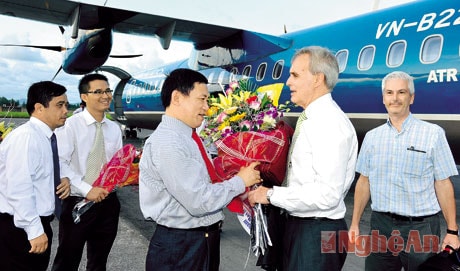 |
| Comrade Ho Duc Phoc congratulates foreign investors on coming to Nghe An. Photo: Sy Minh. |
However, compared to the requirements set for a province with a strategically important geographical location and many potentials and advantages, the achievements are still unmet. We are facing challenges and weaknesses that need to be overcome, namely: low economic growth, slow and unsustainable structural transformation; low quality, efficiency, and competitiveness, not commensurate with the province's potential, opportunities, and development requirements. Some indicators have not met the set targets, such as: the average growth rate during the 2006-2010 period only reached 9.75% (target of 12-13%); the average for 2011-2012 only reached 8.18%.
The revenue structure and balance of expenditures are not yet stable, and the proportion of industry and construction is growing slowly; some key areas and breakthroughs in economic development have fallen short of targets, such as cement, mining and mineral processing, and high-tech industries. Management of planning, land, environment, and mineral activities still has many shortcomings; the efficiency of mineral resource exploitation and processing remains low. While efforts have been made to attract investment and develop businesses, the results are not commensurate with the potential. Foreign investment attraction remains limited; there are not many large-scale projects that represent breakthroughs in the province's economic development.
Most businesses in Nghe An are small-scale, with limited capital and outdated technology, yet they are slow to invest in innovation. Their industrial structure is irrational, their corporate governance is weak, their production capacity is insufficient to compete, and most goods lack branding. The agricultural sector remains high in the province's economic structure, and regional linkages are not strong. Although the western region's economy is large, its production capacity is limited, with a significant disparity compared to the lowlands (in 2010, the value of output in the mountainous region was 12,543 billion VND, only 30.28%; while in the lowlands it was 28,884 billion VND, equivalent to 69.72%). The poverty rate remains high, at 15.61% in 2012 according to current standards. Job creation for workers remains difficult (the overall unemployment rate in 2012 was 5.5%).
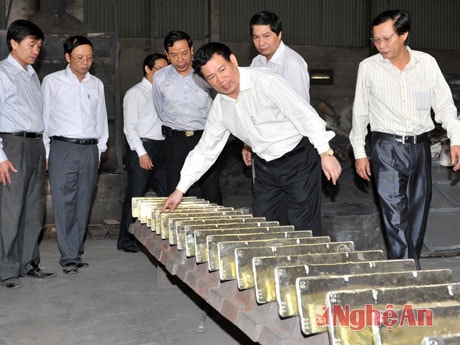 |
| Comrade Ho Duc Phoc visits a tin mining enterprise in Quy Hop district. Photo: Sy Minh. |
Faced with such challenges, Resolution 26-NQ/TƯ dated July 30, 2013, of the Politburo on the direction and tasks for the development of Nghe An until 2020 demonstrates the Politburo's special attention to the homeland of the beloved President Ho Chi Minh. This is an opportunity, a strategic orientation for Nghe An to strive, unite, unleash and maximize resources, take advantage of central government support, and build a transparent mechanism to achieve strong breakthrough development.
Breakthrough solutions
The objectives of Resolution No. 26-NQ/TƯ of the Politburo clearly state: Striving to build Nghe An into a relatively prosperous province in the Northern region by 2015, creating momentum to become an industrial province by 2020. Building Nghe An into a center for finance, trade, tourism, services, education and training, science and technology, healthcare, culture, sports, and high-tech industries in the North Central region. Building a synchronous and modern infrastructure system, improving the material, cultural, and spiritual lives of the people, and building an advanced culture rich in the cultural identity of Nghe An. Building and strengthening national defense, maintaining political security, and ensuring social order and safety. Enhancing the leadership capacity and fighting strength of Party organizations and building a strong political system.
To effectively implement Resolution 26 - NQ/TƯ, the Provincial Party Standing Committee issued Action Program No. 24 on October 8, 2013, comprising 20 major programs and projects, and is currently organizing and leading their implementation. Some of these include very significant and key projects such as: the socio-economic development plan for Western Nghe An until 2020; developing Vinh City into a North Central economic and cultural center from now until 2020; building the Southeast Economic Zone into a key economic zone and developing the Hoang Mai - Dong Hoi Industrial Park into a similar economic zone to the Nghi Son Economic Zone; developing Nghe An into a North Central regional information technology center; the project to build key infrastructure in Nghe An province until 2020;... and several other important projects.
First, in 2014, focus should be placed on four key areas to create economic breakthroughs that will lay the foundation for sustainable development in other sectors:
- Mobilize all resources to invest in essential infrastructure projects serving development such as: upgrading Vinh Airport terminal according to the plan to ensure a capacity of 3 million passengers/year, with extending the runway, building airport infrastructure and opening more international flights; dredging Cua Lo port to allow 20,000-ton ships to enter and exit and building berths 5 and 6; implementing the construction of Dong Hoi port and attracting investment to develop a deep-water port; building Thanh Thuy International Border Gate; focusing on expanding and upgrading key road transport routes: National Highway 1A, National Highway 15A, National Highway 7A; the Western Nghe An road; the Tan Ky - deep-water port road; the Thai Hoa - Nghia Dan - Hoang Mai road; Vinh - Cua Lo boulevard; the coastal road; 3 railway overpasses for a smooth traffic system: the National Highway 46 overpass at Cua Nam, the Yen Ly overpass and the Quan Banh overpass; The ODA project to upgrade the Northern irrigation system, with a total capital of 5,700 billion VND, has commenced; the progress of the ODA project to upgrade Vinh city and several other projects is being accelerated.
- Focus on attracting investment in the 7 identified areas where Nghe An has advantages and 3 key economic zones: Vinh City and its surroundings; Hoang Mai - Dong Hoi region; and Western Nghe An region. In particular, promote investment in high-tech industries and agriculture with large-scale, breakthrough projects that will transform the province's economic structure. Aim to invite strong domestic and foreign economic groups to continue investing in Nghe An, such as Samsung, Kobeco, LG, Hyundai... and domestic groups such as Becamex Group, Nguyen Kim, FPT, Hoa Sen, Muong Thanh, TH true milk, Vietnam National Petroleum Group, Vietnam Cement Industry Corporation... and major credit institutions such as BIDV Bank, Vietcombank, Vietnam Bank for Industry and Trade, Vietnam Bank for Agriculture and Rural Development, HDBank... to ensure sufficient investment capital for development and other economic groups.
- Focus efforts on effectively implementing the National Target Program for Building New Rural Areas, linked with poverty reduction, with many innovative and creative approaches, mobilizing social resources and promoting democracy and solidarity among the people, striving to reduce poverty to 8% by 2014.
- Focus on administrative reform, building a transparent and sound policy mechanism for development; strengthen human resource training, with an emphasis on high-quality human resources; focus on building a strong Party, effectively implementing Central Resolution 4 "Some urgent issues concerning Party building today," and the tasks to be done immediately after the review, in conjunction with promoting the implementation of Directive 03-CT/TƯ "Promoting the study and emulation of Ho Chi Minh's moral example"; build and consolidate high unity and consensus among the people and maintain national defense and security.
Successfully implementing Resolution 26 is the aspiration of the Party Committee and people of Nghe An province. The leaders and people of all ethnic groups in the province recognize their responsibility to unite and strive wholeheartedly for the development of their homeland. The process of implementing this high political determination requires the support and assistance of the Central Government and localities throughout the country, demonstrating their affection, responsibility for their homeland, and respect for the beloved President Ho Chi Minh.


