
Businesses and the New Rural Development Program
With approximately 70% of the population living in rural areas, the New Rural Development Program has immense economic, political, and social significance. However, to realize the program's noble goals, all resources need to be mobilized effectively, especially the business community.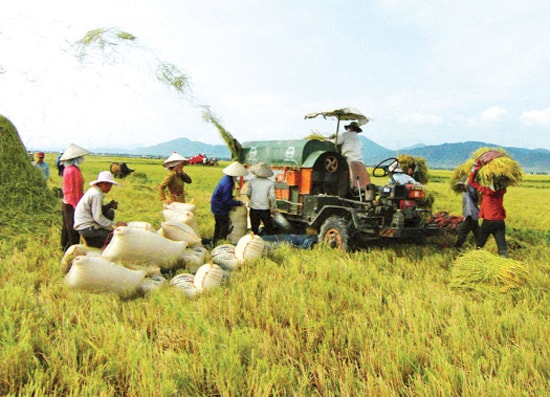
Without investment from businesses, farmers not only face difficulties in selling their products but also suffer disruptions to their production processes.
Implementing Resolution No. 7 of the Central Committee (10th term) on agriculture, farmers, and rural areas, especially in conjunction with the National Target Program on building new rural areas, has brought about many changes to the face of rural areas. Hundreds of billions of dong have been invested in transportation infrastructure and new production models, reflecting the collective efforts and unity of all people in supporting the Program. Fundamentally, the lives of many villages and communes implementing the new rural development model have seen quite positive changes.
The disease of following trends still persists.
However, with the approach of focusing on campaigns and slogans, in many localities, people feel that the New Rural Development program has not been truly effective but rather a burden. With very modest incomes, the communes implementing the New Rural Development program are still burdening the people with excessive contributions for infrastructure development. Sympathizing with these difficulties, Professor Nguyen Lan Dung believes that the basic goal of New Rural Development is to help farmers improve their lives. Higher incomes and better material and spiritual well-being are essential. If this goal is not achieved, the New Rural Development program is considered unsuccessful.
In reality, many rural development projects, although approved, lack the necessary resources for implementation or have unsuitable implementation plans, failing to determine the proportion and mechanisms for mobilizing resources from the people. In many places, people still rely on budget allocations, and many solutions lack practicality in implementation. Agricultural production in most localities remains small-scale and fragmented, primarily based on household economies, while cooperatives are small and inefficient. The "four-party linkage" model is violated due to the lack of sanctions. Therefore, effective production models are difficult to replicate.
Despite government resolutions, decrees, and decisions, implementation remains slow, meaning that people and businesses have largely been unable to access preferential capital sources. Meanwhile, there is still no national strategy for planning large-scale specialized production areas, nor a strategy for addressing the consumption and export of key products such as rice, fish, shrimp, and fruit. This leads to the recurring problem of bumper harvests followed by price drops. Businesses and individuals remain hesitant to invest in agriculture and rural areas.
Mobilizing resources from businesses
The government needs policies to promote public-private partnerships in rural development, encouraging businesses to invest in the construction of rural infrastructure projects. |
Given the current realities of agricultural production, the role of businesses is indispensable in order to effectively develop production models, increase intellectual capital, or integrate science and technology into production to create a competitive advantage. Besides their economic potential and investment in efficient production models, businesses also excel in managing distribution, marketing, and enhancing the value of agricultural products. Without business investment, farmers not only face difficulties in selling their products but also suffer disruptions to the production process. However, many businesses still face setbacks when investing in agriculture and rural areas due to numerous risks. The biggest risk stems from farmers' lack of integrity; when agricultural products fetch high prices, farmers often sell in a way that violates signed contracts. Furthermore, the underdeveloped transportation infrastructure is also a major obstacle, causing concern for businesses…
Former Deputy Minister of Agriculture and Rural Development Nguyen Dang Khoa believes that building new rural areas is a correct policy that is in line with the people's wishes and should be implemented quickly, but it must be done correctly and effectively to achieve its goals. Most importantly, it is necessary to create incentives for businesses to invest in areas directly related to agriculture and rural areas.
According to diendandoanhnghiep-PH


