
Egyptian national dialogue reaches consensus on parliamentary election law.
Egypt's official news agency MENA, citing a statement from the Egyptian Presidential Palace on January 1, reported that the national dialogue, led by President Mohamed Morsi, had reached a consensus on amending the law on parliamentary elections.
The announcement stated: "In order for the Election Law to conform with the new Constitution, the sixth round of the national dialogue, held on December 31 and January 1, discussed several amendments. This agreement will be forwarded to the cabinet and presented to the Senate, thereby maintaining the number of members of the House of Representatives at 498."
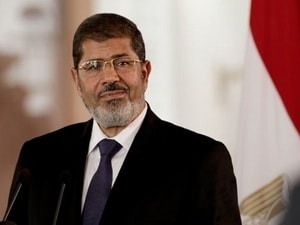
Egyptian President Mohamed Morsi. (Source: AP)
All 90 new members of the Senate, appointed by President Morsi on December 22, 2012, will be sworn in when the Senate convenes its first session.
The national dialogue initiated by President Morsi aimed to engage all political forces in Egypt.
The seventh round of dialogue will be held on January 9th to discuss the contentious constitutional provisions and proposed amendments. Currently, the Senate holds legislative power until a National Congress is elected.
Egypt's new constitution was approved last week with over 63% of the vote in a referendum held in two phases. Voter turnout was approximately 64%.
Egypt has plunged into its worst political crisis since President Morsi's election after the Constituent Assembly, dominated by the Muslim Brotherhood, approved a new draft constitution last month.
Protests by supporters of President Morsi and the opposition took place almost daily in the capital Cairo.
According to regional observers, the adoption of the new draft constitution will not help Egypt end its current political deadlock; on the contrary, it could further ignite stronger protests.
The National Salvation Front (FN), Egypt's main opposition group, has described the referendum as "just another battle" and vowed to continue fighting for the Egyptian people. Mohamed ElBaradei, former Director of the International Atomic Energy Agency (IAEA) and current FN leader, argued that the adoption of the new constitution would "institutionalize instability in Egypt."
According to him, this Constitution should only be considered temporary until another draft constitution is prepared based on consensus among all parties.
According to (VNA) - DT


