
Encouraging the poor to strive for self-improvement.
(Baonghean Newspaper) - Caring for the poor is a regular task for every unit, organization, and individual in the province, with many specific and practical actions. During the peak month of "For the Poor" in 2014 (October 17th - November 18th), Comrade Ho Duc Phoc - Secretary of the Provincial Party Committee - gave an interview to Nghe An Newspaper about poverty eradication and reduction efforts in our province.
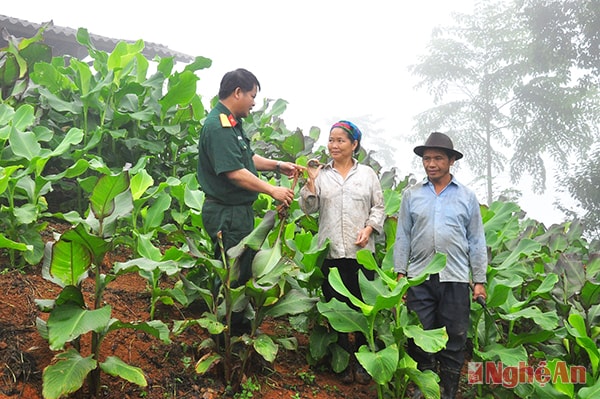 |
| Officers from the 4th Economic-Defense Brigade provide technical guidance on growing ginger to the Mong ethnic minority in Na Ngoi (Ky Son). Photo: Tran Hai. |
PV:Dear Provincial Party Secretary! The "Day for the Poor" campaign has contributed to changing the spiritual and material lives of many poor people, providing them with opportunities to escape poverty. Could you please assess the province's efforts in caring for the poor over the past period?
Comrade Ho Duc Phuoc:Caring for the poor is a deeply humane act, reviving the national tradition of morality and compassion for the poor and people in disadvantaged areas. Over the years, our province has carried out many practical activities to care for the poor. The Provincial Party Standing Committee has issued many projects, documents, and directives on poverty eradication and reduction, which have been implemented vigorously by all levels and sectors with many synchronized solutions, achieving many important results with many specific and practical activities and programs such as launching the "Fund for the Poor," the "Month of Action for the Poor," and calling for the joint efforts of businesses and philanthropists in the area, etc. In the first six months of 2014, thanks to proactive implementation and focused propaganda and mobilization, the entire province has so far donated 16 billion VND out of 17 billion VND registered with the Central Government, reaching 94% of the plan, including over 10.4 billion VND at the district level and over 5 billion VND at the provincial level. The province has focused on building 168 new houses and repairing 54 existing ones, in addition to providing medical care to many poor households. Particularly noteworthy is Nghe An's innovative approach of assigning agencies and departments to provide support to impoverished communes. This policy has mobilized resources and created a vibrant emulation movement with many meaningful and practical actions aimed at helping poor communes by various agencies and units.
It can be affirmed that the work of caring for the poor has spread widely, attracting the attention and enthusiastic support of organizations, individuals, philanthropists both domestically and internationally, and the people of the province. Thanks to this practical support, the poor in the province have more conditions and motivation to overcome difficulties and rise up. Poverty reduction policies have truly been implemented, and poverty eradication efforts in the province have achieved positive results. The average annual poverty rate has decreased by 4%, and currently stands at 12.5%; infrastructure has been strengthened, the rural landscape has improved, and the living standards of the people have been enhanced.
PV:A distinctive feature of Nghe An province is that the poor are concentrated in the western and coastal areas; therefore, besides the general policies for the poor from the central government, does our province have any specific policies, Comrade?
Comrade Ho Duc Phuoc:The western and coastal regions of Nghe An province are unique areas, both strategically important for the socio-economic development, national defense, security, and foreign relations of Nghe An province, the North Central region, and the entire country. The Provincial Party Standing Committee has issued a plan to reduce poverty and improve living standards for the people in the western and coastal regions by 2020. This plan aims to create conditions and opportunities for the people in these regions to fully access basic social services, including infrastructure, culture, education, healthcare, social security, and conditions for production development to increase income, overcome poverty, and achieve sustainable prosperity. With the investment and support of businesses, the socio-economic situation, infrastructure, and living standards of the people in the western region have seen positive changes, and national defense and security have been maintained and stabilized.
The western and coastal regions are two areas requiring special attention from the province in implementing poverty reduction policies. Western Nghe An accounts for over 83% of the province's total area, encompassing 11 mountainous districts and towns. The percentage of poor and near-poor households in this region is also high; at the end of 2013, the poverty rate in the western region was 24.06%, 1.8 times higher than the overall poverty rate of the province. The lives of the people, especially ethnic minorities, remain difficult. For the coastal region of Nghe An, with 82 km of coastline bordering 35 communes and wards in 5 districts and towns, the poverty rate in these communes and wards is still as high as 8.44%.
Over the years, in addition to successfully implementing socio-economic development programs linked to poverty reduction efforts at the central level, the province has also implemented policies such as Decision No. 59/2010/QD-UBND dated August 12, 2010, on poverty reduction support for 42 communes with a poverty rate of 30% or higher; Decision No. 1310/QD-UBND dated April 20, 2012, assigning 86 agencies and units to assist 88 poor communes in the western region; and policies supporting vocational training, job creation, labor export, agricultural extension, forestry extension, and fisheries extension. The province has also encouraged and attracted 120 agencies, businesses, and units to assist poor communes. This has both mobilized significant resources and fostered closer ties between officials and the people. The attention and guidance of Party committees, government agencies, and sectors from the provincial to the grassroots level have focused on exploiting and developing the internal resources of each locality and the efforts of the people. The province's policy is to develop and expand economic models so that the poor in the western and coastal areas can participate in labor, production, and business; to introduce scientific and technological advancements to help people boost production and develop traditional crafts so that the poor have opportunities for work and income.
PV:To achieve sustainable poverty reduction and ensure that the movement for the poor truly spreads, what are the responsibilities of Party committees and local governments at all levels, Comrade?
Comrade Ho Duc Phuoc:Poverty reduction and hunger eradication are not only economic issues, but also fundamental to maintaining political and social security, and ensuring national defense and security. This work requires focused attention and direction from all levels, sectors, and the political system, considering it a political task. Specifically, it is necessary to continue promoting the purpose, significance, content, and methods of fundraising for the "For the Poor" Fund, and to continue implementing the Prime Minister's letter and the Provincial People's Committee Chairman's letter, publicizing the achievements, and inspiring voluntary support from everyone. This will create resources to gradually help poor households stabilize their lives and escape poverty, contributing to a rapid reduction in the poverty rate in the coming years. At the same time, Party committees and local authorities should conduct annual reviews and assessments of poverty eradication efforts, replicating successful practices and effective models to create a ripple effect in the community.
To continue implementing the sustainable poverty reduction program and achieve the provincial poverty reduction target of 10% in 2014, Party committees and government agencies at all levels need to mobilize the strength of the political system, all levels and sectors, mass organizations, and businesses, creating consensus and active participation from all strata of the population, poor households, and poor individuals. Poverty eradication and reduction should be linked to the new rural development program; assigning and assigning responsibility to Party committee members in charge of local areas; and conducting surveys, reviews, and assessments of poor households in accordance with regulations. The Fatherland Front Committee – the Provincial and district/city/town-level committees for supporting the "For the Poor" Fund – should effectively manage records and settle fund income and expenditure according to established financial principles; and closely monitor the situation of poor households to provide targeted assistance, helping the poor and impoverished areas rise out of poverty.
Furthermore, the Fatherland Front at all levels and its member organizations are stepping up efforts to mobilize units, organizations, businesses, and philanthropists to join hands in supporting the "For the Poor" Fund. They call on organizations and individuals both domestically and internationally to continue upholding the tradition of solidarity and mutual assistance through concrete actions to provide material and spiritual support to the poor, especially those in remote areas and ethnic minority communities, so that they can alleviate their difficulties and rise above their circumstances. Eradicating hunger and poverty cannot be accomplished by a single organization or individual; it requires the collective efforts of the entire society.
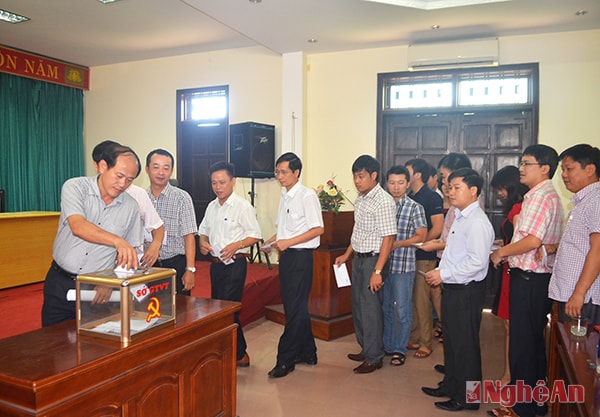 |
| Officials and staff of the Department of Transport donated to the "For the Poor" Fund. |
PV:Comrade Secretary, could you please tell us the message of Nghe An province during the 2014 "For the Poor" campaign month?
Comrade Ho Duc Phuoc:Currently, the poverty rate in the province is still 12.5%, and the number of near-poor households and those at risk of falling back into poverty remains very high. Many localities in the province still face numerous difficulties; many poor households are living in dilapidated, makeshift houses, and many lack seeds, capital for production, and medicine... they urgently need community support. Therefore, to help poor households stabilize their lives and strive to escape poverty, the peak month of action for the poor must become a powerful movement, providing the most effective assistance to the poor. Therefore, Party committees, local governments, and the Fatherland Front at all levels need to focus on the grassroots and the poor to further promote activities caring for the poor and improving the living standards of poor people in mountainous, remote, and disadvantaged areas. Departments, agencies, and mass organizations should continue to mobilize units, organizations, businesses, individuals both domestically and internationally, and all sectors of the population to wholeheartedly care for and assist poor households, poor communes, and poor districts. Develop programs, mobilize resources, and implement support activities to achieve practical results.
Video clip of the Provincial Party Secretary discussing the 2014 Action Month for the Poor:
.
Provincial leaders called on all levels, sectors, political and social organizations, people and soldiers nationwide, overseas Vietnamese, businesses, organizations, and individuals abroad to continue strongly supporting campaigns for the poor with practical contributions, especially during the peak month of "For the Poor" in 2014. At the same time, they urged the poor to always strive to rise above poverty sustainably. All policies, support, assistance, and care for the poor will be more profoundly humane and noble when they motivate the poor to overcome poverty.
PV:Thank you very much, comrade!
Thanh Le
(Perform)


