Light a torch to find the words
(Baonghean) - Carrying torches to school before dawn and returning home after the lights have come on, this is a very familiar sight for secondary school students in Cam village, Cam Lam commune (Con Cuong district). Although this situation has existed for many years, as long as there is no road back to the village, generations of secondary school students here will continue to walk, carrying torches, to seek their education...
(Baonghean) - Carrying torches to school before dawn and returning home after the lights have come on, this is a very familiar sight for secondary school students in Cam village, Cam Lam commune (Con Cuong district). Although this situation has existed for many years, as long as there is no road back to the village, generations of secondary school students here will continue to walk, carrying torches, to seek their education...
To get to school, 70 secondary school students in Cam village wake up at 4 a.m. every day to get ready, prepare their books, lamps, and torches, and then gather at the village entrance at 4:30 a.m. to go to school together. Before 4 a.m., we saw the wife of the village head, Lo Van Dan, waking her sixth-grade son to brush his teeth and wash his face, preparing for school. Following his mother to the water tank, the sixth-grade student, still sleepy, quickly did everything before heading to school.
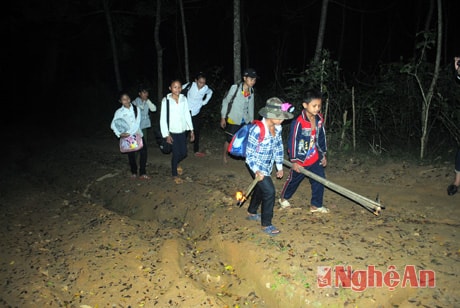 |
| Students from Cam village (Cam Lam commune - Con Cuong district) carry torches to school. |
At exactly 4 a.m., the sound of dogs barking could be heard in the distance, along with the faint glow of flashlights and torches, and the murmur of voices from a group of students. They usually waited for each other at the edge of the village, in groups of seven or eight, before heading to school together.
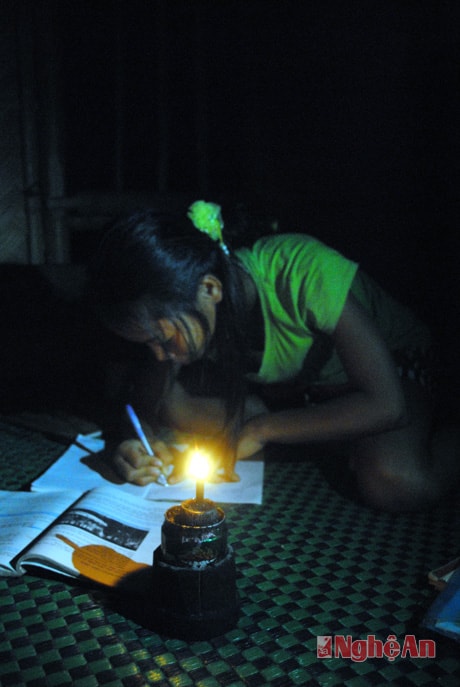 |
| Students in Cam village have to study by the flickering light of an oil lamp. |
Following the children to class, we gained some understanding of the difficulties and hardships they face on their journey to literacy. Families with better resources provide flashlights, while others rely on long, dry bamboo poles as torches to light their way. Usually, the boys lead the way with their torches, followed by the girls. Sometimes, the torches go out or run out, forcing everyone to stop, find more bamboo along the roadside, relight their torches, and continue.
The dirt road was quite long, full of steep slopes, and eroded into large ruts by the rain, so after every one or two slopes, the children had to stop to rest, quickly eating rice balls, cassava, and sweet potatoes for breakfast. Vi Thi Anh, from Cam village, shared: "Today the weather is dry, the road is easy to walk on, but when it rains, the road is slippery, and falling and getting clothes dirty is common." Continuously traversing 5 kilometers of dirt road and steep slopes, the children had to rest 3 or 4 times, picking up bamboo along the roadside to use as torches. The cheerful laughter and innocent joy of the children seemed to dispel the fatigue and hardship of their journey to learn to read.
After navigating the steep, slippery slopes, the children still have to cross the Xi Vang stream and travel another 3 kilometers to reach the school. The Xi Vang stream is about 100 meters wide, but the water is quite deep and flows rapidly, making crossing it difficult. During heavy rains, when the water level rises and the currents are strong, secondary school students in Cam village have to miss school for an entire week.
For nearly four years, since Mr. Lang Van May's raft dock began operating, transportation for the villagers of Cam and the students has become much more convenient. Arriving at the raft dock at dawn, the children board the raft themselves, slowly release the pulley to pull the raft across the stream, and then return to pick up the remaining students. Ho Thi Hong (a student in class 8A, Cam Lam Secondary School) shared: "Before the raft came here, we would roll up our pants, choose a shallow stream, and hold hands to wade across. When the water was too high, we had to swim to get across, and sometimes our clothes and books would get soaked after crossing."
“The road to school is too far, the journey is difficult and arduous. For ethnic minority students in this remote and isolated Cam village, simply attending school and progressing to the next grade is a miracle, let alone achieving high academic results. Even so, one-third of the secondary school students are excellent or advanced students. Currently, the village has one student attending university…,” said Mr. Lo Van Dan, head of Cam village. Speaking with us, Mr. Nguyen Trong Minh, Principal of Cam Lam Secondary School, expressed his concern: “The children are still young, and the road to school is too far. It's especially difficult in the cold season if they have to travel all day with their meals, leaving at dawn and returning home late at night. Although the school has a boarding program, it only helps to some extent. In the long term, the school's management board is looking for funding to build a boarding house for the 80 students (70 from Cam village and 10 from Son village) currently studying at the school. However, the biggest difficulty is the funding. Building a boarding house for 80 students would require approximately 500 million VND for 8 rooms, which is a considerable amount for Cam Lam, a disadvantaged commune.”
Cam Village is the most remote and disadvantaged area in Cam Lam commune. The entire village has 130 Thai households with 671 inhabitants (including 75 poor households). The villagers' lives mainly depend on forest work and slash-and-burn agriculture, so most of their efforts to provide education for their children are very limited. To make the journey to school less difficult, the involvement and cooperation of all levels of government and society as a whole are urgently needed.
Duy Ngoi – Hoang Viet