
Thanh Chuong Chicken - a brand from a hilly region.
(Baonghean) - As a low-lying, midland mountainous district, except for a few communes along both banks of the Lam River, Thanh Chuong is a continuous chain of bowl-shaped hills. There, under the canopy of jackfruit trees and sprawling palm hills, chickens leisurely forage for food, creating a unique and unmistakable brand - Thanh Chuong hill chicken, adding another unique dish of this land besides the ash fruit and jackfruit pickle.
From a specialty dish
The "Thanh Chuong Hill Chicken" brand has a long history, not only a source of pride for Thanh Chuong natives living far from home, but also familiar to every resident of Nghe An province. From ancient times, starting with wild jungle fowl, our ancestors brought them back, domesticated them, and through generations, developed the delicious, firm-fleshed Thanh Chuong chicken breed, unlike any other breed raised elsewhere. No one knows exactly when the Thanh Chuong hill chicken farming tradition began. Even the elderly, nearly a hundred years old, only know that from the time they began to understand their surroundings, the chickens were diligently foraging for worms and ants in their gardens and on the hillsides. Mrs. Nguyen Thi Bien (Hamlet 1, Thanh My Commune), now over 80 years old, has failing eyesight and slow gait, but except for times when she is bedridden with illness, she never forgets to feed her flock of chickens corn and rice.
For this woman, who has reached a rare age, it's not just a lifeline, a means of survival during difficult times, a new pair of sandals, notebooks for her children to go to school, or a luxurious meal to entertain guests on anniversaries, holidays, and festivals, but also a deep attachment, a love for the barren hills and the poor countryside. In the old days, when people didn't have enough to eat, chickens were raised very simply; almost no house had a chicken coop. Every morning, after the "chut chut" sounds of grandmothers and mothers, the chickens would scatter, scrambling to peck at the few grains of corn and rice scattered on the ground, then spread out, leisurely foraging from one hill to another, picking up worms and termites, even eating grass.
Every evening, as the sun set over the village roofs, the chickens would automatically return, enjoying another meager portion of corn, rice, and cassava for the day, then find their place in the guava or longan trees, under the buffalo shed, or nestled in a warm pile of straw. In those days, chickens were precious livestock. Whenever a family married off their child, no matter how poor, they would try to keep a pair of chickens; those who were better off might add a few pots and pans as initial provisions for the couple to build a new, warm, and happy family. These young people, upon starting their own lives, would receive strict instructions from their parents and grandparents: those chickens, no matter how difficult their circumstances, should never be sold or slaughtered, because otherwise, it would be very difficult for them to rebuild their flock later. Whether this is true or not, in reality, those chickens, given as initial capital, were carefully cared for by the young couples. Perhaps, beyond that somewhat "mystical" belief, for them, it is also a sacred memory and sentiment, a heartfelt wish and a sincere hope for a prosperous life in the hearts of their parents.
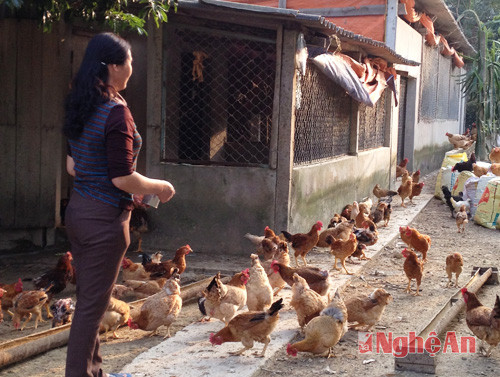 |
| Raising free-range chickens on hillsides in Thanh My commune (Thanh Chuong district). |
There are many interesting stories associated with chickens. In the old Cat Van commune, from the days when a family owning a few dozen chickens was considered the wealthiest in the village, to today, when owning hundreds of free-range chickens in the hills is considered commonplace, "chicken guilds" still exist – a beautiful tradition reflecting the strong sense of community and neighborly solidarity. While those outside the guild struggle to find enough free-range chickens for their children's weddings, even after asking around the village, it's a simple task for those participating in these guilds. Each family in the guild contributes 2 kg of chicken to the "host," and this cycle continues, ensuring no one is left out.
The deliciousness of Thanh Chuong hill chickens is due to many factors. The breed is small, with low productivity; even with prolonged raising, they only reach about 1.5 kg, but the meat is undeniably excellent. These chickens spend their days running and jumping on the hills, eating corn, rice, insects, and ants; very few households use industrial feed. Because of this, it's not easy to buy a genuine hill chicken like this in the hilly areas of Thanh Chuong now. In the past, when people were poor, chicken was only served on the table when guests came or for special occasions; everything – clothes, books, money for children's education – depended on it. Now, with improved living standards, people in Thanh Chuong mostly raise hill chickens for their own consumption and as gifts, rarely selling them, except in cases where they need money. In such situations, they might even have a chicken at the market before reaching it, with someone offering to buy it. Or, if a family in the village is holding a wedding for their child and asks to sell a few chickens beforehand, out of respect for their neighbors, they might contribute a few chickens each for the feast.
No one from Thanh Chuong, no matter how far they travel, can forget the chicken stew. Perhaps it was the hunger and poverty that gave Thanh Chuong its famous chicken stew. Small pieces of chicken are marinated for half an hour to absorb the flavors before being cooked. Once cooked, the chicken is removed from the heat, sprinkled with chopped coriander and lime leaves, and mixed well. Just opening the lid releases the sweet, unmistakable aroma of chicken mixed with coriander, lime leaves, shallots, turmeric, and fresh chili peppers. Perhaps only in Thanh Chuong is there a chicken meatball dish. All the leg bones are discarded, only the body bones, along the back and neck, are finely chopped (not ground), and mixed with shallots, fresh chili peppers, and turmeric (only fresh turmeric, not powder). This simple dish, once a staple during times of scarcity, has now become a highly popular specialty. Put a piece of the chicken ball in your mouth, and the rich, sweet flavor melts and lingers on your tongue; anyone who tastes it once will surely find it unforgettable.
Towards a new mindset and way of doing business.
On a late afternoon at the end of the year, riding on the noisy motorbike of a local Party committee official from Thanh My commune in Thanh Chuong district, passing through almost all 15 hamlets of the commune, I encountered roosters, mother hens, and chicks running around or foraging under the trees on the hillsides, creating a peaceful and warm scene. The chicken farm of Mr. Tran Cong Son's family (Hamlet 13, Thanh My) is located on a hill. They have a long tradition of raising free-range chickens, but about four years ago, having a few hundred chickens in their hillside garden was considered a lot. However, with their vast estate covering several hills, and noticing that free-range chickens were in high demand, especially during holidays, and despite high demand, they were often unavailable – especially at the 324th Division stationed in Do Luong, where they needed to buy hundreds of kilograms – Mr. Son's unit was struggling to find them.
So he discussed it with his wife and they decided to focus on raising free-range chickens on an industrial scale. A clean and spacious farm was built. Besides raising broiler chickens, with sales reaching nearly 2 tons per year, the farm also produces chicks using an automatic incubator, selling around 30,000 chicks annually. Due to the large-scale, commercial nature of their farming, their methods differ from traditional free-range chicken farming. The chickens are raised in enclosures, especially the one-month-old chicks, which are kept indoors during the cold season with an electric heating system. The mother hens are fully vaccinated and kept separate from the broiler flock. And importantly, while most people still allow free-breeding, Mr. Son's unwavering principle is never to crossbreed. Even though the farm already has very beautiful roosters, he still travels to Do Luong district to buy 60-70 roosters at a time to breed with the hens, in order to maintain the quality of the flock.
With a threshing machine at home, each harvest season, he buys tens of tons of corn and rice to feed his chickens; industrial feed is only considered a solution when rice and corn become too expensive. Despite raising chickens on a large scale, he and his wife are determined to uphold certain principles. The chickens on the farm are entirely free-range, not hybrid or "industrial" chickens. Every day, when the sun comes out, the flock is released onto the hills to eat additional food they forage for. Therefore, even though they are not the free-range chickens raised by locals, which are highly sought after by discerning diners, the chickens from Mr. Son's farm are always in high demand. He explains that the chickens here are raised for 4-4.5 months before being sold, not just 3 months like hybrid breeds. However, roosters only weigh 1.8-2.2 kg, and hens 1.4-1.6 kg at most; the meat is delicious and firm.
Thanh Chuong district has great potential for developing free-range chicken farming. Except for a few lowland communes along the Lam River, the entire district has approximately 32 communes with relatively large areas of hillside gardens suitable for free-range chicken farming. The district also enjoys a favorable geographical location, with the Ho Chi Minh Highway and National Highway 46 running through it, facilitating trade and travel to both the South and the North. Furthermore, with about 6,000 hectares of corn and 13,000 hectares of rice annually, and situated next to agricultural areas like Do Luong and Nam Dan, the chicken feed supply is abundant. “All these factors, plus the fact that Thanh Chuong free-range chicken already has a strong reputation among the people, have motivated us to build a brand for Thanh Chuong free-range chicken,” said Mr. Dang Anh Dung, Deputy Secretary of the Thanh Chuong District Party Committee.
Over the past seven years, many households have spontaneously increased their chicken farming scale, with approximately 1,500-2,000 chickens per farm, concentrated mainly in the hilly communes of Thanh My, Thanh Chi, Thanh Ngoc, etc. To learn from their experience, Thanh Chuong organized a visit for district and commune leaders and some households with the capacity to develop hill chicken farming to learn from the hill chicken farming region of Yen The (Bac Giang). Surveys showed that Thanh Chuong even has advantages over this famous hill chicken farming region, with a larger area and extremely convenient transportation. Currently, the district has the idea of developing a project to promote the development of hill chicken farming in a farm-based direction, striving for a minimum of 1,000 chickens per household for those who register to participate. The district will organize guidance and issue proper farming techniques, while also establishing several breeding households to supply chicks to broiler chicken farmers and register the Thanh Chuong hill chicken brand.
Text and photos:Phu Huong


