
Will the Russian "bear" soon overcome the "cold"?
(Baonghean) - This Christmas season, for Russians, the cold weather is perhaps not as frightening as the "cold" of falling into the depths of an economic crisis. Former Russian Minister of Economy Alexei Kudrin believes that Russia has fallen into a comprehensive crisis and that in 2015 a series of small and medium-sized Russian companies will go bankrupt, and Russia's credit rating may fall to "junk" status. President Putin also predicts that difficulties will continue to plague Russia for at least several more years. In recent days, the world has witnessed Russia's repeated, arduous struggles to escape its difficulties.
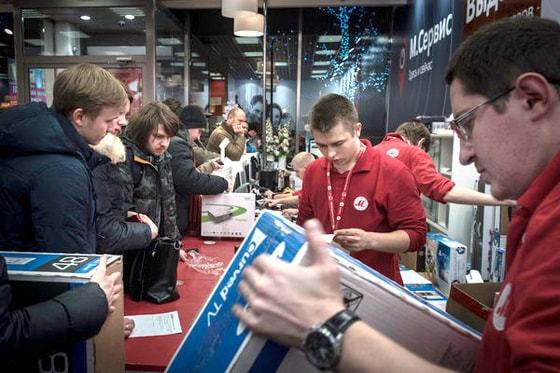 |
| Russians are rushing to buy goods as the ruble falls in value. (Image: Internet) |
| RELATED NEWS |
|---|
Along with the aforementioned measures, the Russians had to resort to drastic measures to halt the decline. On December 23, Prime Minister Medvedev's government "forced" large businesses to sell off foreign currency to support the plummeting ruble. Specifically, leading Russian export companies such as Gazprom and Rosneft had to sell off US dollars, "injecting" US dollars into the market to rescue the ruble. Large businesses were required to reduce their foreign exchange reserves to the lowest level before October 1, 2014. The government would "sit down" with the export "giants" to force them to comply with the regulation before March 1, 2015, according to which at least five corporations had to sell $1 billion each day until March 1. Immediately after this announcement, the ruble not only stopped its decline but also showed signs of increasing by 5.5% to 55.4 rubles per US dollar. This has proven to be an effective measure, as the ruble has recovered by about 20% from its low of 1 USD equaling 80.1 rubles on December 16th.
Along with strong domestic measures, Russia has recently reached cooperation agreements with China. In these agreements, China has pledged to help Russia in its current difficult situation by increasing trade transactions using the yuan. With this measure, Russia accepts being "yuanized" in its imports and exports, and China is also seizing this opportunity to enhance the influence of the yuan, demonstrating its position as the world's second-largest economy.
Thus, Russia has made strong efforts to escape its difficulties, and these efforts have been more or less effective. However, the price paid for decisions forced to be made under unfavorable circumstances is not small, but in this situation, the Russians have no choice but to make the trade-off. Even when Russia has taken temporary measures that come at a cost, the "light at the end of the tunnel" has not yet arrived for the Russians on their path to finding a way out of their difficulties. Analysts predict that even if the ruble appreciates again, the Russian economy will remain dire if world oil prices continue to fall. Another difficulty that continues to emerge for Russia is that the Ukrainian Parliament has just voted to pass a bill abolishing its non-aligned status, paving the way for the Ukrainian government to join the North Atlantic Treaty Organization (NATO), something Russia does not want. Meanwhile, on December 19th, the Kremlin announced that Russian President Vladimir Putin had invited North Korean leader Kim Jong-un to pay an official visit to Russia in 2015. Just a few days later, all international news outlets reported that North Korea was experiencing its worst internet outage. Although these pieces of information are not directly related, they evoke somewhat negative feelings towards Russia at this time.
However, as the new year approaches, people still think of positive things. At this time, the resilience of the Russian people is remembered, and the image of the Russian "bear" enduring the "cold" to survive becomes even more vivid.
Chi Linh Son


