
Recorded in Phu Lien
(Baonghean) - It's a small village nestled against Hon Kien mountain, facing east towards the curved coastline shaped like a sail. I can't remember exactly how many times I've strolled along the smooth sand dunes, delighting in pressing my toes into the shallow, waterlogged sand, suddenly startling a few tall crabs that scurried away and then darted into their burrows for shelter. It seems that this beach, this village, has something both familiar and captivating, yet also surprising, each time one sets foot there.
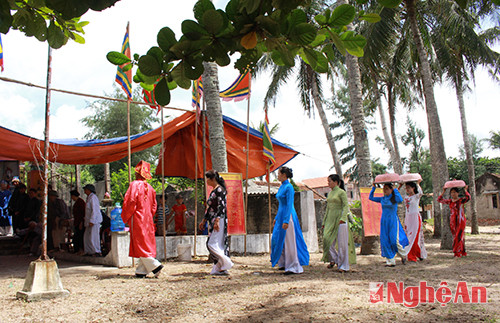 |
| Offering gifts to pray for a good fishing season at the Rết Temple. |
By chance, I arrived at Phu Lien village - Quynh Long commune (Quynh Luu district) just as the villagers were holding their Fishing Prayer Ceremony. From afar, in the afternoon sunlight reflecting off the waves, the Rep temple seemed to move mysteriously with layers of slanted light. Mr. Tran Van Trang squinted at me and exclaimed, "Heavens! A journalist! How are you?! Why didn't you let me know you were coming?" I was fortunate to have known Mr. Tran Van Trang and his family three years ago. That was when I accompanied Mr. Tran Van Thanh - Mr. Trang's son - on his purse seine fishing boat out to sea in the shared fishing grounds of the Gulf of Tonkin. But to this day, what impressed me most after that trip was not the image of the captains and crew members struggling with the waves and casting their nets every night in the open sea, but the image of Mr. Tran Van Trang holding a thorny pineapple stick, tapping it around the boat, muttering prayers for good luck before everyone left the port to go out to sea. It's a ritual for fishermen before each trip. And Mr. Trang, with nearly forty years of experience as a captain for the Phu Lien fishing cooperative, never forgot to perform this ceremony. It's a belief passed down from his ancestors.
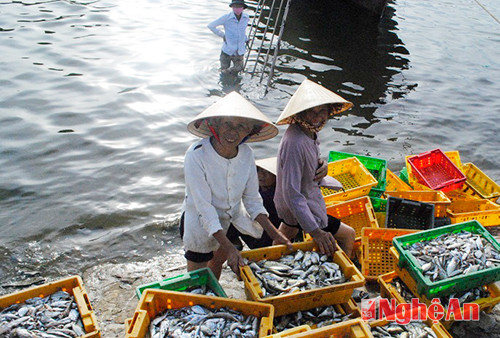 |
| A successful fishing season for fishermen in Quynh Long commune, Quynh Luu district. Photo: Khanh Ly |
“It’s great that you’ve come at this time. Tomorrow our village is holding the Fishing Festival,” Mr. Trang said while offering me a bowl of tea. At this time, there were quite a few people around the Ret Temple. The main ceremony is tomorrow, the 10th day of the 7th lunar month, but tonight everyone came to the temple to hold the Announcement Ceremony. And in a fortunate evening, I had the opportunity to exchange ideas and chat with most of the members of the Phu Lien Village Party Committee. Ms. Tran Thi Dao, the Party Secretary of Phu Lien Village, openly stated that the lives of the people of Phu Lien are undergoing a significant transformation. The village has 295 households with 1,433 inhabitants. Of the 695 people of working age, 275 are directly involved in fishing and seafood harvesting, accounting for 40%. However, if we include activities related to services and the marine economy, the percentage exceeds 90%. Currently, the village has 25 fishing vessels with capacities ranging from 200 to 600 horsepower. Over 65% of households are considered well-off or wealthy. Ms. Tran Thi Dao shared: “The lives and economy of the people in Phu Lien village depend on the sea. While in 2013 the village only had 6 vessels using purse seine fishing, this year there are 13. The number of 2-sao (a unit of area) vessels has decreased from 15 in 2013 to 13 now. The villagers are proactively building more modern, larger vessels. Larger vessels can reach further fishing grounds and be more efficient…”
In reality, in Phu Lien village, the fishermen do not fish in the open sea at all. Therefore, there are no boats with a power output of less than 90 horsepower. A newly built purse seine with a 400 horsepower engine costs between 4.2 and 4.5 billion VND. Including the investment in equipment and fishing gear, the total cost is nearly 5 billion VND. But what is encouraging, or rather admirable, is that the people of Phu Lien have dared to invest to fulfill their aspiration of venturing out to sea. Ms. Ho Thi Duc, the head of the Women's Association in Phu Lien village, said: “Of course we worry. Every time there's a storm, the women, the elderly, and the children sit at home waiting for the men out at sea. But we have to go out to sea, sir. Only big boats with powerful engines can provide peace of mind and ensure successful fishing!” While listening to the head of the Women's Association, I found that her slender figure possessed an extraordinary persuasive power. I learned that her family has been fishing for 20 years using a 45 horsepower fishing boat. And this August, her family will receive the fishing vessel they bought from Quang Ngai, worth 4.2 billion VND.
There's something quite special about Phu Lien village: the majority of the Party Committee, Party Branch, and Village Management Board are held by women. Ms. Nguyen Thi Thap, the head of Phu Lien village, chuckled wittily: "This isn't a model, journalist! It's the reality of life. Men go to sea, women participate in social work. Honestly, the men don't have much time." I secretly thought that, besides managing the household and building a home, in many cases, women always take on social responsibilities more carefully than men. Specifically in Phu Lien village: Party Branch Secretary - Woman. Village Head - Woman. Deputy Village Head - Woman. Youth Union Secretary - Woman. Veterans Association Vice-Chairwoman - Woman… But what people see isn't just the slender figures of women day after day gazing eastward, or rushing back and forth to the market and selling fish whenever the boats dock. It's also the women of the Party Branch who have achieved the title of "Exemplary, Clean, and Strong" of Quynh Long commune for four consecutive years. These are community organizations that have been honored by the local authorities for many years. For example, Ms. Nguyen Thi Thap, the village head, owns a 600 HP fishing vessel with 18 regular workers. She says that owning a vessel and having workers isn't just about getting rich to serve one's own family. Buying a large vessel with powerful engines for offshore fishing is also about fulfilling a responsibility to the village and the fishermen. “The boat goes out to sea 2-3 times a month. The average income is 10 million VND per person per month, and in good months it can reach over 15 million VND. But fishing at sea isn't just about money. There's a strong sense of community between the boat owner and the crew. It's about sharing, mutual support, and responsibility.”
We paused our conversation as the drums and gongs began to sound. Electric lights illuminated the area around the Ret Temple. Mr. Nguyen Khac Thin, the chief priest, dressed in a red robe, knelt before the main hall with two others. Each time the announcer recited the "offerings and bows," the chief priest would prostrate himself or bow in reverence. The offerings were simple, consisting of sticky rice, a chicken, boiled pork, sweet soup, gold coins, fruits, sweets, betel nuts, etc. All were offered by the local people. This year, boat owners and captains contributed at least 300,000 dong, with some contributing as much as 1,000,000 dong. It is thanks to this communal spirit that the Fishing Festival in Phu Lien is regularly held every year in the 7th lunar month. According to Mr. Nguyen Khac Thin, the Ret Temple was built nearly 300 years ago. Legend has it that a giant centipede once lived in a cave in Hon Kien mountain. Every day, the centipede would crawl out to the beach and rest on the land at the foot of the mountain. During the time the centipede resided there, the villagers of Phu Lien had safe and successful fishing trips. Later, a large footprint was left at the spot where the centipede resided. Therefore, the people of Phu Lien village built a temple to worship the centipede, hoping for its blessings for smooth sailing, good fortune, and abundant catches of fish and shrimp. The fishing festival originated from this. However, in the late 1950s and early 1960s, the Centipede Temple was dismantled and destroyed to serve the construction of the new socialist society during a historical period. In 2002, the people of Phu Lien village pooled their resources to rebuild it to serve the spiritual needs of the local fishermen.
After the simple but solemn Announcement Ceremony concluded, Mr. Nguyen Khac Thin, who has served as the chief officiant for many years, felt a weight lifted from his shoulders. He said, "The person chosen by the villagers to be the chief officiant must have a harmonious and happy family, a stable financial situation, and well-behaved children. In particular, that person must be the owner of a boat or ship."
I returned to Phu Lien village the following morning. On the main day of the ceremony, I could clearly see the faces, eyes, and smiles of the seasoned captains and crew members. Amidst the lively sounds of gongs and drums carried on the wind, I could still feel the firm laughter and the vigorous clasped hands of the strong men accustomed to the waves. I noticed a man in his 60s, dressed in military uniform, bustling back and forth in front of the temple. Sometimes he lit incense, sometimes he guided people in placing their offerings. Upon inquiry, I learned that he was Mr. Nguyen Ngoc Chatt – the head of the Veterans Association branch in Phu Lien village. After the ceremony, I spoke with Mr. Chatt, who, unlike others in the village, didn't go to sea or work in any maritime service industry. "But my work is very closely related to the sea," he said, his words sparking curiosity in everyone he spoke to. Then Mr. Chatt explained that the Phu Lien village Veterans Association branch has 87 members. Typically, local community organizations have very limited funds, but in Phu Lien village, the Veterans' Association branch is "very rich." Currently, the branch's fund has 53 million VND. Starting in 2009, the association borrowed money to buy nets and weave them into a type of trawl net – also known as a "golden drag net" (a type of net used for near-shore trawling) – and also built a floating raft. Using the experience of local fishermen, whenever they see a large number of fish near the shore, the association rings a bell to mobilize members to participate in trawling and fishing. Depending on the actual situation, the association organizes trawling three times a year, each time lasting from 2 to 5 days. The fish caught are sold on the spot to raise funds. If a member is unable to participate for any reason, their spouse or child will fill in for them. If even the members' family members cannot be present, the average value will be calculated based on the amount of money earned from selling the fish divided among the number of people directly involved in pulling the nets. Those absent will have to contribute an average amount per person to the branch association. Mr. Nguyen Ngoc Chat shared: “All the branch association's funds have been used to provide interest-free loans to members. The ultimate goal is to motivate and encourage our brothers and sisters to overcome poverty, venture out to sea, and assert their position in the new trend.”
I always thought I knew a lot about Phu Lien village and Quynh Long coastal commune. It turns out my knowledge was quite modest. For example, I only just learned last year that Mr. Tran Van Thanh's boat caught a sunfish weighing nearly 100 kg and donated it to scientists. And during this year's fishing festival, the villagers even came to light incense at the tomb of the whale (or "Ông Cá") buried right in front of the Ret temple – I was quite surprised. Phu Lien remains the same: kind, peaceful, and warm. The village nestles against Hon Kien island, facing east with a curved coastline shaped like a sail. Indeed, it's shaped like a sail.
Text and photos:Dao Tuan


