
Recorded at the "epicenter" of the measles outbreak.
(Baonghean) - ...Upon arriving in Tuong Duong, we received news that in Pieng Coc village, Mai Son border commune, there was an outbreak of measles-like rash with 48 children infected... When we asked for directions to Pieng Coc, Mr. Tran Van Cong, Deputy Director of the Preventive Medicine Center of Tuong Duong district, said that the only way was to hire a boat via the Ban Ve hydroelectric reservoir, which takes about 4 hours; or to travel by road through Ky Son and then down to Pieng Coc, which takes more than 3 hours. To avoid loneliness in this remote mountainous area, we chose to travel by road...
Pieng Coc Night
At 1:30 PM on October 14th, I set off with a veteran from Hoa Binh Town (Tuong Duong District) who works as a motorbike taxi driver. We passed through Muong Xen Town, Ta Ca, Pha Danh, Huoi Tu, and My Ly communes in Ky Son District before heading down to Mai Son. To reach the center of Mai Son commune, we had to take a ferry across the Nam Non River at the Nhon Mai Border Guard Station, located in Huoi Mun village. And to reach Pieng Coc, where 100% of the population are Hmong people, it took another hour. It was past 6 PM, but the sky was already dark and the air was bitterly cold.
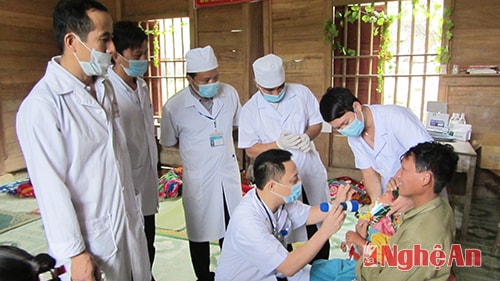 |
| Doctors and nurses at the field hospital check the children's condition. |
To combat the rash outbreak in Piêng Cọc, Tương Dương district established a field hospital at the primary school. Besides 12 medical staff from the Preventive Medicine Center, Tương Dương District General Hospital, Nhôn Mai Commune Health Station, and Mai Sơn Commune Health Station, there were also staff from the Provincial Obstetrics and Pediatrics Hospital and two health communication officers. The people of Piêng Cọc and the commune officials and management board were all delighted to have additional medical staff from the province. Firm handshakes in the night conveyed hopes and expectations.
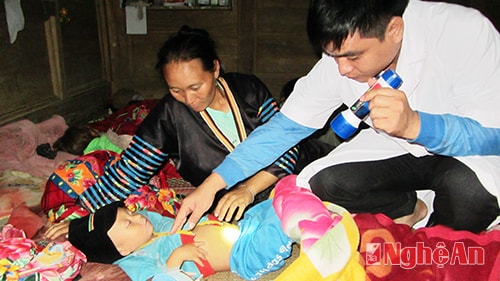 |
| Monitor severe cases overnight. |
Pieng Coc, like the entire Mai Son commune, currently lacks grid electricity and relies on mini hydroelectric generators built by the villagers along the stream. Under the dim light, two doctors from the Obstetrics and Pediatrics Hospital, despite their fatigue from the long journey, diligently worked with medical staff from Tuong Duong Hospital to check the condition of each child aged 1-14, who were being treated in two classrooms. One room housed seven seriously ill children, while the other had nine children whose condition was generally stable. On the tiled floor, the children lay simply on mats and woolen blankets. According to Dr. Va Ba Tua, a Hmong doctor and head of the Nhon Mai Health Station who was deployed to assist Mai Son, from October 10th to 12th, there were three treatment rooms occupied because 48 children were ill at that time. Currently, 32 children have fully recovered and have been discharged to continue monitoring at home.
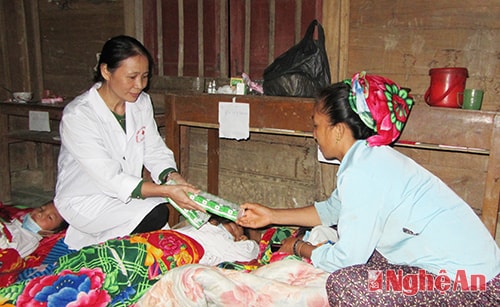 |
| Providing milk for children in Piêng Cọc |
On the night of October 14th, although the children were still very tired, they were almost no longer suffering from persistent fever. According to Dr. Tran Van Cuong, Deputy Director of the Obstetrics and Pediatrics Hospital, clinical examination indicated that the children most likely had measles. With this type of disease, doctors and nurses must adhere to the treatment protocol of the Ministry of Health. I took the opportunity to speak with the officer in charge of the field hospital in Pieng Coc, Dr. Lo Van Hung - Department of Pediatrics, Tuong Duong General Hospital. Dr. Hung recounted: At 9 am on October 10th, I received instructions from the district to gather people, prepare a quantity of medicine, and set off. We arrived in Pieng Coc at 9 pm. At this time, the children were suffering from persistent fever, which was very worrying. While examining them and giving them medicine, the team contacted the district to set up a field clinic at the Pieng Coc Primary School. On October 10th, 38 children fell ill, 11 of whom were in critical condition. In the early morning of October 11th, we discovered 10 more children with high fevers. After consultation and reporting to the District Health Center and Hospital, even without testing or sample collection, we diagnosed the children with measles and prescribed appropriate medication. For the past five days, all members of the team have been spending time with the children, sharing everything with them. And tonight will be no different...
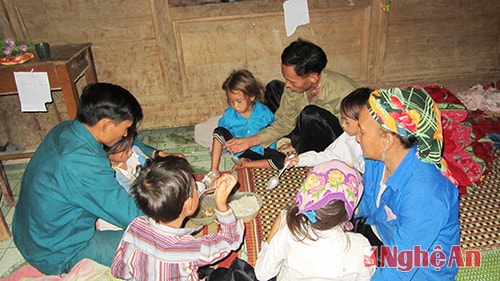 |
| Some children whose conditions improved were able to return home. |
Near midnight, the field hospital staff arranged for us to rest in a classroom next to the room where the seriously ill children were. Our resting place was a thin mat on the tiled floor, and a few thin blankets. Doctor Va Ba Tua and medical assistant Kha Van Dau lay beside us, their faces covered with blankets to protect against mosquitoes, explaining the "difficulties" of this remote place: "You guys try to get some sleep, but we can only lie here. We'll have to get up again to check on the children later." As the night progressed, Pieng Coc grew colder. In the next room, the children occasionally coughed and cried loudly. Each time this happened, Doctor Tua and medical assistant Dau would get up...
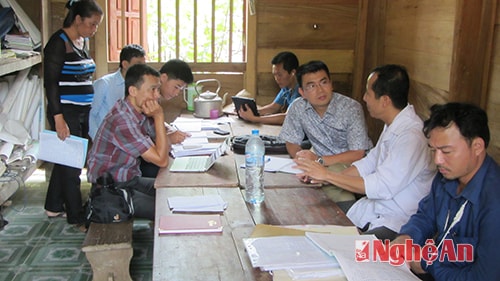 |
| The delegation from the Central Institute of Hygiene and Epidemiology held a meeting. |
Difficult in every way
Since the field hospital was established, a "no entry, no exit" order has been in effect within the Piêng Cọc village area. Children from Piêng Cọc village attending secondary school at the commune center must remain in the boarding school, while those who have already returned home are not allowed to go back. The Piêng Cọc primary school has also suspended classes to prevent the spread of the disease to other villages.
One issue that has garnered much attention is the origin of the disease. According to Doctor Va Ba Tua, it originated from Laos. Around August 2014, an outbreak of rash occurred in the villages of Pha Danh and Pom Bai in Laos. Four children died in Pha Danh village, and 17 in Pom Bai. These two villages are separated from Pieng Coc by only a mountain, a nearly three-hour walk. When there was a tragedy in Pha Danh, the Laotian village, families in Pieng Coc often carried their children to visit relatives. On September 22nd, a couple from Pha Danh village brought their two sick children to Nhon Mai to seek treatment from Doctor Va Ba Tua. To get to Nhon Mai, the couple stayed overnight in Pieng Coc. "I think the fever outbreak in Pieng Coc originated from there," said Doctor Tua.
Health worker Va Ba Xenh from Pieng Coc village also agreed with the reason given by Doctor Va Ba Tua. According to Va Ba Xenh, because there were many sick people in Pha Danh, he went there to examine and treat some patients...
Pieng Coc, home to 52 households and 375 people, is located high in the mountains, isolated and inaccessible. The climate is harsh, with unpredictable hot and cold spells. The people here live in extreme poverty, with simple living conditions and poor sanitation. For example, young children with high fevers need warm clothing, but most only wear thin garments. Their meals consist of rice, beans dipped in salt, and boiled bean water, leading to malnutrition and weak immune systems. During our stay in Pieng Coc, we had a meal at the home of the village head, Va Xai Cho, and understood this firsthand. Despite being the village head, Va Xai Cho's house was just like any other in the village. In his earthen-floored house with a dark, polished wooden roof, typical of the Hmong people, there were no valuable possessions, and living conditions and sanitation were still inadequate. Doctor Va Ba Tua said: “It’s too difficult. Medical equipment and personnel are limited. The people of Pieng Coc are too poor and have limited awareness. Their way of life hasn’t changed. Overall hygiene in the villages is poor. Personal hygiene is also poor. Therefore, the work of preventing and controlling various diseases is extremely difficult…”
At 12:30 PM on October 15th, Piêng Cọc received a delegation from the Central Institute of Hygiene and Epidemiology. At that time, of the 16 children still at the field hospital, only 3 remained with severe fever. The rest were conscious. Mr. Nguyen Van Dan, Head of the Epidemiology Department of the Provincial Preventive Medicine Center, said: Since the outbreak in Piêng Cọc, he and the staff of the Provincial Preventive Medicine Center have collected 16 samples for testing. To date, the results show that 12 out of 16 samples tested positive. This means Piêng Cọc is currently the epicenter of the measles outbreak. Therefore, the delegation from the Central Institute of Hygiene and Epidemiology, in addition to participating in professional matters, requested the Tuong Duong Health Center to take all measures to prevent the disease from spreading to other areas; not only to villages in Mai Son commune, but also to other communes in the region...
After a 20-hour stay, at 1:30 PM on October 15th, we left Pieng Coc with mixed feelings of joy and sadness. Joy because the epidemic control efforts had made significant progress, and the health of the children had improved considerably… Concern and worry because the awareness of the local people is still limited, while the infrastructure and medical personnel are still severely lacking. The question that lingered in our minds was: What must we do to improve healthcare for the people?!
Text and photos:Nhat Lan


