
Addressing the homelessness problem: A decisive approach is needed.
(Baonghean) - For many years, in Vinh City and tourist destinations throughout the province, there has been a problem of homeless people and beggars harassing tourists, causing offense and detracting from the aesthetics of the area. In response to this situation, the Provincial People's Committee recently issued Plan No. 206/KH-UBND to address the issue of homeless people in the province.
Things that were seen…
One morning at a cafe located at 201 Nguyen Van Cu Street, Vinh City, at a time when it was quite crowded, a woman in her 50s, looking tired, went from table to table, holding out her hand to beg for money. According to her, her husband had passed away early, and she had to raise three children alone; her family was very poor. A few days earlier, her son had been in a traffic accident, breaking his femur, and was being treated at the provincial hospital. Without surgery, he would be permanently disabled, but the family had no money. Many people, hearing her story, took pity on her and gave her money. Some customers in the cafe said that a few weeks earlier, they had seen this woman begging on Nguyen Thi Minh Khai Street and Le Hong Phong Street, with a similar tone of voice. Linh, a waitress at the cafe, said that every morning they are bothered by the excessive number of beggars and street vendors "visiting" them. "They went to each table begging, which made many customers very uncomfortable. Some even carried children with them to gain the customers' sympathy," Linh recounted.
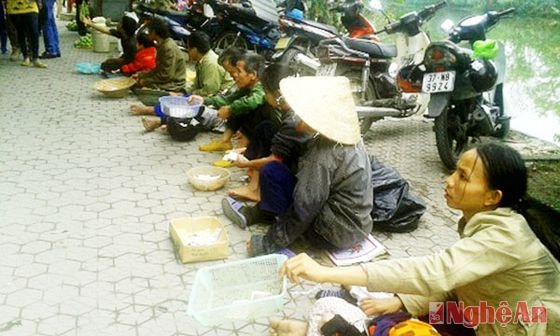 |
| The sight of homeless beggars gathering in front of the gates of some temples on holidays is not uncommon. |
At Quan Banh Market (also known as Nghi Phu afternoon market), we encountered a man with both legs deformed, carrying a child and begging for alms. A vegetable vendor outside the market said, "This man begs at the market 2-3 days a week; some days his income is even higher than that of several vendors like us."
As the political, economic, cultural, and social center of the province, Vinh City is also the place with the highest concentration of homeless people – especially beggars. They congregate in parks, cafes, intersections, markets, temples, and pagodas, detracting from the urban landscape. In particular, streets with many shops and restaurants such as Nguyen Thi Minh Khai, Le Hong Phong, Le Loi, Phan Dinh Phung, Nguyen Van Cu, Tran Hung Dao, and along the shores of Goong Lake… are often hotspots for beggars and street vendors. Besides Vinh City, Cua Lo Town and several famous spiritual tourist destinations in the province, such as Hoang Muoi Temple and Corn Temple, also have a large number of beggars, especially during tourist seasons and festivals, creating a very unsightly scene.
A comprehensive and decisive solution is needed.
In April, the Provincial People's Committee issued Plan No. 206/KH-UBND on addressing the issue of homeless people in the province. Accordingly, the goal is to return 95% of homeless people in the province to their families or place them in social welfare facilities annually, aiming for the elimination of homelessness in the province by 2020. Homeless people are categorized into three groups: the elderly, children, and people with disabilities or pseudo-disabilities (including accompanying persons) who beg; people with mental illness who wander the streets; and people who use sidewalks, streets, parks, bus stations, and abandoned houses as places to eat and sleep.
Mr. Nguyen Dang Duong, Deputy Director of the Department of Labor, War Invalids and Social Affairs, the permanent agency advising the Provincial People's Committee on the issuance of Plan 206, said: “According to incomplete statistics, there are currently 111 beggars and mentally ill homeless people in the province. In recent years, the province has returned 142 cases of beggars and mentally ill homeless people to other provinces; received 64 cases of people from Nghe An who had been begging in other provinces; brought 78 people back to their families and 46 people into social welfare facilities. With Plan 206, this is the first time at the provincial level that the issue of homeless people has been seriously considered, discussed, and had a specific plan for resolution.”
However, achieving the goals of Plan 206 requires the synchronized and decisive involvement of all departments, agencies, and localities. In reality, definitively resolving the issue of homelessness requires close coordination among three parties: local authorities where homeless people operate, relevant agencies, and local authorities where homeless people have permanent residence. Local authorities where homeless people operate need to strengthen household registration management, procedures for temporary residence registration, and inspection of lodging houses where homeless people reside, in order to encourage, advise, and assist them in returning home, reintegrating into their families, and reintegrating into the community.
Relevant departments and agencies need to implement social welfare policies, encourage humanitarian and charitable organizations to support people in difficult circumstances, especially children from poor households, people with disabilities, and lonely elderly people without support, providing vocational training, counseling, and job placement to help them avoid wandering and begging; investigate, detect, and strictly punish those who organize or incite others to wander and beg. Local authorities where homeless people have permanent residence should focus on economic development to create more local jobs, and at the same time, conduct extensive public awareness campaigns through mass media to raise public awareness and emphasize the role and responsibility of parents and all levels of government in protecting and caring for the elderly and children.
In recent times, several localities have also done well in addressing this issue, notably Dien Trung commune (Dien Chau district). Previously, Dien Trung was the commune with the highest number of children dropping out of school and wandering the streets to earn a living in the province, with approximately 30 children each year. However, since 2009, thanks to the joint efforts of the entire political system and all the people, the situation of children dropping out of school and wandering the streets has basically ended. According to Mr. Le Cong Sau, Vice Chairman of the People's Committee of Dien Trung commune, along with promoting the transformation of crop and livestock structures to develop the economy, the commune has intensified propaganda to each family with homeless children. The commune's policy committee, in coordination with the Education Promotion Association, has organized campaigns on occasions such as International Children's Day (June 1st), Mid-Autumn Festival, and Lunar New Year, paying special attention to helping children who are particularly disadvantaged and homeless... As a result, the number of children dropping out of school and wandering the streets to earn a living has significantly decreased, and many children who previously wandered the streets have now returned to school. I think that's a model that many other localities can learn from.
Minh Quan


